

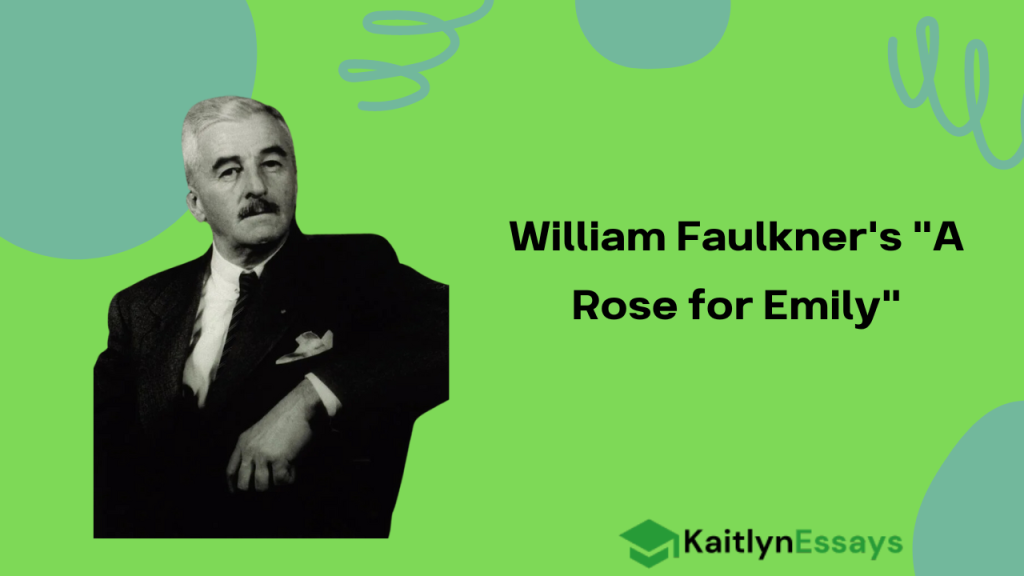
William Faulkner’s “A Rose for Emily” is a timeless masterpiece of American literature, celebrated for its intricate narrative structure, rich symbolism, and profound exploration of themes such as tradition, decay, and the human condition. Through a detailed analysis of the text, we will look into the various layers of meaning embedded within the story, examining its allegorical elements, thematic depth, narrative technique, and cultural significance.
Summary of a Rose for Emily
“A Rose for Emily” by William Faulkner is a haunting tale set in the post-Civil War South, revolving around the enigmatic figure of Emily Grierson and the decay of the once-grand town of Jefferson. Through a nonlinear narrative, Faulkner paints a portrait of Emily’s life, marked by tragedy, isolation, and a descent into madness.
The story begins with Emily’s funeral, drawing the reader into a tale of intrigue and mystery. The narrator, representing the collective voice of the town, recounts Emily’s life, from her privileged upbringing as the daughter of a respected Southern aristocrat to her eventual descent into madness and death.
Emily’s father, a domineering figure, shapes much of her life. He prevents her from marrying and maintains a strict control over her, isolating her from society. His death leaves Emily bereft, and she refuses to acknowledge his passing, keeping his corpse in her home for days, a poignant symbol of her inability to let go of the past.
As the town changes around her, Emily remains trapped in time, living in her decaying mansion, a relic of the Old South. She becomes a curiosity, an object of fascination for the townspeople who speculate about her life behind closed doors.
Emily’s only connection to the outside world is her relationship with Homer Barron, a Yankee laborer. Despite their differences in background and social status, Emily becomes infatuated with Homer, clinging to him as her last hope for companionship and happiness.
However, their relationship takes a dark turn when Homer mysteriously disappears. The townspeople whisper of Emily’s involvement, but nothing is ever proven. Years pass, and Emily becomes increasingly reclusive, withdrawing further into her own world.
The climax of the story comes with the discovery of Homer’s corpse in Emily’s bed, a shocking revelation that exposes the depths of Emily’s descent into madness. It is implied that she murdered Homer in a desperate attempt to keep him with her forever, unable to bear the thought of losing yet another person she loved.
In the end, Emily’s story serves as a poignant commentary on the decline of the Old South and the destructive power of isolation and obsession. Through her tragic fate, Faulkner explores themes of tradition, decay, and the human condition, leaving readers haunted by the image of a woman trapped in the past, forever clinging to a rose-colored memory of days long gone.
A Rose for Emily in Chronological Order

In William Faulkner’s “A Rose for Emily,” the narrative unfolds in a complex, non-linear manner, weaving together past and present to explore the tragic life of Emily Grierson, a woman trapped in the confines of her own mind and the rigid expectations of Southern society. Through a chronological lens, we can delve deeper into the sequence of events that shape Emily’s existence and ultimately lead to her downfall.
The story begins with the death of Emily’s father, a pivotal event that sets the stage for much of what follows. Emily’s father is a domineering figure who exerts control over her life, keeping her isolated from the outside world and preventing her from forming meaningful connections. His death leaves Emily emotionally adrift, clinging desperately to the vestiges of the past in an attempt to fill the void left by his absence.
Following her father’s death, Emily’s refusal to accept his passing serves as a catalyst for her descent into madness. Unable to cope with the reality of his death, Emily keeps his corpse in her home for several days, a shocking act that underscores her profound psychological turmoil and inability to move forward.
Amidst the backdrop of Emily’s grief and isolation, her relationship with Homer Barron emerges as a beacon of hope. Homer, a Yankee laborer, represents a departure from the Southern tradition and offers Emily the promise of companionship and happiness. However, their relationship is fraught with tension and controversy, as Emily’s association with a Northern outsider threatens to disrupt the delicate social order of Jefferson.
The disappearance of Homer Barron marks a turning point in Emily’s life, triggering a downward spiral into madness and despair. Rumors swirl throughout the town, implicating Emily in Homer’s disappearance and fueling speculation about the nature of their relationship. Yet, despite mounting suspicions, Emily remains cloistered within the walls of her decaying mansion, a prisoner of her own making.
As the years pass, Emily’s seclusion deepens, and the once-grand mansion becomes a symbol of her mental and emotional decay. The townspeople watch with a mixture of fascination and horror as Emily’s world crumbles around her, a poignant reminder of the fleeting nature of time and the destructive power of isolation.
The discovery of Homer Barron’s corpse serves as a chilling climax to Emily’s tragic saga, confirming the suspicions that have long plagued the town. Locked away in a hidden room within Emily’s house, Homer’s decomposed remains bear silent witness to the dark secrets that lie buried beneath the surface of Jefferson.
Emily’s death marks the end of an era, the final chapter in a story of madness, obsession, and the relentless march of time. As the townspeople gather to pay their respects, they are left to grapple with the legacy of a woman who defied convention and paid the ultimate price for her defiance.
In “A Rose for Emily,” Faulkner masterfully explores the complexities of the human psyche and the enduring legacy of the Old South. Through Emily’s tragic journey, he offers a poignant meditation on the fragility of identity, the corrosive effects of isolation, and the inescapable grip of the past.
“A Rose for Emily” Setting

The setting of William Faulkner’s “A Rose for Emily” is crucial to understanding the story’s themes, characters, and overall atmosphere. Set in the fictional town of Jefferson, Mississippi, the narrative unfolds against the backdrop of a changing Southern landscape in the aftermath of the Civil War and Reconstruction era.
Jefferson serves as more than just a backdrop; it becomes a character in its own right, embodying the traditions, values, and conflicts of the Old South. The town is depicted as a place steeped in history, where the remnants of antebellum aristocracy collide with the forces of modernization and progress. Faulkner’s vivid descriptions evoke a sense of nostalgia for a bygone era, while also highlighting the town’s gradual decay and decline.
The physical setting of “A Rose for Emily” is dominated by two primary locations: Emily Grierson’s ancestral home and the town itself. Emily’s mansion, once a symbol of wealth and prestige, has fallen into disrepair, its grandeur fading as the years pass. The mansion serves as a metaphor for the fading glory of the Old South, mirroring Emily’s own decline into madness and obscurity. Its crumbling façade reflects the town’s dwindling fortunes and fading sense of identity.
In contrast to the decaying mansion, the town of Jefferson undergoes its own transformation over the course of the story. Faulkner depicts Jefferson as a microcosm of Southern society, with its rigid social hierarchies, deep-seated prejudices, and resistance to change. The town is characterized by its gossiping inhabitants, who observe Emily’s life with a mixture of curiosity, judgment, and fascination. Through their eyes, Faulkner offers a glimpse into the collective consciousness of a community struggling to reconcile its past with an uncertain future.
The temporal setting of “A Rose for Emily” is equally significant. The story unfolds over several decades, spanning the late 19th and early 20th centuries. This temporal scope allows Faulkner to explore the legacy of the Civil War and Reconstruction era, as well as the enduring impact of Southern history on the lives of its inhabitants. By juxtaposing past and present, Faulkner highlights the cyclical nature of time and the ways in which history shapes individual destinies.
The setting of “A Rose for Emily” serves as a multi-dimensional backdrop against which Faulkner explores timeless themes of tradition, decay, isolation, and the human condition. Through his vivid portrayal of Jefferson and its inhabitants, Faulkner invites readers to contemplate the complexities of Southern identity and the enduring legacy of the Old South.
A Rose for Emily Analysis
“A Rose for Emily” by William Faulkner is a rich and complex short story that explores the themes of tradition, decay, isolation, and the psychological effects of living under the weight of Southern societal expectations. Through a nonlinear narrative structure and vividly drawn characters, Faulkner crafts a haunting portrait of Emily Grierson, a woman whose life becomes emblematic of the decline of the Old South.
One of the central themes in the story is the clash between tradition and change. Emily Grierson, a relic of the antebellum era, is fiercely resistant to the encroaching forces of modernity. Her father, a figure of authority and control, represents the old guard of Southern aristocracy, and his domineering influence continues to shape Emily’s life even after his death. Emily’s refusal to accept change is epitomized by her stubborn insistence on maintaining her family’s aristocratic status and by her inability to adapt to the shifting social dynamics of Jefferson.
The theme of decay is intricately woven throughout the narrative, both in the physical deterioration of Emily’s mansion and in the psychological deterioration of Emily herself. Faulkner vividly describes the decaying mansion as a symbol of the fading grandeur of the Old South, mirroring Emily’s own decline into madness and obscurity. The town of Jefferson, too, undergoes a process of decay, as its once-thriving community dwindles and its traditions erode in the face of progress.
Isolation is another prominent theme in “A Rose for Emily.” Emily Grierson is portrayed as an isolated and lonely figure, cut off from the outside world by the walls of her own making. Her reclusiveness serves as a metaphor for the isolation of the South in the aftermath of the Civil War, as well as for the isolation of individuals who are unable or unwilling to conform to societal norms.
The psychological dimension of the story is perhaps its most compelling aspect. Faulkner offers a nuanced portrayal of Emily’s mental state, exploring the ways in which trauma, grief, and societal pressure have warped her perception of reality. Emily’s descent into madness is depicted with haunting clarity, culminating in the shocking revelation of her involvement in Homer Barron’s death and her subsequent refusal to let him go, even in death.
“A Rose for Emily” is a profound meditation on the human condition, exploring universal themes of loss, longing, and the search for meaning in a world that is constantly changing. Faulkner’s masterful storytelling and evocative prose invite readers to grapple with the complexities of Emily’s character and the enduring legacy of the Old South. Through its exploration of tradition, decay, isolation, and psychological turmoil, “A Rose for Emily” continues to captivate and resonate with readers decades after its initial publication.
“A Rose for Emily” Symbolism
“A Rose for Emily” by William Faulkner is rich in symbolism, with many elements of the story serving as metaphors for broader themes and ideas. These symbols deepen the narrative, offering insight into the characters and the world they inhabit. Here’s an extensive exploration of some key symbols in the story:
- Emily’s House/Mansion: Emily’s mansion symbolizes the decline of the Old South and the decay of traditional Southern values. Once grand and imposing, the mansion has fallen into disrepair over the years, mirroring Emily’s own mental and emotional deterioration. It becomes a physical manifestation of the past’s hold on Emily and the town of Jefferson.
- Emily’s Hair: Emily’s hair is described as iron-gray, indicating her strength and resilience, but also her entrapment in the past. It symbolizes her refusal to conform to societal norms and her defiance against the passage of time. Her refusal to cut her hair after her father’s death reflects her inability to let go of the past and move forward.
- The Grierson Family Name: The Grierson family name represents the fading aristocracy of the Old South. Emily’s family was once prominent and respected in Jefferson, but as the town changes and modernizes, their influence wanes. The name carries with it a sense of history and tradition, but also of decline and decay.
- Homer Barron: Homer Barron symbolizes the North, modernity, and change. As a Yankee laborer, he represents the intrusion of outside forces into the insulated world of the South. Emily’s relationship with Homer, and ultimately her murder of him, can be seen as a desperate attempt to cling to the past and resist the inevitable march of progress.
- The Rose: The title of the story itself, “A Rose for Emily,” is symbolic. Roses traditionally represent love, beauty, and romance, but in Emily’s case, the rose takes on a darker meaning. It symbolizes the fleeting nature of love and the tragic consequences of holding onto the past. The rose placed on Homer’s grave at the end of the story is a poignant reminder of the twisted nature of Emily’s love and the tragedy of her life.
- The Watch: The gold watch given to Homer Barron by Emily symbolizes the passage of time and the inevitability of death. It serves as a reminder of the fleeting nature of life and the futility of trying to hold onto the past.
- The Narrator: The narrator, representing the collective voice of the town, symbolizes the gossip, judgment, and hypocrisy of society. The townspeople observe Emily’s life from a distance, speculating about her actions and motives without truly understanding her. Their unreliable narration underscores the theme of perception versus reality and the difficulty of discerning the truth in a world clouded by prejudice and rumor.
These symbols, among others, contribute to the richness and complexity of “A Rose for Emily,” allowing readers to delve deeper into the themes of tradition, decay, isolation, and the human condition. Faulkner’s masterful use of symbolism adds layers of meaning to the story, inviting readers to contemplate its broader implications and enduring relevance.
“A Rose for Emily” Themes
Tradition and Change
One of the central themes in “A Rose for Emily” by William Faulkner is the tension between tradition and change. Throughout the story, Faulkner explores how the clash between these two forces shapes the lives of the characters and the society they inhabit.
Tradition is deeply ingrained in the fabric of Jefferson, the fictional Southern town where the story takes place. The Grierson family, particularly Emily, is emblematic of the Old South, clinging to the customs and values of a bygone era. Emily’s father, in particular, represents the rigid adherence to tradition, exerting control over his daughter’s life and isolating her from the outside world. His influence continues to loom large even after his death, as Emily struggles to maintain the status quo in the face of changing circumstances.
Change, on the other hand, is inevitable and inexorable. As the world around them evolves, the inhabitants of Jefferson are forced to confront the realities of progress and modernization. The arrival of Homer Barron, a Northern laborer, symbolizes the encroachment of outside forces into the insulated world of the South. His presence disrupts the established social order and challenges the town’s deeply entrenched beliefs and prejudices.
The tension between tradition and change is most evident in Emily’s struggle to adapt to the shifting dynamics of her environment. Unable to reconcile her longing for the past with the realities of the present, Emily retreats further into isolation and denial. Her refusal to accept the passage of time ultimately leads to her downfall, as she becomes increasingly disconnected from reality and unable to cope with the changing world around her.
Through the theme of tradition and change, Faulkner explores larger issues of identity, nostalgia, and the human condition. He highlights the complexities of Southern society and the enduring legacy of the Old South, while also acknowledging the inevitability of progress and the need for adaptation. Ultimately, “A Rose for Emily” serves as a poignant meditation on the enduring struggle between tradition and change, and the consequences of clinging too tightly to the past.
Isolation
Isolation is a prominent theme in “A Rose for Emily” by William Faulkner, permeating the narrative and shaping the lives of the characters, particularly the protagonist, Emily Grierson. Faulkner explores various aspects of isolation, both physical and psychological, and how it impacts individuals and their relationships with others.
- Emily’s Psychological Isolation: Emily Grierson is portrayed as a deeply isolated character, both emotionally and psychologically. She is cut off from the outside world by the walls of her own making, clinging to the remnants of the past and unable to adapt to the changing realities of the present. Her isolation is exacerbated by her father’s domineering influence, which leaves her ill-equipped to navigate the complexities of human interaction.
- Physical Isolation: Emily’s physical isolation is evident in her reclusive lifestyle and her refusal to engage with the community. She becomes increasingly withdrawn as the story progresses, retreating further into the confines of her decaying mansion. Her seclusion serves as a barrier between herself and the outside world, reinforcing her sense of alienation and detachment.
- Social Isolation: Emily’s social isolation is a result of both her own actions and the prejudices of the townspeople. She is ostracized and marginalized by society, viewed with a mixture of fascination and contempt. Her unconventional behavior and refusal to conform to societal norms further isolate her from the community, leaving her adrift in a sea of gossip and speculation.
- Symbolism of the House: Emily’s house serves as a symbol of her isolation, representing the barriers she erects between herself and the outside world. The decaying mansion becomes a physical manifestation of her inner turmoil, its crumbling façade mirroring Emily’s own deteriorating mental state. The house becomes a prison of her own making, trapping her in a cycle of loneliness and despair.
- Effects of Isolation: Emily’s isolation has profound effects on her psyche and behavior. It leads to her descent into madness and obsession, as she becomes increasingly disconnected from reality. Her inability to form meaningful connections with others ultimately drives her to desperate measures, culminating in the tragic events that unfold at the end of the story.
Through the theme of isolation, Faulkner explores broader issues of loneliness, alienation, and the human condition. He highlights the destructive power of isolation and the toll it takes on individuals who are cut off from the world around them. In “A Rose for Emily,” isolation serves as both a catalyst for tragedy and a reflection of the deeper existential struggles faced by the characters.
Death and Decay
Death and decay are pervasive themes in “A Rose for Emily” by William Faulkner, symbolizing not only the physical deterioration of the characters and their surroundings but also the moral and societal decline of the Old South.
- Physical Decay: The story is filled with images of physical decay, most notably represented by Emily’s decaying mansion. Once grand and imposing, the mansion has fallen into disrepair over the years, its once-elegant facade now crumbling and dilapidated. This decay serves as a metaphor for the fading glory of the Old South, mirroring the decline of traditional Southern values and customs.
- The Grierson Family: The Grierson family itself is emblematic of decay, with Emily representing the last vestiges of a once-prominent Southern dynasty. As the story unfolds, it becomes clear that the family’s fortunes have waned over the years, leaving Emily isolated and alone in her decaying mansion. Her father’s death marks the beginning of this decline, and Emily’s subsequent descent into madness and obscurity serves as a stark reminder of the inevitability of death and decay.
- Death as a Presence: Death looms large over the narrative, with multiple deaths occurring throughout the story. Emily’s father’s death sets the stage for much of what follows, leaving her emotionally adrift and vulnerable to the forces of decay and decline. The discovery of Homer Barron’s corpse in Emily’s bed serves as a chilling reminder of the transience of life and the inevitability of death. Even the narrator’s description of the town’s cemetery as “our only sign of life” underscores the pervasive presence of death in Jefferson.
- The Theme of Time: Time is also closely linked to the theme of death and decay in the story. As time passes, the characters and their surroundings deteriorate, reflecting the passage of time and the toll it takes on individuals and society. Emily’s refusal to acknowledge the passage of time and her obsession with preserving the past ultimately lead to her own demise, highlighting the destructive consequences of clinging too tightly to the past in the face of change.
Through the themes of death and decay, Faulkner explores broader issues of mortality, impermanence, and the cyclical nature of life. He underscores the inevitability of death and the futility of trying to resist the passage of time, while also offering a poignant meditation on the legacy of the Old South and the enduring impact of tradition and change.
The Allegorical Elements of “A Rose for Emily”

At its core, “A Rose for Emily” is a multi-layered allegory that invites readers to explore its hidden meanings and symbolic imagery. One of the most debated aspects of the story is its alleged allegory for necrophilia, with scholars interpreting Emily Grierson’s eccentric behavior and her fascination with death as evidence of necrophilic tendencies. However, alternative interpretations suggest that Emily’s actions can be attributed to psychological trauma, social isolation, or a commentary on the decline of the Old South.
Narrative Technique in “A Rose for Emily”
Faulkner’s narrative technique in “A Rose for Emily” is as masterful as it is innovative. Through a non-linear narrative structure and shifting perspectives, Faulkner weaves a tale that blurs the lines between past and present, memory and reality. By employing a collective first-person plural point of view, Faulkner invites readers to inhabit the minds of the townspeople of Jefferson, offering multiple perspectives on the enigmatic figure of Emily Grierson.
Cultural and Historical Context
To fully appreciate “A Rose for Emily,” it is essential to understand the cultural and historical context in which it was written. Set in the post-Civil War South, the story reflects Faulkner’s own experiences growing up in the American South and offers a nuanced portrayal of Southern society in transition. By examining the social norms, values, and attitudes of the time, readers can gain insight into Faulkner’s thematic concerns and narrative choices.
Critical Reception and Legacy
Since its publication in 1930, “A Rose for Emily” has captivated readers and critics alike, earning a place as one of Faulkner’s most renowned works. Its innovative narrative structure, rich symbolism, and profound exploration of themes have cemented its status as a timeless classic of American literature. Through countless interpretations and analyses, “A Rose for Emily” continues to resonate with readers across generations, inviting reflection on the human condition and the complexities of Southern identity.
Ready to take your academic writing to the next level? Our professional writers are equipped with the skills and knowledge to help you succeed. From brainstorming ideas to polishing your final draft, we’ll support you every step of the way. Don’t settle for mediocre grades – invest in your future with our writing service today.
FAQs
What is “A Rose for Emily” about?
“A Rose for Emily” is a short story written by William Faulkner. It explores the life of Emily Grierson, a reclusive woman from a once-prominent family in the town of Jefferson. The story delves into themes of tradition, decay, and the human condition.
Who is the author of “A Rose for Emily”?
“A Rose for Emily” was written by William Faulkner, an American author renowned for his contributions to Southern Gothic literature. Faulkner was awarded the Nobel Prize in Literature in 1949 for his literary achievements.
What genre does “A Rose for Emily” belong to?
“A Rose for Emily” is often categorized as Southern Gothic literature, a subgenre of Gothic fiction that explores themes of decay, madness, and the macabre. It is also considered a work of modernist literature due to its experimental narrative structure and thematic complexity.
When was “A Rose for Emily” published?
“A Rose for Emily” was first published in 1930 in the literary magazine “The Forum.” It later appeared in Faulkner’s collection of short stories titled “Collected Stories of William Faulkner,” published by Random House in 1950.
What are some common themes in “A Rose for Emily”?
Some common themes in “A Rose for Emily” include decay, isolation, tradition versus change, the passage of time, and the complexities of human relationships. These themes are explored through the character of Emily Grierson and the town of Jefferson.
Is “A Rose for Emily” based on a true story?
“A Rose for Emily” is a work of fiction and is not based on a true story. However, Faulkner drew inspiration from various sources, including his own experiences growing up in the American South, to create the narrative and characters in the story.
What is the significance of the title “A Rose for Emily”?
The title “A Rose for Emily” carries multiple layers of meaning. It can be interpreted as a tribute to Emily Grierson, symbolizing both beauty and decay. Additionally, the title hints at the theme of lost love and the passage of time, as roses are often associated with romance and mortality.
Why is “A Rose for Emily” considered a classic?
“A Rose for Emily” is considered a classic of American literature due to its thematic depth, complex characters, and innovative narrative structure. Faulkner’s exploration of Southern identity, tradition, and the human psyche has cemented the story’s status as a timeless masterpiece.
What are some literary devices used in “A Rose for Emily”?
Faulkner employs various literary devices in “A Rose for Emily,” including symbolism, imagery, foreshadowing, and nonlinear narrative structure. These devices enhance the story’s themes and create a rich and immersive reading experience.
Where can I read “A Rose for Emily”?
“A Rose for Emily” is widely available in anthologies of Faulkner’s works, as well as in many literature textbooks and online databases. It is also in the public domain, so it can be found for free on websites dedicated to classic literature.