

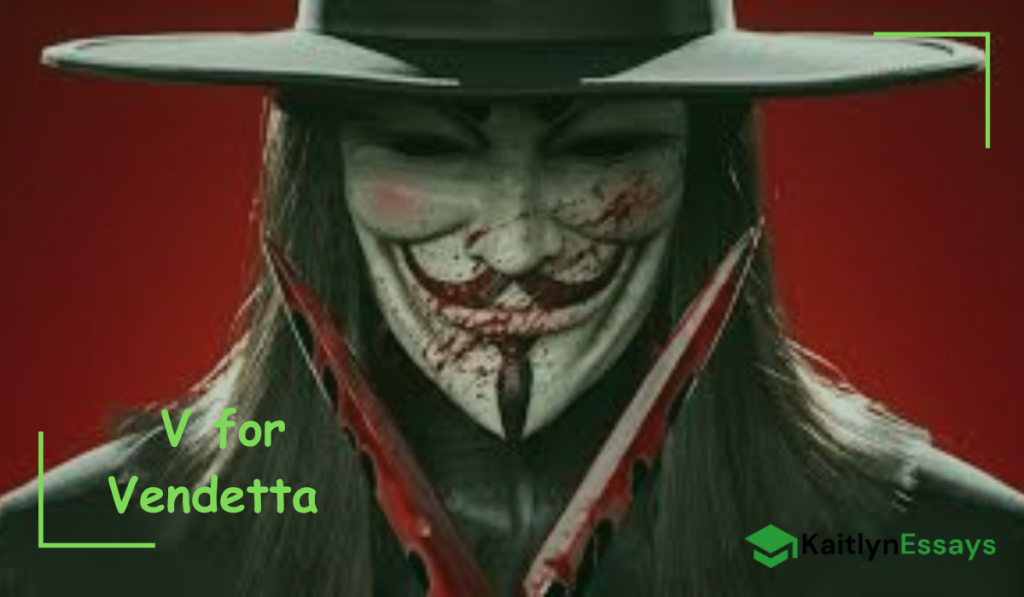
Alan Moore’s V for Vendetta is a gripping graphic novel that explores themes of power, rebellion, and identity in a dystopian future. Set in a totalitarian Britain, the story follows V, a mysterious and charismatic freedom fighter, as he seeks to overthrow the oppressive regime that controls every aspect of society. Through V’s actions and his relationship with Evey, a young woman he rescues, Moore examines the nature of resistance and the cost of freedom. The novel raises thought-provoking questions about justice, morality, and the role of the individual in challenging authority. With its striking visuals and compelling narrative, V for Vendetta has become a cultural touchstone, inspiring readers to reflect on the importance of standing up against tyranny.
Summary of V for Vendetta
The story begins with Evey Hammond, a young woman struggling to survive in this oppressive society, who is rescued by V, a mysterious and enigmatic figure wearing a Guy Fawkes mask. V is a revolutionary anarchist who seeks to dismantle the regime through a series of calculated and theatrical acts of terrorism. His ultimate goal is to inspire the people to rise up against their oppressors and reclaim their freedom.
V’s first major act is the destruction of the Old Bailey, a symbol of the regime’s judicial power, followed by a broadcast hijacking where he exposes the government’s corruption and calls for rebellion. As the story progresses, V’s past is revealed: he was a victim of inhumane experiments at Larkhill, a government detention camp, where he was subjected to torture and experimentation. These experiences transformed him into the vengeful and determined figure he is today. V’s vendetta is not only against the individuals responsible for his suffering but also against the entire system that enabled such atrocities.
Evey’s journey is central to the narrative. Initially frightened and confused by V’s methods, she gradually comes to understand and embrace his cause. V subjects her to a harrowing ordeal, simulating imprisonment and torture to teach her the value of fearlessness and self-reliance. This transformative experience empowers Evey to become a symbol of resistance in her own right. Meanwhile, the government, led by the ruthless Leader Adam Susan, struggles to maintain control as V’s actions spark unrest among the populace.
The climax of the story occurs on November 5th, Guy Fawkes Night, when V’s plan reaches its culmination. He orchestrates the destruction of Parliament, a final act of defiance against the regime. Though V dies in the process, his legacy lives on as the people of Britain, inspired by his actions, rise up against their oppressors. Evey, now wearing the Guy Fawkes mask, steps into V’s role, ensuring that the fight for freedom continues.
V for Vendetta is a powerful exploration of themes such as resistance, identity, and the cost of freedom. Moore’s intricate storytelling and David Lloyd’s evocative artwork create a compelling narrative that challenges readers to reflect on the nature of power and the importance of standing up against tyranny.
To discover more about the characters, themes, and deeper meanings of V for Vendetta, explore further insights here.
Characters
V
V is the enigmatic protagonist of V for Vendetta, a revolutionary figure who wears a Guy Fawkes mask and seeks to overthrow the totalitarian Norsefire regime. He is a complex character, embodying both heroism and vengeance. V is highly intelligent, charismatic, and skilled in combat, using his talents to orchestrate elaborate acts of terrorism against the government. His past as a victim of the regime’s inhumane experiments at Larkhill fuels his relentless quest for justice. V’s philosophy is rooted in anarchism, believing that only through the destruction of the existing system can true freedom be achieved. However, his methods are morally ambiguous, as he is willing to sacrifice lives, including his own, to achieve his goals. V’s relationship with Evey is pivotal, as he becomes both her mentor and a catalyst for her transformation. His ultimate sacrifice on November 5th cements his legacy as a symbol of resistance.
To look deeper into V’s motivations and significance, uncover more insights here.
Evey Hammond
Evey is the emotional heart of the story, evolving from a vulnerable young woman into a strong and fearless revolutionary. At the beginning of the novel, she is struggling to survive in the oppressive society, forced into prostitution to make ends meet. Her life changes when V rescues her, and she becomes entangled in his mission. Initially, Evey is frightened and conflicted by V’s violent methods, but she gradually comes to understand and embrace his cause. V’s simulated imprisonment and torture of Evey serve as a turning point in her character arc, teaching her to overcome fear and find strength within herself. By the end of the story, Evey takes up V’s mantle, donning the Guy Fawkes mask and continuing his fight for freedom. Her transformation symbolizes the power of individual agency and the potential for ordinary people to become agents of change.
To explore Evey’s journey and her role in the story, learn more here.
Adam Susan (The Leader)
Adam Susan, known as “The Leader,” is the head of the Norsefire regime and the primary antagonist of the story. He is a cold, calculating, and authoritarian figure who believes in the absolute control of the state over its citizens. Susan’s obsession with maintaining order and purity leads to the implementation of brutal policies, including surveillance, censorship, and the persecution of minorities. Despite his outward strength, Susan is deeply lonely and emotionally unstable, forming an attachment to the supercomputer “Fate,” which he sees as his only true companion. His downfall is brought about by V’s relentless campaign against the regime, which exposes its corruption and weakens Susan’s grip on power. Susan’s character serves as a critique of fascism and the dangers of unchecked authority.
To gain a deeper understanding of Adam Susan’s role and ideology, discover more.
Eric Finch
Eric Finch is the detective tasked with tracking down V, making him a central figure in the narrative. Unlike many of the other characters, Finch is portrayed as a morally complex individual. He is a loyal servant of the regime but begins to question its legitimacy as he uncovers the truth about its atrocities, including the experiments at Larkhill. Finch’s investigation leads him to confront the darker aspects of the society he has helped to uphold. His journey is one of disillusionment and self-reflection, as he grapples with his own complicity in the regime’s crimes. Finch’s character adds depth to the story, highlighting the internal conflicts faced by those who serve oppressive systems.
To explore Eric Finch’s character and his moral dilemmas, uncover more details here.
Delia Surridge
Delia Surridge is a former doctor who worked at Larkhill, where she conducted the experiments that created V. She is a tragic figure, burdened by guilt and remorse for her actions. Surridge’s character represents the moral compromises made by individuals in service of the regime. After leaving Larkhill, she lives in isolation, haunted by the consequences of her work. V’s eventual confrontation with Surridge forces her to confront her past, and she accepts her fate as part of his vendetta. Her character serves as a reminder of the human cost of authoritarianism and the ethical dilemmas faced by those who enable it.
To learn more about Delia Surridge’s role and her moral struggles, explore further here.
Conrad Heyer
Conrad Heyer is a high-ranking official within the Norsefire regime, serving as the head of the propaganda department known as “The Voice of Fate.” He is a manipulative and cunning figure who uses media to control public perception and maintain the regime’s power. Heyer’s character represents the role of propaganda in authoritarian societies, highlighting how information can be weaponized to suppress dissent. His eventual downfall, orchestrated by V, underscores the vulnerability of those who rely on deception to maintain control. Heyer’s presence in the story adds another layer to the critique of totalitarianism and the mechanisms of oppression.
To uncover more about Conrad Heyer’s role and his impact on the narrative, visit this link for further insights.
Roger Dascombe
Roger Dascombe is the creator of “Fate,” the supercomputer used by the Norsefire regime to monitor and control the population. He is a brilliant but morally ambiguous character who takes pride in his technological achievements, despite their use for oppressive purposes. Dascombe’s relationship with Adam Susan is complex, as he views the Leader as both a benefactor and a tyrant. His eventual realization of the destructive consequences of his work adds a layer of tragedy to his character. Dascombe’s story serves as a cautionary tale about the ethical responsibilities of scientists and the dangers of unchecked technological advancement.
For a deeper exploration of Roger Dascombe’s character and his role in the story, explore this link for more details.
Rose Almond
Rose Almond is a minor but significant character who represents the ordinary citizens living under the Norsefire regime. She is a neighbor of Evey’s and becomes a victim of the regime’s brutal policies when her husband is arrested for suspected dissent. Rose’s story highlights the pervasive fear and suffering experienced by the general population under totalitarian rule. Her interactions with Evey provide a glimpse into the everyday struggles of those who are not directly involved in the resistance but are deeply affected by the regime’s actions. Rose’s character adds a humanizing element to the narrative, emphasizing the widespread impact of oppression.
To learn more about Rose Almond’s role and her significance in the story, visit this link for further analysis.
Helen Heyer
Helen Heyer is the wife of Conrad Heyer and a symbol of the privileged class within the Norsefire regime. She lives a life of luxury and indifference, oblivious to the suffering of those outside her social circle. Helen’s character serves as a critique of complacency and the moral blindness that often accompanies privilege. Her eventual downfall, brought about by V’s actions, underscores the fragility of her insulated world. Helen’s presence in the story highlights the disparities between the ruling elite and the oppressed masses, adding depth to the novel’s exploration of social inequality.
For a more detailed look at Helen Heyer’s character and her role in the narrative, explore this link for additional insights.
Dominic Stone
Dominic Stone is a loyal enforcer of the Norsefire regime, serving as a member of the secret police known as “The Finger.” He is a ruthless and pragmatic character who embodies the brutality of the regime’s methods. Stone’s interactions with Eric Finch reveal the tension between blind loyalty and moral questioning within the regime’s ranks. His eventual fate, tied to the collapse of the regime, serves as a reminder of the consequences of serving oppressive systems. Stone’s character adds a layer of tension and conflict to the story, highlighting the moral compromises made by those in positions of power.
To look deeper into Dominic Stone’s character and his role in the story, visit this link for more information.
Themes in V for Vendetta
Freedom and Anarchy
One of the central themes in V for Vendetta is the concept of freedom—both personal and societal. The story presents a dystopian world where a totalitarian government suppresses individual freedoms in the name of security. V, the protagonist, represents the anarchist ideal of complete personal liberty. He believes that society must be destroyed and rebuilt to achieve true freedom. This theme is exemplified in V’s fight against the oppressive Norsefire regime and his efforts to awaken the public to their own potential for liberation.
The theme of freedom is juxtaposed with anarchy, as V’s methods often blur the lines between heroism and extremism. His actions raise questions about the cost of freedom and the ethical boundaries of rebellion.
Continue exploring the theme of freedom in V for Vendetta
Identity and Transformation
The theme of identity is central to the journeys of both V and Evey. V’s true identity remains a mystery, symbolizing the idea that he is not an individual but a representation of an idea. His Guy Fawkes mask underscores this notion, as he becomes a symbol of resistance and revolution. By shedding his personal identity, V transcends individuality to embody a collective spirit.
Evey’s transformation is another significant aspect of this theme. Through her experiences and V’s mentorship, she evolves from a frightened and submissive individual into a confident and empowered woman. Her journey illustrates the idea that identity is not fixed but can be shaped by experiences and choices.
Discover more about identity in V for Vendetta
The Power of Ideas
“Ideas are bulletproof,” V famously declares, emphasizing the enduring nature of ideas over physical beings. This theme underscores the novel’s message that ideas can inspire change and outlive the individuals who promote them. V’s actions are driven by his belief in the power of ideas to ignite revolution and dismantle oppressive systems.
The theme also explores how ideas can be both liberating and dangerous. While V’s philosophy inspires hope and resistance, the Norsefire regime’s ideology shows how ideas can be manipulated to oppress and control.
Learn more about the power of ideas in V for Vendetta
Government Control and Oppression
The totalitarian regime in V for Vendetta highlights the dangers of unchecked government power. The Norsefire government uses propaganda, surveillance, and fear to maintain control, stripping citizens of their individuality and freedom. This theme serves as a critique of authoritarianism and a warning against the erosion of democratic values.
Through the regime’s actions, the novel explores the moral compromises individuals make under oppressive systems. It challenges readers to consider their own responsibility in resisting or enabling such control.
Read more about government oppression in V for Vendetta
Love and Human Connection
Despite its dark and violent themes, V for Vendetta also explores love and human connection. V’s relationship with Evey evolves into a complex bond that is both paternal and romantic. While V teaches Evey about strength and independence, their connection highlights the importance of trust and mutual growth.
The theme extends to broader human connections, as V’s actions aim to unite the people against a common enemy. Love, in this sense, becomes a form of rebellion against the isolation and fear imposed by the regime.
Examine the theme of love in V for Vendetta
Revenge and Justice
V’s crusade against the Norsefire regime is fueled by a desire for revenge, particularly against those who tortured him and others in the Larkhill detention facility. This theme explores the thin line between justice and vengeance. V’s methods are often violent and ruthless, raising questions about whether his actions are justified or if they perpetuate a cycle of violence.
The theme also invites readers to consider the concept of justice in a broader sense: Is it about punishment, or is it about restoring balance and harmony? Evey’s eventual rejection of V’s violent methods suggests a more compassionate form of justice.
Analyze the theme of justice in V for Vendetta
Fear and Manipulation
The Norsefire regime’s primary tool for maintaining control is fear. Through propaganda and surveillance, the government manipulates its citizens into compliance. This theme examines how fear can be weaponized to suppress dissent and enforce conformity.
V counters this manipulation by creating fear within the regime itself. His acts of rebellion demonstrate how fear can also be used as a tool of resistance, turning the oppressors’ tactics against them.
Explore more about fear in V for Vendetta
Symbols in V for Vendetta
The Guy Fawkes Mask
The Guy Fawkes mask worn by V is one of the most recognizable symbols in V for Vendetta. It represents resistance against tyranny and the enduring power of ideas. By donning the mask, V anonymizes himself, allowing his actions to symbolize a collective fight for freedom rather than a personal vendetta. The mask also connects V to the historical figure Guy Fawkes, who attempted to overthrow an oppressive government in 1605.
The mask’s use has extended beyond the novel, becoming a global icon for protests and movements advocating social change. It underscores the theme of identity and the idea that revolution is not about an individual but a shared purpose.
Discover more about the Guy Fawkes mask in V for Vendetta
The V Symbol
The letter “V” appears repeatedly throughout the novel, symbolizing multiple concepts: vengeance, victory, and revolution. V’s name itself is a direct reference to this letter, reinforcing his mission to dismantle the Norsefire regime. The symbol is prominently displayed when V destroys the Old Bailey, leaving behind a fiery “V” as a message of defiance.
The repeated use of “V” also ties to the Roman numeral for five, alluding to the fifth of November—the date of Guy Fawkes’ attempted rebellion. This numerical connection emphasizes the cyclical nature of resistance and the idea that ideas cannot be silenced.
Explore the significance of the V symbol in V for Vendetta
Roses
The roses in V for Vendetta, specifically the Scarlet Carson variety, carry deep symbolic weight. V leaves these roses at the scenes of his killings, tying them to both revenge and beauty. The roses symbolize V’s humanity, showing that his actions, though violent, are rooted in personal loss and a sense of justice. The flowers also serve as a tribute to Valerie, a key figure in V’s backstory, highlighting the connection between love and resistance.
By using roses, the novel juxtaposes fragility and strength, suggesting that even in the darkest times, beauty and humanity persist.
Learn more about the symbolism of roses in V for Vendetta
The Shadow Gallery
The Shadow Gallery, V’s underground lair, symbolizes freedom, knowledge, and rebellion. Filled with art, literature, and music banned by the Norsefire regime, it represents a haven for cultural preservation and intellectual freedom. The Shadow Gallery is not just a physical space but a metaphor for resistance against oppressive systems that seek to control thought and expression.
The gallery’s name itself evokes imagery of light and darkness, highlighting the contrast between the oppressive surface world and the intellectual refuge V has created underground.
Look into the importance of the Shadow Gallery
Fireworks and Explosions
Explosions and fireworks are recurring motifs in the novel, symbolizing both destruction and renewal. V uses explosions not only to destroy symbols of the regime but also to inspire hope and signal the beginning of change. The destruction of landmarks like the Old Bailey and Parliament signifies the end of an era and the potential for rebuilding a freer society.
These explosions also tie to the theme of revolution, emphasizing the transformative power of action in the face of oppression.
Uncover more about the symbolism of explosions in V for Vendetta
Valerie’s Letter
Valerie’s letter is one of the most poignant symbols in the novel, representing hope, resilience, and the power of love. Written by a fellow prisoner, the letter details Valerie’s life, struggles, and refusal to compromise her identity. For Evey, reading the letter is a transformative experience, teaching her the value of holding onto one’s principles, even in the face of suffering.
The letter symbolizes the enduring strength of the human spirit and the importance of personal integrity. It also highlights the interconnectedness of resistance, as Valerie’s story inspires both V and Evey to continue their fight.
Learn more about Valerie’s letter in V for Vendetta
The Dominoes
The dominoes V meticulously arranges symbolize the interconnectedness of his plans and the inevitability of their success. When V topples the dominoes, it represents the cascading effect of his actions, leading to the eventual downfall of the Norsefire regime. The dominoes also emphasize the meticulous planning and strategy behind V’s rebellion.
This symbol reinforces the theme of cause and effect, showing how small acts of resistance can lead to significant change.
Examine the meaning of the dominoes in V for Vendetta
Literary Devices in V for Vendetta
Allusion
Allusion is a prominent literary device in V for Vendetta. The narrative frequently references historical events, literature, and cultural symbols. For instance, V’s actions and philosophies are heavily inspired by Guy Fawkes and the Gunpowder Plot, as well as classic works like Shakespeare’s Macbeth and The Tempest. These allusions enrich the story, providing historical and philosophical depth.
By drawing on these references, Moore connects the fictional dystopia of the Norsefire regime to real-world struggles against tyranny and oppression, encouraging readers to draw parallels with their own societal context.
Explore the allusions in V for Vendetta
Symbolism
Symbolism is central to V for Vendetta. From the Guy Fawkes mask to the Scarlet Carson roses, symbols play a vital role in conveying the story’s themes. These symbols add layers of meaning, making the graphic novel a rich text for analysis. For instance, the mask represents anonymity and collective resistance, while the roses symbolize beauty amidst chaos and loss.
The pervasive use of symbols invites readers to interpret and re-interpret the narrative through various lenses.
Discover the significance of symbolism in V for Vendetta
Irony
Irony permeates V for Vendetta, often highlighting the contradictions within the Norsefire regime and its propaganda. For example, the government’s claim to maintain order and safety starkly contrasts with its oppressive tactics, surveillance, and brutality. Similarly, V’s use of violence to promote freedom creates a moral ambiguity that challenges readers to grapple with the complexities of resistance.
This use of irony adds depth to the narrative, making it more than a simple tale of good versus evil.
Learn more about irony in V for Vendetta
Foreshadowing
Foreshadowing is subtly woven throughout the novel, preparing readers for key events while maintaining suspense. For instance, V’s meticulous planning and cryptic remarks hint at the eventual downfall of the Norsefire regime. The domino sequence, where V sets up and topples an intricate pattern, visually and metaphorically foreshadows the regime’s collapse.
This device keeps readers engaged, as they piece together clues and anticipate the story’s developments.
Examine the role of foreshadowing in V for Vendetta
Juxtaposition
Juxtaposition is used to contrast characters, settings, and ideologies. For example, the oppressive, sterile world of the Norsefire regime is starkly contrasted with the vibrant and eclectic Shadow Gallery. Similarly, the selflessness of Valerie’s love and sacrifice contrasts with the cold, calculating nature of the regime.
These contrasts highlight the moral and philosophical divides within the story, emphasizing the stakes of the conflict.
Look into the use of juxtaposition in V for Vendetta
Metaphor
Metaphors abound in V for Vendetta, enriching the narrative’s thematic complexity. V himself is a metaphor for revolution and the enduring power of ideas. The Shadow Gallery serves as a metaphor for freedom of thought and cultural preservation, standing in opposition to the regime’s censorship and control.
These metaphors deepen the reader’s understanding of the story’s messages, offering layers of interpretation.
Learn more about metaphors in V for Vendetta
Flashbacks
Flashbacks are used effectively to provide backstory and context. Valerie’s letter, for instance, is presented as a flashback that reveals her struggles and reinforces the importance of identity and resistance. V’s own mysterious origins are hinted at through fragmented flashbacks, creating intrigue and emphasizing the personal stakes of his mission.
These moments connect past events to the present narrative, showing how history influences the characters’ actions and decisions.
Explore the use of flashbacks in V for Vendetta
Personification
Personification is used to imbue abstract concepts with life and agency. The Norsefire regime is depicted as an almost omnipresent force, embodying fear and control. Conversely, freedom is portrayed as a living, breathing ideal that V seeks to revive through his actions.
This literary device emphasizes the stakes of the conflict, transforming abstract ideas into tangible forces within the narrative.
Uncover the role of personification in V for Vendetta
Quotes in V for Vendetta
“People should not be afraid of their governments. Governments should be afraid of their people.”
This iconic quote, spoken by V, serves as a rallying cry against tyranny. It underscores the novel’s central theme of empowerment and resistance, reminding readers that power ultimately resides with the populace, not with oppressive regimes. This statement inspires a sense of agency, urging individuals to challenge unjust systems.
Discover the significance of this quote in V for Vendetta
“Beneath this mask, there is more than flesh. Beneath this mask, there is an idea… and ideas are bulletproof.”
V delivers this line to emphasize the enduring nature of ideas. It reflects the narrative’s focus on the power of ideology over physical force. By declaring that ideas cannot be destroyed, V affirms his belief in the resilience of human spirit and the inevitability of change.
Learn more about the power of ideas in V for Vendetta
“Happiness is a prison, Evey. Happiness is the most insidious prison of all.”
This quote, spoken by V, challenges the notion of complacency. It suggests that contentment can trap individuals within oppressive systems by making them accept their circumstances. This line provokes readers to question the cost of their own comfort and whether it comes at the expense of freedom.
Explore the deeper meaning of this quote
“The past can’t hurt you anymore, unless you let it.”
This line, found in Valerie’s letter, offers solace and strength to Evey. It reflects the novel’s theme of overcoming personal and collective trauma to embrace a hopeful future. It serves as a reminder that liberation begins with letting go of fear and pain.
Analyze the context of this quote in V for Vendetta
“Artists use lies to tell the truth.”
This thought-provoking quote highlights the role of art and storytelling in revealing deeper truths. It resonates with the graphic novel’s structure, as V for Vendetta itself uses fiction to critique real-world issues. The statement encourages readers to seek truth beneath the surface.
Uncover the role of art in V for Vendetta
“There’s no flesh or blood within this cloak to kill. There’s only an idea.”
V articulates this line to assert his symbolic identity. By rejecting the constraints of physical existence, he becomes a representation of revolution and resilience. This quote encapsulates the novel’s focus on the transformative power of collective ideals.
Discover the significance of this symbolism
“Authority, when it is not resisted, will invariably become tyranny.”
This line critiques the dangers of unchecked power. It aligns with the novel’s exploration of how apathy enables authoritarianism. By stating this, Moore warns readers about the consequences of complacency in the face of oppressive governance.
Learn how resistance shapes the narrative
“Every inch of me shall perish. Every inch… but one.”
Valerie’s declaration of defiance epitomizes the human capacity to resist dehumanization. Her words inspire Evey and affirm the novel’s belief in the invincibility of dignity and identity. This quote remains a poignant testament to the strength of the human spirit.
Explore Valerie’s role in the narrative
V For Vendetta Essays
Critique of Current Society in V for Vendetta by Alan Moore and The Handmaid’s Tale
Alan Moore’s V for Vendetta and Margaret Atwood’s The Handmaid’s Tale are two seminal works of speculative fiction that offer scathing critiques of contemporary society. Though distinct in their narratives and settings, both texts explore themes of authoritarianism, societal complacency, and the erosion of individual freedoms. Through their dystopian lenses, they serve as cautionary tales, reflecting the dangers of unchecked power, ideological extremism, and the fragility of human rights in the face of societal and political upheaval.
Authoritarianism and Totalitarian Regimes
Both V for Vendetta and The Handmaid’s Tale depict societies ruled by oppressive regimes that exploit fear and control to maintain power. In V for Vendetta, the Norsefire government in Britain uses surveillance, propaganda, and violence to suppress dissent and enforce conformity. The regime capitalizes on societal fears—such as terrorism and disease—to justify its authoritarian measures, mirroring real-world concerns about the erosion of civil liberties in the name of security. Similarly, in The Handmaid’s Tale, the theocratic regime of Gilead imposes a rigid hierarchy based on gender and religious extremism. Women are stripped of their rights, reduced to their reproductive functions, and subjected to systemic oppression. Both works highlight how authoritarian regimes manipulate ideology and exploit societal vulnerabilities to consolidate power, offering a stark warning about the consequences of complacency in the face of such threats.
Societal Complacency and Complicity
A central critique in both texts is the role of societal complacency in enabling oppression. In V for Vendetta, the majority of the population is depicted as apathetic or resigned to the Norsefire regime’s atrocities. This complacency is symbolized by the character of Evey, who initially accepts the status quo until her transformation under V’s influence. Similarly, in The Handmaid’s Tale, the rise of Gilead is facilitated by the indifference and complicity of those who fail to resist its encroaching tyranny. Offred’s recollections of the pre-Gilead era reveal how societal divisions, environmental crises, and political inertia allowed the regime to take hold. Both works underscore the dangers of passivity, suggesting that the erosion of freedoms often occurs not through sudden upheaval but through gradual acquiescence.
Resistance and the Power of Individual Agency
Despite their bleak depictions of society, both V for Vendetta and The Handmaid’s Tale emphasize the importance of resistance and individual agency. In V for Vendetta, the titular character V embodies the spirit of rebellion, using theatricality and violence to challenge the Norsefire regime and inspire others to rise against oppression. Evey’s transformation from a passive bystander to an active participant in the resistance symbolizes the potential for individual awakening and collective action. In The Handmaid’s Tale, Offred’s subtle acts of defiance—such as her secret meetings with the Commander and her inner resistance to Gilead’s ideology—highlight the enduring power of individual agency even in the face of overwhelming oppression. Both texts suggest that resistance, whether overt or covert, is essential to challenging tyranny and reclaiming freedom.
Gender, Identity, and Oppression
While both works critique authoritarianism, The Handmaid’s Tale places particular emphasis on gender and the intersection of patriarchy and theocracy. Gilead’s regime reduces women to their reproductive roles, stripping them of autonomy and identity. Atwood’s critique extends beyond the fictional world of Gilead, reflecting real-world issues such as the politicization of women’s bodies and the persistence of gender inequality. In contrast, V for Vendetta explores themes of identity and individuality in a broader sense, with V’s masked persona symbolizing the idea that anyone can embody the spirit of resistance. However, both works ultimately underscore the importance of preserving individual identity and autonomy in the face of dehumanizing systems.
Relevance to Contemporary Society
The critiques presented in V for Vendetta and The Handmaid’s Tale remain strikingly relevant in contemporary society. Issues such as government surveillance, the rise of authoritarianism, and the erosion of civil liberties continue to resonate in the modern world. The #MeToo movement and ongoing debates about reproductive rights echo the gender-based oppression depicted in The Handmaid’s Tale, while concerns about political extremism and societal division reflect the warnings of V for Vendetta. Both texts serve as reminders of the fragility of democracy and the need for vigilance in protecting human rights.
Conclusion
Alan Moore’s V for Vendetta and Margaret Atwood’s The Handmaid’s Tale offer powerful critiques of current society through their dystopian visions. By exploring themes of authoritarianism, societal complacency, and the importance of resistance, they challenge readers to confront the dangers of unchecked power and the erosion of individual freedoms. Both works serve as urgent reminders of the need for vigilance, activism, and the preservation of human dignity in the face of oppression. As speculative fiction, they not only reflect the anxieties of their time but also provide timeless warnings about the potential consequences of societal and political failures.
Censorship and Dehumanization in V for Vendetta and Brave New World
Censorship and dehumanization are central themes in both Alan Moore’s V for Vendetta and Aldous Huxley’s Brave New World. These dystopian works explore how oppressive regimes manipulate information and strip individuals of their humanity to maintain control. While V for Vendetta focuses on the overt suppression of dissent and the erasure of identity, Brave New World depicts a society where censorship and dehumanization are achieved through technological and psychological conditioning. Together, these texts offer a profound critique of the mechanisms by which authoritarian systems undermine individuality and freedom.
Censorship as a Tool of Control
In V for Vendetta, censorship is a cornerstone of the Norsefire regime’s control over Britain. The government suppresses dissenting voices, manipulates the media, and rewrites history to maintain its authority. The character of V, a former victim of the regime’s experiments, symbolizes the resistance to this censorship. His destruction of the Old Bailey and Parliament serves as a dramatic rejection of the regime’s lies and a call for truth. The film adaptation’s iconic line, “People should not be afraid of their governments. Governments should be afraid of their people,” underscores the importance of free expression in challenging tyranny.
In Brave New World, censorship takes a more insidious form. The World State controls information not through brute force but by conditioning its citizens to reject anything that disrupts societal stability. Books, art, and ideas that provoke critical thinking or emotional depth are banned, and individuals are conditioned to avoid them. The character of John the Savage, who represents the clash between natural human emotions and the sterile, controlled world of the State, highlights the consequences of this intellectual and emotional censorship. His inability to reconcile his humanity with the dehumanized society ultimately leads to his tragic downfall.
Dehumanization and the Loss of Identity
Dehumanization is a recurring theme in both works, though it manifests differently. In V for Vendetta, the Norsefire regime dehumanizes its citizens by reducing them to mere cogs in a machine. Political dissidents, minorities, and other “undesirables” are systematically eliminated or subjected to inhumane experiments. V’s backstory as a victim of these experiments underscores the regime’s cruelty and its disregard for human dignity. The masks worn by V and his followers symbolize the erasure of individual identity under authoritarian rule, while also serving as a unifying symbol of resistance.
In Brave New World, dehumanization is achieved through technological and psychological means. Citizens are genetically engineered and conditioned to fit into predetermined social roles, stripping them of individuality and autonomy. The use of soma, a drug that suppresses emotions and critical thought, further reinforces this dehumanization. Characters like Bernard Marx and Helmholtz Watson, who struggle with their conditioning and seek deeper meaning, represent the flicker of humanity that persists despite the State’s efforts to extinguish it. However, their eventual exile or submission to the system highlights the difficulty of resisting such pervasive control.
The Role of Technology and Propaganda
Both works explore the role of technology and propaganda in facilitating censorship and dehumanization. In V for Vendetta, the Norsefire regime uses surveillance and state-controlled media to monitor and manipulate the population. The character of Evey’s transformation from a passive observer to an active participant in the resistance illustrates the power of individual awakening in the face of such propaganda.
In Brave New World, technology is used to enforce conformity from birth. Genetic engineering, conditioning, and the pervasive use of soma create a society where individuals are content in their subjugation. The World State’s motto, “Community, Identity, Stability,” reflects its prioritization of societal control over individual freedom. The contrast between the sterile, technologically advanced World State and the raw, imperfect humanity of the Savage Reservation underscores the dehumanizing effects of such a system.
Relevance to Contemporary Society
The themes of censorship and dehumanization in V for Vendetta and Brave New World remain alarmingly relevant in contemporary society. Issues such as government surveillance, the manipulation of information through social media, and the erosion of privacy echo the warnings of these texts. The rise of authoritarian regimes and the increasing use of technology to control and monitor individuals further highlight the enduring relevance of these dystopian critiques.
Conclusion
V for Vendetta and Brave New World offer powerful critiques of censorship and dehumanization, exploring how oppressive regimes manipulate information and strip individuals of their humanity to maintain control. While V for Vendetta focuses on the overt suppression of dissent and the erasure of identity, Brave New World depicts a society where censorship and dehumanization are achieved through technological and psychological conditioning. Together, these works serve as cautionary tales, reminding us of the importance of preserving individuality, freedom, and human dignity in the face of authoritarianism. As society continues to grapple with issues of censorship and dehumanization, the warnings of these texts remain as urgent and relevant as ever.
The Fight for Individualism in V for Vendetta
Alan Moore’s V for Vendetta is a powerful exploration of the struggle for individualism in the face of oppressive authoritarianism. Set in a dystopian future where Britain is ruled by the totalitarian Norsefire regime, the graphic novel looks into themes of identity, freedom, and resistance. Through its characters and narrative, V for Vendetta underscores the importance of preserving individuality in a society that seeks to suppress it, offering a compelling critique of conformity and the erosion of personal autonomy.
The Norsefire regime in V for Vendetta represents the ultimate negation of individualism. Through surveillance, propaganda, and violence, the government enforces conformity and eliminates dissent. Minorities, political dissidents, and anyone deemed “undesirable” are systematically persecuted, reducing individuals to mere categories or threats to the state. The regime’s control extends to every aspect of life, from the media to personal relationships, creating a society where individuality is not only discouraged but actively punished.
This suppression of individualism is symbolized by the character of V, who wears a mask to conceal his identity. While the mask initially represents the erasure of individuality under authoritarian rule, it also becomes a symbol of resistance. By adopting the mask, V transcends his personal identity and becomes an embodiment of the fight for freedom, inspiring others to reclaim their individuality.
Evey Hammond’s character arc is central to the novel’s exploration of individualism. At the beginning of the story, Evey is a passive and fearful young woman, shaped by the oppressive environment of Norsefire Britain. Her transformation begins when she is taken in by V, who subjects her to a series of trials designed to strip away her fear and awaken her sense of self.
The most pivotal moment in Evey’s journey occurs when she is imprisoned and tortured, believing she has been captured by the regime. Through this harrowing experience, Evey confronts her deepest fears and emerges with a newfound sense of strength and independence. Her decision to shave her head symbolizes her rejection of societal expectations and her embrace of her true self. By the end of the novel, Evey becomes a symbol of individualism, carrying on V’s legacy of resistance.
V himself is a complex figure in the fight for individualism. On one hand, he is a symbol of resistance against the dehumanizing forces of the Norsefire regime. His actions, from destroying symbols of the state to inspiring the public to rise up, are driven by a desire to restore individuality and freedom. On the other hand, V’s methods are often extreme, and his single-minded pursuit of vengeance raises questions about the cost of his fight.
V’s mask, while a powerful symbol of resistance, also obscures his personal identity, creating a paradox. By hiding his face, V rejects the regime’s attempts to define him, but he also sacrifices his individuality in the process. This tension highlights the challenges of preserving individualism in the face of oppression, as well as the sacrifices that may be required in the fight for freedom.
While V for Vendetta emphasizes the importance of individualism, it also recognizes the power of collective action in challenging authoritarianism. V’s ultimate goal is not just to destroy the Norsefire regime but to inspire the public to reclaim their freedom. The novel’s climax, in which thousands of citizens don V’s mask and march on Parliament, demonstrates the transformative potential of collective resistance.
This moment underscores the idea that individualism and collective action are not mutually exclusive. By embracing their individuality, the citizens of Britain are able to unite in their fight against oppression, creating a powerful force for change.
The fight for individualism in V for Vendetta resonates deeply in contemporary society, where issues such as government surveillance, censorship, and the erosion of civil liberties continue to threaten personal autonomy. The novel serves as a reminder of the importance of resisting conformity and preserving individuality in the face of authoritarianism.
V for Vendetta is a compelling exploration of the fight for individualism in a dystopian world where personal autonomy is under constant threat. Through its characters and narrative, the novel highlights the importance of resisting conformity, embracing one’s true self, and standing up against oppression. V’s legacy, carried on by Evey and the citizens of Britain, serves as a powerful reminder that the fight for individualism is not just a personal struggle but a collective one. In a world where authoritarianism and conformity continue to pose challenges, V for Vendetta remains a timely and inspiring call to action.
Comparison of Values: Animal Farm and V for Vendetta
George Orwell’s Animal Farm and Alan Moore’s V for Vendetta are two iconic works of literature that explore themes of power, oppression, and resistance. While Animal Farm uses allegory to critique the corruption of revolutionary ideals, V for Vendetta presents a dystopian vision of authoritarianism and the fight for individual freedom. Despite their different narrative approaches, both works share a common focus on the values of justice, equality, and the dangers of unchecked power. A comparison of the values in these texts reveals their shared concerns and distinct perspectives on the human struggle for freedom.
Justice and Equality
Both Animal Farm and V for Vendetta emphasize the importance of justice and equality, though they approach these values from different angles. In Animal Farm, the animals’ rebellion against Mr. Jones is driven by a desire for equality and fairness, as encapsulated in the Seven Commandments of Animalism. However, the pigs’ gradual corruption and betrayal of these ideals highlight the fragility of justice in the face of greed and ambition. The novel serves as a cautionary tale about how revolutionary ideals can be subverted by those in power.
In V for Vendetta, the fight for justice is embodied by the character of V, who seeks to dismantle the oppressive Norsefire regime and hold its leaders accountable for their crimes. V’s actions are driven by a desire to restore justice and equality to a society that has been stripped of its freedoms. Unlike Animal Farm, which focuses on the betrayal of revolutionary ideals, V for Vendetta emphasizes the importance of individual agency in the pursuit of justice.
The Dangers of Unchecked Power
Both works explore the dangers of unchecked power and the potential for corruption in leadership. In Animal Farm, the pigs’ rise to power and their manipulation of the other animals illustrate how authority can be abused to serve the interests of a few. Napoleon’s transformation into a tyrant mirrors the corruption of real-world leaders who exploit their positions for personal gain. The novel’s famous line, “All animals are equal, but some animals are more equal than others,” encapsulates the hypocrisy and injustice of such systems.
In V for Vendetta, the Norsefire regime’s authoritarian rule is characterized by surveillance, propaganda, and violence. The government’s abuse of power is evident in its persecution of minorities, suppression of dissent, and manipulation of the truth. V’s rebellion against the regime highlights the need to challenge and dismantle systems of oppression. Both works serve as warnings about the dangers of concentrating power in the hands of a few and the importance of holding leaders accountable.
Resistance and Rebellion
Resistance and rebellion are central themes in both Animal Farm and V for Vendetta, though they are portrayed in different ways. In Animal Farm, the animals’ initial rebellion against Mr. Jones is a symbol of hope and the possibility of change. However, the eventual failure of the revolution underscores the challenges of sustaining resistance in the face of corruption and betrayal. The novel suggests that true change requires vigilance and a commitment to justice.
In V for Vendetta, resistance is embodied by the character of V, whose acts of sabotage and defiance inspire others to rise against the Norsefire regime. The novel’s climax, in which thousands of citizens don V’s mask and march on Parliament, symbolizes the power of collective resistance. Unlike Animal Farm, which ends on a note of disillusionment, V for Vendetta offers a more hopeful vision of rebellion, emphasizing the potential for individuals to effect change.
Individualism vs. Collective Action
While both works explore the tension between individualism and collective action, they approach this theme differently. In Animal Farm, the collective action of the animals is initially successful in overthrowing Mr. Jones, but it ultimately fails due to the pigs’ manipulation and the other animals’ passivity. The novel suggests that collective action must be accompanied by a commitment to justice and equality to be effective.
In V for Vendetta, individualism is a central value, as embodied by V and Evey. V’s masked persona symbolizes the idea that anyone can embody the spirit of resistance, while Evey’s transformation from a passive bystander to an active revolutionary highlights the importance of individual agency. However, the novel also recognizes the power of collective action, as demonstrated by the citizens’ uprising in the final act.
Relevance to Contemporary Society
Both Animal Farm and V for Vendetta remain relevant in contemporary society, where issues such as authoritarianism, corruption, and the erosion of civil liberties continue to pose challenges. Animal Farm serves as a warning about the dangers of unchecked power and the betrayal of revolutionary ideals, while V for Vendetta emphasizes the importance of individual agency and collective resistance in the fight for freedom.
Conclusion
Animal Farm and V for Vendetta share a common focus on the values of justice, equality, and resistance, though they approach these themes from different perspectives. While Animal Farm critiques the corruption of revolutionary ideals and the dangers of unchecked power, V for Vendetta offers a more hopeful vision of rebellion and the potential for individuals to effect change. Together, these works serve as powerful reminders of the importance of vigilance, accountability, and the ongoing struggle for freedom in the face of oppression.
Struggling with deadlines?
Let us handle your assignments while you focus on what matters most
FAQs
Is there a book version of V for Vendetta?
Yes, there is a book version of V for Vendetta. It is a graphic novel written by Alan Moore and illustrated by David Lloyd. Originally published as a serialized comic in the early 1980s, it was later compiled into a single volume. The graphic novel is the source material for the 2005 film adaptation, though there are significant differences between the two.
What is the main idea of V for Vendetta?
The main idea of V for Vendetta is the struggle for individual freedom and resistance against authoritarianism. Set in a dystopian future where Britain is ruled by the fascist Norsefire regime, the story follows V, a masked anarchist revolutionary, as he seeks to dismantle the oppressive government and inspire the people to reclaim their autonomy. The graphic novel explores themes of justice, identity, and the power of ideas, emphasizing the importance of standing up against tyranny.
What was the whole point of V for Vendetta?
The whole point of V for Vendetta is to critique authoritarianism and highlight the importance of individual agency in the fight for freedom. Through the character of V and his acts of rebellion, the story demonstrates how oppressive regimes rely on fear, propaganda, and control to maintain power. At the same time, it shows how individuals can resist and inspire collective action. The graphic novel also serves as a cautionary tale, warning against complacency and the erosion of civil liberties.
What is the message in V for Vendetta?
The message in V for Vendetta is complex, but it primarily centers on the following ideas:
Resistance to Oppression: The story encourages individuals to resist authoritarianism and fight for their freedom, even in the face of overwhelming odds.
The Power of Ideas: V’s mantra, “Ideas are bulletproof,” underscores the enduring power of ideas and the importance of challenging oppressive systems through thought and action.
Individual Agency: The transformation of Evey Hammond from a passive victim to an active revolutionary highlights the importance of personal awakening and the role of individuals in effecting change.
The Dangers of Complacency: The graphic novel warns against societal complacency and the dangers of allowing authoritarianism to take root.
Identity and Anonymity: V’s mask symbolizes the idea that anyone can embody the spirit of resistance, emphasizing the collective nature of the fight for freedom.