

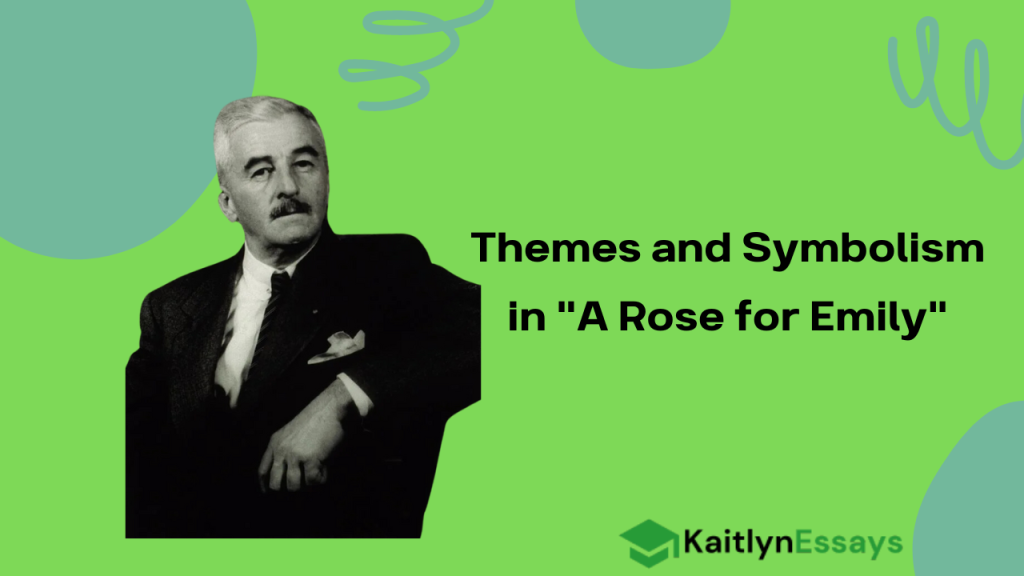
William Faulkner’s “A Rose for Emily” is a masterpiece of Southern Gothic literature, renowned for its exploration of complex themes and its rich symbolism. Through the story of Emily Grierson, a reclusive woman from a once-prominent family, Faulkner delves into the decay of the Old South, the effects of isolation, and the nature of time. In this essay, we will analyze the themes and symbolism present in “A Rose for Emily,” examining how Faulkner uses these literary devices to convey deeper meanings and insights.
Themes in “A Rose for Emily”
1. Decay and Decline
One of the central themes of “A Rose for Emily” is decay and decline, both in terms of the physical environment and the characters themselves. The story is set in the post-Civil War South, a time of social and economic upheaval, and Faulkner vividly depicts the decay of the Old South through descriptions of the dilapidated Grierson mansion and the deteriorating town of Jefferson.
The theme of decay is also reflected in the character of Emily Grierson, who becomes increasingly isolated and mentally unstable as the story progresses. Her refusal to adapt to the changing world around her and her desperate attempts to cling to the past symbolize the decline of the old Southern aristocracy and the inability to escape the passage of time.
2. Isolation and Loneliness

Another prominent theme in “A Rose for Emily” is isolation and loneliness. Emily Grierson is portrayed as a tragic figure, cut off from the outside world by the constraints of tradition and societal expectations. Her reclusive nature and her inability to connect with others ultimately lead to her emotional and psychological isolation.
Faulkner explores the effects of isolation not only on Emily but also on the town of Jefferson itself, which becomes increasingly insular and judgmental as the story unfolds. The theme of isolation underscores the broader societal changes taking place in the post-Civil War South and the alienation experienced by those who cannot or will not conform to its norms.
3. The Nature of Time
Time is a recurring theme in “A Rose for Emily,” symbolizing both continuity and change. Faulkner employs a nonlinear narrative structure, moving back and forth in time to reveal different aspects of Emily’s life and the history of the town of Jefferson. This fractured sense of time reflects the characters’ struggle to come to terms with the past and the inevitability of change.
The theme of time is also represented through the motif of the ticking watch, which Emily’s father gives her as a symbol of control and domination. The watch becomes a symbol of the passage of time and the burden of history, as Emily is unable to escape its relentless march forward.
Symbolism in “A Rose for Emily”
1. The Grierson Mansion
The Grierson mansion serves as a powerful symbol in “A Rose for Emily,” representing the decline of the Old South and the fading aristocracy to which the Grierson family once belonged. The mansion is described as “an eyesore among eyesores,” a decaying relic of a bygone era that stands in stark contrast to the modernizing town of Jefferson.
2. The Rose
The rose is a central symbol in “A Rose for Emily,” representing both beauty and decay. In Emily’s case, the rose symbolizes her tragic fate and her inability to escape the confines of tradition and societal expectations. The title of the story itself, “A Rose for Emily,” suggests both love and mourning, as the rose is laid on Emily’s grave as a final tribute.
3. The Hair

The strand of gray hair found on the pillow next to Homer Barron’s corpse is a potent symbol in “A Rose for Emily,” representing Emily’s desperate attempt to cling to youth and vitality. The hair serves as a reminder of Emily’s obsession with preserving the past and her inability to accept the passage of time.
Conclusion
“A Rose for Emily” is a rich and multifaceted work that explores themes of decay, isolation, and the nature of time through its vivid portrayal of the Southern Gothic genre. Faulkner’s use of symbolism and imagery adds depth and complexity to the story, inviting readers to contemplate the broader social and historical context in which it is set.
Through the themes of decay, isolation, and the nature of time, Faulkner offers a poignant meditation on the legacy of the Old South and the human condition. “A Rose for Emily” remains a timeless masterpiece of American literature, a haunting reminder of the past and its enduring influence on the present.
Ready to conquer your academic challenges? Let our experienced writers guide you towards success. With our custom writing services, you’ll receive original, plagiarism-free content that meets the highest standards. Don’t procrastinate any longer – take the first step towards academic excellence today.
FAQs About Themes and Symbolism in “A Rose for Emily”
What are the main themes of “A Rose for Emily”?
The main themes of “A Rose for Emily” include decay and decline, isolation and loneliness, and the nature of time. These themes are explored through the story of Emily Grierson and the town of Jefferson, offering insights into the changing social and cultural landscape of the post-Civil War South.
How does Faulkner use symbolism in “A Rose for Emily”?
Faulkner employs symbolism to add depth and complexity to “A Rose for Emily,” using objects, characters, and events to represent broader ideas and themes. Key symbols include the Grierson mansion, the rose, and the strand of gray hair, each carrying multiple layers of meaning that enrich the story.
What does the Grierson mansion symbolize in “A Rose for Emily”?
The Grierson mansion serves as a symbol of the decline of the Old South and the fading aristocracy. Its dilapidated state reflects the decay and decline of traditional Southern values, while also highlighting the characters’ struggle to come to terms with the changing world around them.
What is the significance of the rose in “A Rose for Emily”?
The rose in “A Rose for Emily” symbolizes both beauty and decay, serving as a metaphor for Emily’s tragic fate and her inability to escape the confines of tradition and societal expectations. The title of the story itself, “A Rose for Emily,” suggests both love and mourning, as the rose is laid on Emily’s grave as a final tribute.
How does Faulkner explore the theme of isolation in “A Rose for Emily”?
Faulkner depicts Emily Grierson as a reclusive figure, isolated from the outside world by the constraints of tradition and societal expectations. Her loneliness and isolation serve as a reflection of broader societal changes taking place in the post-Civil War South, where old traditions are giving way to new ways of life.
What role does time play in “A Rose for Emily”?
Time is a recurring theme in “A Rose for Emily,” symbolizing both continuity and change. Faulkner’s use of a nonlinear narrative structure reflects the characters’ struggle to come to terms with the past and the inevitability of change, highlighting the tension between tradition and modernity in the post-Civil War South.
How does “A Rose for Emily” reflect the Southern Gothic genre?
“A Rose for Emily” exhibits many characteristics of the Southern Gothic genre, including a decaying Southern setting, grotesque imagery, and themes of decay, isolation, and the supernatural. Faulkner’s portrayal of the Old South and its lingering effects on the present embodies the eerie and haunting atmosphere typical of Southern Gothic literature.
What is the significance of the strand of gray hair in “A Rose for Emily”?
The strand of gray hair found on the pillow next to Homer Barron’s corpse symbolizes Emily’s desperate attempt to cling to youth and vitality. It serves as a potent reminder of Emily’s obsession with preserving the past and her inability to accept the passage of time, adding depth to her character and the story as a whole.
Works Cited
Faulkner, William. “A Rose for Emily.” Collected Stories of William Faulkner. Random House, 1950.