

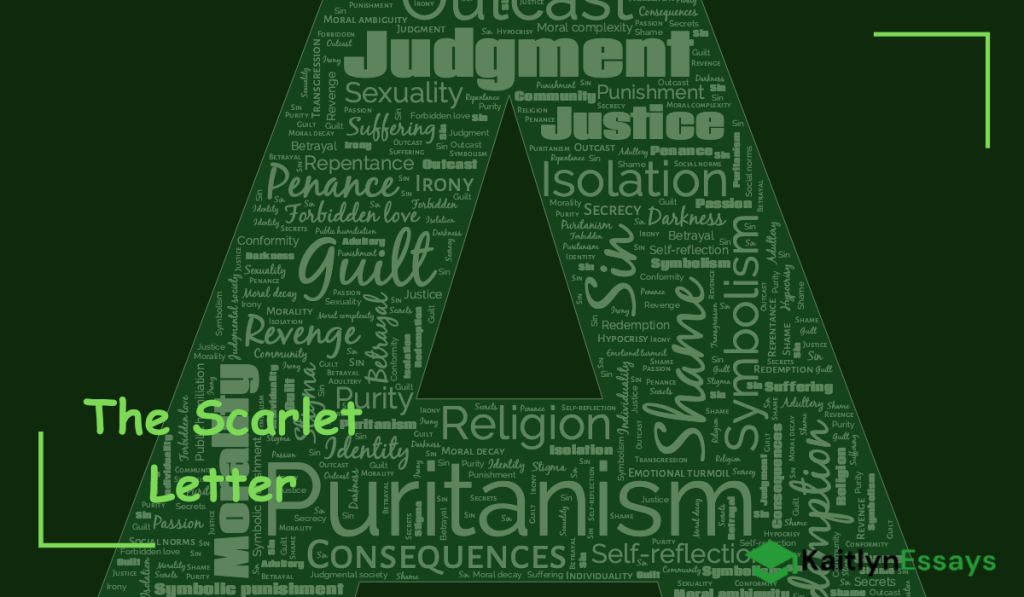
Nathaniel Hawthorne’s “The Scarlet Letter” stands as a timeless exploration of sin, guilt, and redemption in Puritan New England. Published in 1850, this classic novel looks into the life of Hester Prynne, a woman ostracized by her community for adultery. The scarlet ‘A’ she is forced to wear becomes a powerful symbol, evolving in meaning throughout the narrative.
This article examines the plot, symbols, and profound themes that have secured “The Scarlet Letter” a place in the American literary canon. We’ll dissect Hawthorne’s masterful use of symbolism, his critique of Puritan society, and the psychological depth he brings to his characters.
The Scarlet Letter Summary
Chapter 1: “The Prison-Door”
The story opens in 17th-century Puritan Boston. The narrator describes a weathered wooden prison door, symbolizing the strict moral code of the community. Near the prison grows a wild rose bush, which contrasts with the gloomy surroundings and foreshadows the complex themes of sin and beauty to come.
Chapter 2: “The Market-Place”
A crowd gathers in the marketplace to witness the public shaming of Hester Prynne, who has been convicted of adultery. She emerges from the prison carrying her infant daughter, Pearl, and wearing a scarlet letter “A” on her chest. Hester stands on a scaffold for three hours, enduring the judgmental stares and whispers of the townspeople.
Chapter 3: “The Recognition”
As Hester stands on the scaffold, she notices a man in the crowd – her long-lost husband, who has been presumed dead. He learns of her adultery and silently vows revenge. Meanwhile, local clergymen urge Hester to reveal the identity of her lover, but she refuses.
Chapter 4: “The Interview”
Hester returns to her prison cell, where she is visited by her husband, now calling himself Roger Chillingworth. He extracts a promise from her to keep his identity secret. Chillingworth, a physician, tends to Hester and Pearl but also begins to plot his revenge against Hester’s unknown lover.
Chapter 5: “Hester at Her Needle”
After her release from prison, Hester settles in a small cottage on the outskirts of town. She supports herself and Pearl through her skilled needlework, which ironically includes embroidering gloves for the governor and other officials. Despite her isolation, Hester’s scarlet letter becomes a symbol of her exceptional needlework skills.
Chapter 6: “Pearl”
This chapter focuses on Hester’s daughter, Pearl, now a young child. Hawthorne describes Pearl as beautiful but wild, with a capricious nature that reflects her origins. The author explores the complex relationship between mother and daughter, with Pearl showing an almost unnatural fascination with the scarlet letter. The townspeople view Pearl as a living embodiment of Hester’s sin, and there are hints that the child might have an otherworldly quality to her.
Chapter 7: “The Governor’s Hall”
Hester visits Governor Bellingham’s mansion with Pearl to deliver some needlework and address rumors that Pearl might be taken away from her. The opulent surroundings contrast sharply with Puritan austerity. A key moment occurs when Pearl sees her reflection in a polished breastplate, focusing on the distorted image of the scarlet letter. The chapter ends with an encounter between Hester, Pearl, and local clergymen, including Reverend Dimmesdale.
Chapter 8: “The Elf-Child and the Minister”
This chapter centers on the attempt to separate Pearl from Hester. The governor and other officials question Hester’s fitness as a mother. Unexpectedly, Reverend Dimmesdale speaks in Hester’s defense, arguing that Pearl serves as both a blessing and a reminder of her mother’s sin. Pearl shows an unusual affinity for Dimmesdale, hinting at their connection. Roger Chillingworth, now the governor’s physician, observes the proceedings with great interest. Ultimately, Hester is allowed to keep Pearl, largely due to Dimmesdale’s intervention.
Chapter 9: “The Leech”
The focus shifts to Roger Chillingworth and his growing relationship with Reverend Dimmesdale. Chillingworth establishes himself as a respected physician in the community and becomes particularly interested in Dimmesdale, who is suffering from a mysterious ailment. He moves in with the reverend under the guise of providing better medical care. The community views this arrangement positively, unaware of Chillingworth’s true motives. Hawthorne uses the term “leech” symbolically, referring both to Chillingworth’s role as a physician and his parasitic nature. As the chapter progresses, Chillingworth’s physical appearance begins to change, reflecting his internal corruption.
Chapter 10: “The Leech and His Patient”
This chapter explores the relationship between Chillingworth and Dimmesdale. Chillingworth becomes increasingly obsessed with uncovering Dimmesdale’s secret, suspecting him to be Hester’s former lover. The two men engage in philosophical discussions about sin, guilt, and the nature of confession. Dimmesdale, unaware of Chillingworth’s true identity and motives, finds himself drawn into these conversations. The chapter builds tension as Chillingworth’s suspicions grow, and he begins to plot ways to make Dimmesdale reveal his secret.
Chapter 11: “The Interior of a Heart”
This chapter explores Reverend Dimmesdale’s internal struggle with his unconfessed sin. His guilt manifests in various ways, including self-flagellation and nighttime vigils on the scaffold where Hester was publicly shamed. Dimmesdale’s health continues to deteriorate, and he becomes increasingly paranoid, fearing that his secret sin is visible to others. The chapter highlights the stark contrast between Dimmesdale’s public persona as a revered spiritual leader and his private torment.
Chapter 12: “The Minister’s Vigil”
One night, Dimmesdale climbs the scaffold in the town square, seeking some form of public confession. Hester and Pearl, returning from a deathbed visit, join him. The three hold hands in a moment of unity. Suddenly, a meteor illuminates the sky, seemingly forming an “A”. Chillingworth appears, adding to the tension of the scene. This chapter serves as a turning point, bringing the main characters together and foreshadowing future events.
Chapter 13: “Another View of Hester”
Seven years have passed since Hester’s public shaming. This chapter explores how the community’s perception of Hester has gradually changed. Her charitable works and quiet dignity have earned her a measure of respect. The scarlet letter has taken on new meanings, with some viewing it as a symbol of Hester’s strength rather than her shame. Hester, however, remains isolated and continues to bear the burden of her secret.
Chapter 14: “Hester and the Physician”
Hester confronts Chillingworth about his treatment of Dimmesdale. She reveals that she intends to tell Dimmesdale about Chillingworth’s true identity. Chillingworth, consumed by his desire for revenge, refuses to relent. The chapter showcases the complex dynamics between Hester and her estranged husband, highlighting how both have been changed by their experiences over the years.
Chapter 15: “Hester and Pearl”
This chapter focuses on the relationship between Hester and her daughter Pearl, now seven years old. As they walk along the beach, Pearl questions her mother about the meaning of the scarlet letter and why Dimmesdale often holds his hand over his heart. Hester struggles to answer these probing questions, revealing the ongoing impact of her past actions on her present life. The chapter ends with Pearl creating an “A” out of seaweed on her own chest, further emphasizing her intuitive connection to her mother’s situation.
Chapter 16: “A Forest Walk”
Hester decides to meet Dimmesdale in the forest to reveal Chillingworth’s true identity. As she walks with Pearl, the forest symbolizes a place free from societal judgment. Pearl, attuned to nature, asks about the “Black Man” (a reference to the devil) and his connection to the scarlet letter. This chapter sets the stage for a pivotal encounter between Hester and Dimmesdale.
Chapter 17: “The Pastor and His Parishioner”
Hester and Dimmesdale meet in the forest. She reveals Chillingworth’s identity and his desire for revenge. Dimmesdale is initially angry at Hester for keeping this secret but then despairs over his situation. Hester suggests they leave Boston together to start a new life. This chapter marks a turning point in their relationship and the plot.
Chapter 18: “A Flood of Sunshine”
Hester and Dimmesdale plan their escape. In a symbolic gesture, Hester removes her scarlet letter and lets down her hair, momentarily reclaiming her beauty and freedom. The forest seems to come alive with their renewed hope. However, Pearl’s reaction to her mother’s transformation foreshadows the challenges they will face.
Chapter 19: “The Child at the Brook-Side”
Pearl, who has been playing by a brook, returns to find her mother changed. She refuses to approach Hester without the scarlet letter, highlighting how integral the symbol has become to their identities. Dimmesdale kisses Pearl’s forehead, marking a tentative step toward acknowledging her as his daughter.
Chapter 20: “The Minister in a Maze”
Dimmesdale returns to town, his mind reeling from the encounter with Hester and their plans to leave. He feels a new energy and is tempted to act out of character, shocking his parishioners. Meanwhile, he encounters Mistress Hibbins, who hints at knowledge of his forest meeting. The chapter ends with Dimmesdale rejecting Chillingworth’s offer of medicine, signaling a change in their relationship.
Chapter 21: “The New England Holiday”
The town is preparing for a holiday to install a new governor. Hester learns that Chillingworth has booked passage on the same ship she and Dimmesdale plan to take. The festive atmosphere contrasts with Hester’s inner turmoil. Pearl observes sailors from the ship, foreshadowing the possibility of escape.
Chapter 22: “The Procession”
The chapter describes the election day procession. Dimmesdale, despite his plans to leave, delivers a powerful sermon. Hester, standing with the crowd, notices the change in Dimmesdale’s demeanor. Mistress Hibbins again hints at knowledge of Dimmesdale’s secrets. The chapter builds tension as the characters’ fates hang in balance.
Chapter 23: “The Revelation of the Scarlet Letter”
In a dramatic turn of events, Dimmesdale, after his sermon, calls Hester and Pearl to the scaffold. He confesses his sin to the shocked crowd, revealing a scarlet letter carved into his own chest. He collapses and dies in Hester’s arms after kissing Pearl. This public confession marks the climax of the novel, bringing the main conflict to a resolution.
Chapter 24: “Conclusion”
The final chapter wraps up the fates of the characters. Following Dimmesdale’s dramatic confession and death, Roger Chillingworth, now devoid of his object of revenge, withers away and dies within a year. In a surprising turn of events, he bequeaths his considerable fortune to Pearl, Hester’s daughter, effectively providing her with a chance at a new life. Hester and Pearl subsequently leave New England, and it is suggested that Pearl marries into European nobility and starts a family of her own, finally finding happiness and acceptance far from the judgmental shores of colonial America. Hester, however, feels drawn back to Boston and eventually returns, choosing to wear the scarlet letter once more.
In a poignant twist, she becomes a respected figure in the community, offering comfort and counsel to women in distress. The symbol that once marked her as an outcast now becomes a badge of wisdom and compassion. Years later, Hester dies and is buried near Dimmesdale. Their shared tombstone bears a scarlet letter “A,” a final testament to their intertwined fates. Hawthorne concludes with reflections on the nature of human sorrow and the enduring power of Hester’s story, suggesting that the weight of the past continues to shape the present and future.
The novel ends on a note of cautious hope, implying that even in the face of harsh judgment and personal tragedy, there remains the possibility of redemption and societal transformation over time.
Themes in The Scarlet Letter
Sin, Guilt, and Redemption in The Scarlet Letter
Sin in “The Scarlet Letter” is presented as a complex concept. Hester Prynne’s adultery is the most obvious and publicly acknowledged sin in the novel. However, Hawthorne portrays this sin with a degree of sympathy, questioning the harsh judgment of Puritan society. Arthur Dimmesdale’s sin is twofold: not only did he commit adultery with Hester, but he also continues to deceive his congregation by hiding his transgression.
This dual nature of his sin weighs heavily on him throughout the story. Roger Chillingworth, Hester’s husband, commits perhaps the most insidious sin of all. His relentless pursuit of vengeance against Dimmesdale is portrayed as a corruption of the soul, highlighting how sin can consume a person if left unchecked.
Guilt manifests differently for each character, illustrating the psychological complexity of this emotion. Hester bears her guilt publicly, forced to wear the scarlet letter ‘A’ on her chest. However, over time, she internalizes this symbol, allowing it to become a part of her identity and even a source of strength. Dimmesdale’s guilt, in contrast, is entirely internal.
His inability to confess publicly leads to severe psychological torment and physical illness, demonstrating the destructive power of hidden guilt. Chillingworth, interestingly, seems the least affected by guilt initially. However, his lack of remorse for his cruel actions ultimately leads to the complete corruption of his character, suggesting that an absence of guilt can be just as damaging as its excess.
Redemption is a central theme in the novel, with each character seeking it in different ways. Hester’s path to redemption is perhaps the most straightforward. Through her public penance, good works, and the raising of her daughter Pearl, she gradually earns the respect of the community. Her redemption is a slow process, mirroring the gradual change in the meaning of the scarlet letter from “Adulteress” to “Able.” Dimmesdale’s redemption comes much later and more suddenly.
His public confession in the novel’s climax serves as a cathartic moment of truth, finally aligning his public persona with his private guilt. This act, while ultimately fatal, provides him with a sense of peace he lacked throughout the story. Chillingworth, unfortunately, fails to find redemption. His obsession with revenge prevents him from seeking forgiveness or making amends, leading to his spiritual and eventual physical demise.
Through these characters’ experiences, Hawthorne explores the interconnected nature of sin, guilt, and redemption. He suggests that while sin may be inevitable in human nature, it is how we respond to our transgressions that defines us.
The novel posits that honest acknowledgment of one’s sins, though painful, is necessary for true redemption. Furthermore, it illustrates how the weight of unresolved guilt can be far more damaging than the consequences of confessing one’s sins. Ultimately, “The Scarlet Letter” presents a detailed view of morality, challenging readers to consider the complex relationships between sin, guilt, and the possibility of redemption.
Identity and Society in The Scarlet Letter
Identity in “The Scarlet Letter” is a fluid and complex concept, deeply intertwined with societal expectations and personal choices. Hester Prynne’s identity undergoes a significant transformation throughout the novel. Initially branded as an adulteress, she is forced to wear the scarlet letter ‘A’ as a mark of shame. However, over time, Hester reclaims this symbol, transforming it into a mark of her own identity and strength. Her needlework on the letter and her quiet dignity in the face of public scorn gradually reshape her identity in the eyes of the community.
Arthur Dimmesdale struggles with a fractured identity throughout the story. Publicly, he maintains the persona of a pious and respected minister, while privately, he grapples with the guilt of his hidden sin. This dichotomy between his public and private selves creates intense internal conflict, ultimately leading to his physical and mental deterioration. Dimmesdale’s journey highlights the psychological toll of maintaining a false identity.
Pearl, Hester’s daughter, serves as a living embodiment of her mother’s sin and a symbol of individualism. Her wild, capricious nature stands in stark contrast to the rigid Puritan society. Pearl’s identity is intrinsically linked to the scarlet letter, and she struggles to form her own identity separate from her mother’s shame.
Roger Chillingworth’s identity undergoes a dark transformation. Once a scholarly man, he allows his desire for revenge to consume him, becoming a symbol of malevolence. His adopted identity as a physician serves merely as a façade to hide his true intentions, illustrating how identity can be manipulated for personal gain.
Society plays a crucial role in shaping and constraining identity in the novel. The Puritan community of 17th century Boston is portrayed as a rigid, authoritarian society with strict moral codes. This society serves as both the backdrop and a character in its own right, influencing the actions and identities of the main characters.
The novel explores how society’s judgments and expectations can shape an individual’s sense of self. Hester’s identity is initially defined by society’s condemnation, but she gradually reclaims her individuality through her actions and resilience. The community’s perception of her evolves over time, demonstrating the dynamic relationship between individual identity and societal views.
Hawthorne critiques the Puritan society’s harsh judgments and the hypocrisy inherent in its treatment of sin. The forest, standing in opposition to the town, represents a space free from societal constraints where characters can express their true selves. This dichotomy between the town and the forest underscores the tension between societal expectations and individual identity.
The novel also examines how societal roles can conflict with personal identity. Dimmesdale’s role as a minister clashes with his private guilt, leading to his internal struggle. Hester’s role as a mother conflicts with society’s view of her as a sinner, forcing her to navigate these competing identities.
Through these themes, Hawthorne explores the complex relationship between individual identity and society. He suggests that while society plays a significant role in shaping identity, individuals have the power to reclaim and redefine themselves. The novel challenges readers to consider the balance between conformity and individuality, and the costs of maintaining a false identity in the face of societal pressure.
Isolation and Community in The Scarlet Letter
Isolation is a pervasive theme in “The Scarlet Letter,” affecting nearly all the main characters in various ways. Hester Prynne experiences the most obvious form of isolation. As punishment for her adultery, she is physically separated from the community, forced to live on the outskirts of town. Her scarlet letter serves as a visible barrier between her and others, marking her as an outcast. However, Hawthorne shows how Hester’s isolation also becomes a source of strength, allowing her to develop independence and a unique perspective on her society.
Arthur Dimmesdale’s isolation is primarily psychological. While he remains an integral part of the community as a respected minister, his secret sin creates an insurmountable emotional barrier between himself and his congregation. His inability to confess traps him in a lonely world of guilt and self-torment. Dimmesdale’s isolation is perhaps the most painful, as he must constantly maintain a facade of piety while inwardly suffering.
Pearl, Hester’s daughter, experiences isolation from birth. As the living embodiment of sin in the eyes of the community, she is shunned by other children and viewed with suspicion by adults. Her unique personality and her mother’s influence further set her apart, making her a true outsider in Puritan society.
Roger Chillingworth, in his quest for revenge, isolates himself from normal human emotions and connections. His single-minded focus on tormenting Dimmesdale cuts him off from any possibility of genuine human relationships, leading to a profound spiritual isolation.
Community plays a complex and often contradictory role in the novel. The Puritan community of Boston is presented as a tight-knit, highly structured society with shared values and beliefs. This community serves as both a source of judgment and a framework for order and stability.
The novel explores how the community’s rigid moral codes and harsh judgments can lead to the isolation of individuals. The public shaming of Hester is a prime example of how the community enforces its norms by ostracizing those who transgress. However, Hawthorne also shows how the community gradually softens its stance towards Hester as she proves her worth through good deeds, illustrating the potential for redemption and reintegration.
The relationship between isolation and community is not simply antagonistic. Hawthorne suggests that some degree of isolation from society can lead to personal growth and insight. Hester’s separation from the community allows her to develop a critical perspective on Puritan society and its treatment of women. Similarly, Dimmesdale’s internal isolation drives him to a deeper understanding of human nature and sin.
The forest in the novel serves as a symbolic space outside of community norms, where characters can escape societal judgments and connect with their true selves. It’s in the forest that Hester and Dimmesdale can openly acknowledge their love and plan for a future together, free from the constraints of their community.
Hawthorne also explores the idea of creating alternative communities. Hester’s plan to escape with Dimmesdale and Pearl represents an attempt to form a new, smaller community based on love rather than rigid moral codes. Pearl’s affinity for nature and her mother suggests the possibility of finding community outside of traditional societal structures.
Through these themes, Hawthorne presents a complex view of the relationship between isolation and community. He suggests that while community is essential for human society, it can also be oppressive when it becomes too rigid or judgmental. Conversely, while isolation can be painful, it can also lead to personal growth and a deeper understanding of oneself and society.
The novel poses questions about the balance between individual freedom and societal norms, and about the nature of true community. Hawthorne seems to suggest that genuine community must allow for individual difference and moral complexity, rather than enforcing a single, inflexible standard of behavior.
In exploring these themes, “The Scarlet Letter” offers a timeless reflection on the human need for both individual identity and communal belonging, and on the challenges of reconciling these often conflicting desires.
The Nature of Evil in The Scarlet Letter
In “The Scarlet Letter,” Hawthorne presents a complex and detailed view of evil, eschewing simplistic moral judgments in favor of a more psychological and philosophical exploration. The nature of evil is examined through various characters and situations, revealing it as a complex concept that often stems from human weakness rather than inherent malice.
The most obvious representation of evil in the novel is the act of adultery committed by Hester Prynne and Arthur Dimmesdale. However, Hawthorne complicates this seemingly straightforward moral transgression by presenting it as an act born out of genuine love and human desire rather than malicious intent. This portrayal challenges readers to consider whether actions deemed “evil” by society are truly so in a moral sense.
Roger Chillingworth emerges as the character who most closely embodies traditional notions of evil in the novel. His transformation from a scholarly man into a figure of vengeance and malice is a central exploration of how evil can consume a person. Chillingworth’s deliberate torment of Dimmesdale, under the guise of a concerned friend and physician, represents a more insidious form of evil—one that corrupts the soul of the perpetrator as much as it harms the victim. Hawthorne suggests that Chillingworth’s vengeful obsession is a greater evil than the original sin of adultery.
Dimmesdale’s internal struggle provides another perspective on the nature of evil. His inability to confess his sin publicly, choosing instead to preserve his reputation at the cost of his integrity, can be seen as a form of evil. Hawthorne explores how cowardice and hypocrisy can be just as damaging as more overt forms of wrongdoing. Dimmesdale’s self-flagellation and psychological torment illustrate the destructive power of unresolved guilt.
The Puritan society itself is portrayed as a source of a certain kind of evil. Its rigid moral codes and harsh judgments create an environment of fear and repression. The community’s treatment of Hester, particularly in the early chapters, demonstrates how societal norms can be wielded as instruments of cruelty. Hawthorne suggests that evil can exist within institutions and collective behaviors, not just in individuals.
Pearl, paradoxically, is both a product of sin and a force that exposes the evil in others. Her wild nature and uncanny perceptiveness serve to reveal the hypocrisy and hidden sins of the adult world around her. Through Pearl, Hawthorne explores the idea that what society deems “evil” may in fact possess a kind of elemental truth or naturalness.
Hawthorne also examines the concept of original sin, a fundamental belief in Puritan theology. The idea that all humans are born sinful and prone to evil is reflected in the novel’s portrayal of human nature as inherently flawed. However, Hawthorne complicates this notion by showing how characters like Hester can transcend their supposed sinful nature through strength of character and good deeds.
The forest in the novel serves as a symbol for moral ambiguity. Often associated with the devil in Puritan belief, the forest is where Hester and Dimmesdale meet and where Pearl seems most at home. Rather than depicting it as a place of evil, Hawthorne presents it as a realm free from societal judgments, where characters can be true to themselves. This portrayal challenges the binary notion of good and evil, suggesting a more complex moral landscape.
Hawthorne’s exploration of evil in “The Scarlet Letter” is deeply psychological and morally ambiguous. He suggests that evil is not always what it appears to be on the surface and that it often arises from human weaknesses such as fear, pride, and the desire for vengeance. The novel posits that the most dangerous forms of evil may be those that corrupt the soul gradually, like Chillingworth’s revenge or Dimmesdale’s cowardice, rather than overt acts of sin.
Through this portrayal, Hawthorne challenges readers to reconsider their understanding of evil, sin, and moral judgment. He presents a world where the line between good and evil is blurred, and where redemption is possible even for those deemed sinful by society. This complex exploration of the nature of evil continues to resonate with readers, offering insights into the moral challenges and ambiguities of human existence.
Hypocrisy and Judgment in The Scarlet Letter
Hypocrisy is a central theme in “The Scarlet Letter,” permeating the Puritan society depicted in the novel and manifesting in various characters’ actions and attitudes. Hawthorne uses this theme to critique the rigid moral standards of Puritan New England and to explore the complexities of human nature.
The most prominent example of hypocrisy in the novel is embodied in the character of Arthur Dimmesdale. As a respected minister, Dimmesdale is viewed as a paragon of virtue by his congregation. However, his hidden sin of adultery with Hester Prynne creates a stark contrast between his public persona and his private guilt. Dimmesdale’s inability to confess his sin publicly, while preaching about morality and repentance, represents the height of hypocrisy. His internal struggle and physical deterioration serve as a powerful illustration of the destructive nature of living a double life.
The Puritan community itself is portrayed as deeply hypocritical. While outwardly pious and morally rigid, many members of the community are shown to harbor their own secrets and sins. The women who gather to judge Hester at the beginning of the novel are described as gossiping and showing a certain relish in Hester’s punishment, betraying a less-than-Christian attitude. The community’s gradual acceptance of Hester as she proves her worth through good deeds highlights the superficiality of their initial moral condemnation.
Roger Chillingworth, while not traditionally seen as hypocritical, embodies a different kind of hypocrisy. He presents himself as a concerned friend and physician to Dimmesdale, while secretly tormenting him. His adopted role as a healer stands in stark contrast to his true intentions, making him a hypocrite in his own right.
Judgment is another pervasive theme in the novel, closely intertwined with hypocrisy. The Puritan society is quick to judge and condemn Hester for her sin, subjecting her to public shame and ostracism. This harsh judgment is contrasted with the community’s reverence for Dimmesdale, highlighting the often arbitrary and unfair nature of societal judgment.
Hawthorne explores how judgment can be a tool of social control. The public nature of Hester’s punishment serves as a warning to others, reinforcing societal norms through fear and shame. However, the novel also shows the limitations of such judgment. Despite her public shaming, Hester maintains her dignity and eventually earns respect through her actions, challenging the effectiveness of the community’s judgment.
The theme of judgment is also examined through the characters’ self-judgment. Dimmesdale’s harsh self-condemnation contrasts with Hester’s more balanced view of her own sin. Hawthorne suggests that self-judgment can be even more punishing than societal judgment, as seen in Dimmesdale’s psychological torment.
Interestingly, Pearl serves as a kind of judgment personified. Her uninhibited nature and piercing questions often make the adults around her uncomfortable, as if she’s able to see through their hypocrisies. Her role highlights how judgment can come from unexpected sources and how innocence can often perceive truth more clearly than adults clouded by societal expectations.
Hawthorne also explores the concept of divine judgment versus human judgment. The Puritan belief in predestination and divine judgment is contrasted with the human tendency to judge and condemn. The novel suggests that human judgment is often flawed and hypocritical, while true judgment is beyond human capability.
Through these themes, Hawthorne critiques the moral absolutism of Puritan society and, by extension, any society that claims moral superiority. He suggests that hypocrisy often accompanies harsh judgment, and that those who judge others most severely often have their own hidden sins.
The novel advocates for a more compassionate and complex view of human morality. Hawthorne implies that understanding and forgiveness may be more Christian virtues than harsh judgment and punishment. He also suggests that true morality comes from within and is demonstrated through actions rather than adherence to societal norms.
By exploring hypocrisy and judgment, “The Scarlet Letter” offers a powerful examination of human nature and societal morality. It challenges readers to consider their own tendencies towards hypocrisy and hasty judgment, and to strive for a more honest and compassionate approach to human frailty and sin. These themes continue to resonate with modern readers, offering insights into the complexities of morality and the human condition.
Civilization vs. Nature in The Scarlet Letter
Hawthorne presents a stark contrast between the rigid, oppressive Puritan civilization and the wild, free natural world. This dichotomy serves as a backdrop for the characters’ struggles and provides a rich metaphor for the conflict between societal expectations and natural human impulses.
Civilization in the novel is represented by the Puritan settlement of Boston. Hawthorne portrays this society as strictly ordered, with rigid moral codes and severe punishments for those who transgress. The town is described in terms of its man-made structures: the prison, the scaffold, the governor’s house, and the church. These buildings symbolize the various aspects of civilized society: punishment, governance, and religion. The Puritans view their civilization as a bulwark against the perceived evils of the surrounding wilderness, which they associate with the devil and sin.
In contrast, nature is embodied by the forest that surrounds the town. The forest represents freedom from societal constraints, a place where the rules of civilization do not apply. It’s in the forest that Hester and Dimmesdale can meet freely, away from the judgmental eyes of the community. The forest is also where Pearl seems most at home, highlighting her connection to natural impulses rather than societal norms.
Hester Prynne serves as a bridge between these two worlds. Forced to live on the outskirts of town, she inhabits a liminal space between civilization and nature. Her cottage is described as being on the edge of the forest, symbolizing her status as an outcast from society but not fully embraced by nature. Over time, Hester’s ability to navigate both worlds gives her a unique perspective and strength.
Pearl, Hester’s daughter, is closely associated with nature throughout the novel. She is often described in terms of natural elements – wild, capricious, like a bird or a woodland creature. Pearl’s affinity for nature and her difficulty conforming to societal expectations highlight the conflict between innate human nature and civilized behavior.
Dimmesdale’s character arc also illustrates this theme. As a minister, he is a pillar of civilized society. However, his hidden passion for Hester represents his natural impulses. His internal conflict between these two aspects of himself drives much of the novel’s psychological drama. It’s significant that his moment of confession and redemption occurs in the town square – a triumph of honesty (associated with nature) within the heart of civilization.
The contrast between civilization and nature is further emphasized in the different moral codes associated with each. The civilized world of the Puritans is characterized by strict rules, harsh judgments, and the suppression of natural impulses. The natural world, on the other hand, is presented as amoral but also free from hypocrisy. In the forest, characters can be their true selves without fear of judgment.
Hawthorne uses this dichotomy to critique the constraints of civilized society. While he doesn’t wholly endorse a return to nature (the forest is also associated with potential danger and the unknown), he suggests that the extreme rigidity of Puritan society is unnatural and ultimately harmful. The hypocrisy and hidden sins of the townspeople imply that attempting to completely suppress natural impulses leads to moral decay rather than purity.
The author also explores how the natural world can be a source of healing and truth. Hester and Dimmesdale’s meeting in the forest allows them to be honest with each other and plan for a future together. The sunshine that seems to avoid Hester in town shines on her freely in the forest, suggesting nature’s nonjudgmental acceptance.
However, Hawthorne doesn’t present a simplistic “nature good, civilization bad” narrative. The characters cannot simply flee to the forest and escape their problems. They must find a way to integrate their natural selves with the demands of society. This is perhaps best exemplified by Hester, who eventually finds a balance between individual freedom and social responsibility.
The theme of Civilization vs. Nature in “The Scarlet Letter” serves as a powerful metaphor for the conflict between societal expectations and individual desires. Hawthorne uses this dichotomy to critique the excesses of Puritan society while also acknowledging the need for some form of social order. The novel suggests that true moral growth comes from finding a balance between our natural impulses and our responsibilities to society, rather than from rigid adherence to civilized norms or complete rejection of societal constraints. This complex exploration of the tension between civilization and nature continues to resonate with readers, offering insights into the ongoing struggle to reconcile individual freedom with social responsibility.
Gender Roles and Feminism in The Scarlet Letter
Hawthorne’s portrayal of women, particularly through the character of Hester Prynne, challenges many of the patriarchal norms of both the setting’s time period and his own.
Hester Prynne stands as one of literature’s early feminist icons. Despite being punished and ostracized for her adultery, Hester maintains her dignity and independence throughout the novel. She refuses to name her child’s father, protecting Dimmesdale but also asserting her own agency in controlling information about her life. Hester’s strength in the face of public shame and her ability to build a life for herself and Pearl outside of societal norms present a powerful image of female resilience and self-reliance.
Hawthorne’s portrayal of Hester’s sexuality is also notably progressive for its time. While the Puritan society condemns her for her sexual transgression, the narrative does not. Instead, Hawthorne presents Hester’s affair with Dimmesdale as a natural expression of love and passion, implicitly challenging the repressive attitudes towards female sexuality in both Puritan and 19th-century society.
The novel also explores how Hester’s marginalization paradoxically leads to a form of freedom. Excluded from normal society, Hester is able to develop her own moral code and philosophical outlook. She becomes a kind of freethinker, questioning the established norms of her society, particularly those related to women’s roles and rights. This aspect of her character development can be seen as an early exploration of how women’s perspectives might differ from and challenge patriarchal norms when freed from societal constraints.
Pearl, Hester’s daughter, represents another challenge to traditional gender roles. Wild, capricious, and uncontainable, Pearl defies the Puritan ideal of the obedient, docile child. Her strong will and vivid imagination can be seen as a rejection of the limitations placed on women in Puritan society. Pearl’s character suggests that women’s nature is far more complex and powerful than the restrictive roles assigned to them by society.
In contrast to these strong female characters, the male characters in the novel often appear weak or flawed. Dimmesdale, despite his public reputation, is privately tormented and unable to take responsibility for his actions. Chillingworth allows himself to be consumed by revenge. This inversion of traditional gender stereotypes – with women appearing strong and men appearing weak – can be read as a critique of patriarchal assumptions about gender.
Hawthorne also explores the double standards applied to men and women in Puritan society. While Hester is publicly shamed and forced to wear the scarlet letter, Dimmesdale faces no such punishment for the same sin. This stark contrast highlights the unfair treatment of women in a patriarchal society and the different moral standards applied to men and women.
The novel also touches on issues of women’s economic independence. Hester supports herself and Pearl through her needlework, demonstrating a woman’s capacity for self-sufficiency in a society that generally denied women economic opportunities. Her skill with the needle becomes both a practical means of survival and a form of artistic expression, suggesting the potential for women’s work to be both economically valuable and creatively fulfilling.
It’s worth noting that while Hawthorne’s portrayal of women was progressive for his time, it still reflects some of the limitations of 19th-century thinking. For instance, Hester’s ultimate acceptance of her place in society and her return to wearing the scarlet letter can be seen as a capitulation to societal norms. However, this can also be interpreted as Hester choosing to redefine the meaning of the letter on her own terms, thus maintaining her agency.
Revenge and Forgiveness in The Scarlet Letter
Revenge:
Roger Chillingworth is the primary agent of revenge in the novel. Upon discovering his wife Hester’s adultery, he dedicates himself to finding and tormenting her lover. Chillingworth’s revenge is cold, calculated, and persistent. He assumes a false identity and ingratiates himself with Dimmesdale, becoming his physician and confidant, all the while psychologically torturing him.
Hawthorne uses Chillingworth to illustrate the corrosive effects of revenge on the human soul. As Chillingworth pursues his vendetta, he becomes increasingly twisted and malevolent. The narrator describes him as transforming from a scholar into a demon, emphasizing how revenge consumes and corrupts him. Chillingworth’s physical appearance even begins to reflect his inner corruption, with his face becoming more sinister and his shoulder developing a deformity.
The futility of revenge is also highlighted through Chillingworth’s character. Despite achieving his goal of tormenting Dimmesdale, Chillingworth finds no satisfaction or peace. Instead, he becomes emptier and more miserable, demonstrating that revenge ultimately harms the avenger as much as, if not more than, the target.
Forgiveness:
In contrast to Chillingworth’s vengeful path, Hester Prynne embodies the theme of forgiveness. Despite being publicly shamed and ostracized, Hester doesn’t seek revenge against her community. Instead, she works to redeem herself through good deeds and eventually earns a measure of respect from the townspeople.
More significantly, Hester forgives Dimmesdale for his weakness in not acknowledging their relationship and sharing her punishment. Her forgiveness is evident in her continued love for him and her plan to escape with him to start a new life. This capacity for forgiveness allows Hester to maintain her dignity and ultimately find a degree of peace and acceptance.
Hester’s forgiveness extends to Chillingworth as well. In her final conversation with him, she expresses pity rather than hatred, recognizing how his pursuit of revenge has destroyed him. This demonstrates Hester’s growth and her understanding of the futility of vengeance.
Dimmesdale’s story arc also involves themes of forgiveness, though in a more complex way. He struggles to forgive himself for his sin and his cowardice in not confessing. His inability to self-forgive leads to his psychological and physical deterioration. It’s only in his final confession and plea for God’s forgiveness that Dimmesdale finds some measure of peace.
The contrast between revenge and forgiveness is starkly illustrated in the fates of the characters. Chillingworth, consumed by revenge, loses his humanity and dies a bitter man. Hester, through her capacity for forgiveness, is able to find redemption and peace. Dimmesdale, tormented by guilt but ultimately seeking forgiveness, finds a kind of redemption in his confession.
Societal Forgiveness:
The theme of forgiveness is also explored on a societal level. The Puritan community’s gradual softening towards Hester represents a form of social forgiveness. As Hester proves her worth through her good deeds and quiet dignity, the meaning of the scarlet letter changes in the public’s perception from “Adulteress” to “Able,” or even “Angel.” This transformation suggests the possibility of redemption and the power of a community to forgive.
However, Hawthorne complicates this notion of societal forgiveness. The community’s harsh initial judgment of Hester and their slow, begrudging acceptance of her highlight the difficulty of true forgiveness in a rigid society. The fact that Hester continues to wear the scarlet letter even after gaining acceptance suggests that complete forgiveness and reintegration remain elusive.
Symbols in The Scarlet Letter
The Scarlet Letter “A”
The Scarlet Letter “A” serves as the novel’s central symbol, evolving in meaning throughout the story. Initially representing Hester’s adultery and intended as a mark of shame, it becomes a complex emblem of identity and societal judgment. As Hester demonstrates her resilience and good character, some begin to interpret the “A” as standing for “Able.” Hester herself internalizes the letter, choosing to wear it even when given the option to remove it. This transformation of the symbol reflects Hester’s personal growth and highlights the hypocrisy of the Puritan society that judges her while ignoring its own sins.
Pearl
Hester’s daughter born from her affair, is a living symbol within the novel. Often described with otherworldly attributes, Pearl embodies the consequences of Hester’s passion and represents a bridge between civilized society and the natural world. Her intuitive nature and ability to make adults uncomfortable symbolize truth and honesty in a society built on secrets and rigid morality. As Pearl grows, she becomes a symbol of hope and new beginnings, particularly when she inherits wealth at the novel’s conclusion, suggesting a future unencumbered by the sins of the past.
The Forest
The forest in The Scarlet Letter symbolizes a space free from societal constraints, where characters can reveal their true selves. In Puritan belief, the forest was associated with the devil and sin, adding layers of danger and temptation to scenes set there. It serves as a meeting place for Hester and Dimmesdale, representing their hidden relationship. The forest also contrasts sharply with the strict Puritan society, embodying nature and the natural order. For Pearl, it’s a natural habitat, underscoring her wild nature and freedom from societal norms. Throughout the novel, the forest becomes a place of truth and revelation, where important conversations and confessions occur.
The Scaffold
The scaffold in The Scarlet Letter serves as a potent symbol of Puritan justice and public shame. It’s a raised platform in the town center where criminals are punished and humiliated before the community. For Hester, it’s the site of her initial punishment, where she must stand holding Pearl and wearing the scarlet letter.
The scaffold appears at key moments in the novel, each time representing a crucial point in the characters’ journeys. It’s not only a place of punishment but also of revelation and, ultimately, redemption. Dimmesdale’s midnight vigil on the scaffold and the final scene where he confesses demonstrate how this symbol evolves from representing rigid societal judgment to a place where truth can be spoken and burdens lifted.
The Meteor
The meteor that streaks across the sky is a symbol open to multiple interpretations, reflecting the subjective nature of perception and belief. Occurring during Dimmesdale’s night on the scaffold, the meteor is seen by some as a divine sign, forming an “A” in the sky. To the townspeople, it might represent the angel of Governor Winthrop, who has just died. To Dimmesdale, it’s a stark reminder of his hidden sin, seemingly branding him as Hester was branded. This symbol underscores the novel’s theme that people often see what they want or expect to see, rather than objective reality. The meteor also represents the revelation of hidden truths, foreshadowing Dimmesdale’s eventual public confession.
The Rose Bush
The rose bush outside the prison door is a symbol that appears briefly but carries significant meaning. In the harsh, grey world of Puritan Boston, the rose bush represents unexpected beauty and a touch of compassion. Hawthorne suggests it might have sprung up under Anne Hutchinson’s feet, tying it to themes of religious dissent and the punishment of women.
The rose bush symbolizes hope and moral blemish existing side by side – much like Hester herself, who is both a sinner in the eyes of society and a figure of strength and compassion. It also foreshadows Pearl, who like the rose bush, is a beautiful and wild creation born from transgression. The rose bush’s survival next to the prison door suggests that beauty and nature can thrive even in the midst of human judgment and punishment.
Hester’s Cottage
Hester’s cottage, located on the outskirts of town, symbolizes her isolation and alienation from Puritan society. Its position on the edge of the wilderness represents Hester’s status as an outcast, existing between the civilized world and the untamed forest. The cottage becomes a space where Hester can live on her own terms, free from constant scrutiny. Over time, it transforms from a place of punishment to one of relative freedom and self-sufficiency.
Hester’s ability to make a life for herself and Pearl in this isolated spot demonstrates her resilience and strength. The cottage also serves as a sanctuary for other marginalized members of society, as Hester uses it as a base for her charitable works, thus transforming a symbol of shame into one of compassion and redemption.
Dimmesdale’s Hand over His Heart
Dimmesdale’s habit of clutching his hand over his heart is a powerful symbol of his hidden guilt and internal suffering. This gesture, often accompanied by expressions of pain, represents the psychological and physical toll of his unconfessed sin. It’s a physical manifestation of the scarlet letter that he bears internally, in contrast to Hester’s external brand.
The hand over the heart also symbolizes Dimmesdale’s attempt to hide his true self from the world, keeping his sin literally close to his chest. As his guilt intensifies, this gesture becomes more frequent and pronounced, serving as a visual cue to the reader of his deteriorating mental and physical state. It’s a constant reminder of the destructive power of hidden sin and the contrast between Dimmesdale’s public persona and his private torment.
The Black Man (Satan)
The Black Man, often associated with Satan in the novel, is a symbol of temptation and sin. He’s said to inhabit the forest, linking him to the wild, uncivilized world beyond Puritan control. This symbol plays on Puritan fears of the devil lurking in the wilderness, ready to tempt the faithful. Mistress Hibbins, the witch-like character, is associated with the Black Man, representing the allure of sin and the rejection of societal norms.
For Pearl, the Black Man is a figure of fascination, highlighting her connection to nature and her position outside of conventional society. The symbol of the Black Man serves to externalize the internal struggles of characters like Dimmesdale, who feels he has already signed the Black Man’s book through his sin. This symbol underscores the novel’s exploration of good and evil, civilization and wilderness, and the nature of sin itself.
Literary Devices in The Scarlet Letter
Allegory
Allegory in The Scarlet Letter functions on multiple levels, transforming the narrative into a broader commentary on human nature and society. The main characters can be seen as allegorical figures: Hester represents the consequences of sin and the possibility of redemption through dignity and good works; Dimmesdale embodies the destructive power of hidden guilt; and Pearl symbolizes the unexpected outcomes of sin. The Puritan community itself becomes an allegory for rigid societal norms and the often hypocritical nature of human judgment. Through this allegorical structure, Hawthorne explores universal themes of morality, identity, and the tension between individual conscience and societal expectations. The novel thus transcends its specific setting to comment on broader human experiences and social dynamics.
Irony
Irony permeates the novel, often highlighting the discrepancy between appearance and reality. The most striking example is Reverend Dimmesdale, publicly revered as a paragon of virtue while privately tormented by his unconfessed sin. This situational irony underscores the novel’s themes of hypocrisy and the dangers of hidden guilt. There’s also irony in how the scarlet letter, intended as a mark of shame, becomes a symbol of Hester’s strength and even takes on positive meanings for some townspeople. Dramatic irony occurs when readers understand the true relationships between characters while the Puritan community remains oblivious. Hawthorne’s use of irony serves to critique Puritan society and explore the complexity of human nature and morality.
Foreshadowing
Foreshadowing in The Scarlet Letter creates anticipation and deepens the narrative’s symbolism. Pearl’s intuitive and sometimes unsettling behavior foreshadows the eventual revelation of Dimmesdale as her father. Her fascination with Hester’s scarlet letter and her pointed questions about it hint at its significance to her own identity. The recurring scenes at the scaffold foreshadow Dimmesdale’s final confession, with each scaffold scene building tension towards this climax. The meteor forming an “A” in the sky foreshadows the public revelation of Dimmesdale’s sin.
Even Chillingworth’s physical transformation, becoming increasingly dark and misshapen, foreshadows his role as a malevolent force in Dimmesdale’s life. By using foreshadowing, Hawthorne creates a sense of inevitability to the story’s events, reinforcing themes of fate and the inescapable consequences of one’s actions.
Imagery
Imagery in The Scarlet Letter is used extensively to create vivid contrasts and set the mood. Hawthorne paints the Puritan town in somber, oppressive tones, with descriptions of grey buildings, stern-faced townspeople, and gloomy weather. This is juxtaposed with the vibrant, wild imagery of the forest, described with lush, colorful language that emphasizes its freedom and vitality. The imagery extends to characters as well, with Hester often described in terms of dark beauty and dignity, while Pearl is portrayed with bright, wild imagery that links her to nature. These powerful visual descriptions not only bring the setting to life but also reinforce the novel’s themes of civilization versus nature, and conformity versus individuality.
Metaphor and Simile
Metaphors and similes in the novel often draw comparisons between characters or situations and elements of nature or religious concepts. For instance, Pearl is frequently compared to a bird or elf-child, emphasizing her wild nature. Dimmesdale’s guilt is described as a snake gnawing at his heart, a vivid metaphor for his internal torment. The scarlet letter itself is compared to a “red-hot brand” and later to a “cross on a nun’s bosom,” evolving its meaning through metaphor. These figurative language devices deepen characterization and thematic exploration, often linking the physical world to moral and spiritual concepts.
Narrative Framing
The narrative framing of The Scarlet Letter is a crucial device. Hawthorne presents the story as a retelling of events recorded in an old manuscript discovered in the Salem Custom House. This framing serves multiple purposes: it creates a sense of historical authenticity, distances the narrator from the events (allowing for more objective commentary), and adds a layer of interpretation between the original events and the reader. This structure also allows Hawthorne to comment on how stories are told and retold over time, adding depth to the novel’s exploration of truth and perception.
Allusion
Allusions in the novel are numerous and varied, drawing on biblical, mythological, and historical sources. Biblical allusions are particularly frequent, with references to Adam and Eve, the “scarlet woman” of Babylon, and various other scriptural passages. These reinforce the novel’s religious themes and provide a familiar context for readers. Historical allusions, such as references to Anne Hutchinson, place the story within a specific historical framework. Mythological allusions often relate to nature and wildness, particularly in descriptions of Pearl. These allusions enrich the text, providing additional layers of meaning and connecting the story to broader cultural and literary traditions.
Ambiguity
Ambiguity is a key feature of The Scarlet Letter, with many elements of the story left open to interpretation. The exact nature of Hester and Dimmesdale’s sin, the true identity of Pearl’s father (until late in the novel), and the meaning of various symbols are all subject to reader interpretation. Even the ending leaves some questions unanswered, such as the exact nature of the mark on Dimmesdale’s chest. This ambiguity encourages active engagement from readers, allowing for multiple interpretations and discussions about the novel’s meaning.
Characterization
Characterization in the novel is complex. Characters are revealed through their actions, dialogue, internal thoughts, and the perceptions of others. Hester’s strength and dignity are shown through her actions and demeanor in the face of public shame. Dimmesdale’s internal struggle is revealed through his impassioned sermons and private torment. Pearl’s wild nature is demonstrated through her behavior and speech. Chillingworth’s transformation from a scholarly man to a figure of vengeance is gradually revealed through his actions and appearance. This characterization allows for deep exploration of human nature and morality, as readers see the complexity within each character.
FAQs
How does the setting affect the story?
The strict Puritanical setting of 17th-century Massachusetts Bay Colony provides a backdrop for exploring the rigid moral codes and the consequences of transgressions. It also highlights the contrast between individual desires and societal norms.
Why is The Scarlet Letter considered a classic?
The Scarlet Letter is considered a classic because of its exploration of complex moral and psychological themes, its rich symbolism, and its portrayal of the human condition. Hawthorne’s complex characters and critique of societal norms continue to resonate with readers.
What is the historical context of the novel?
The Scarlet Letter was published in 1850 but is set in the mid-1600s. It reflects Hawthorne’s interest in the early American Puritan experience and the moral and ethical issues of his time, particularly concerning judgment, punishment, and the nature of evil.