

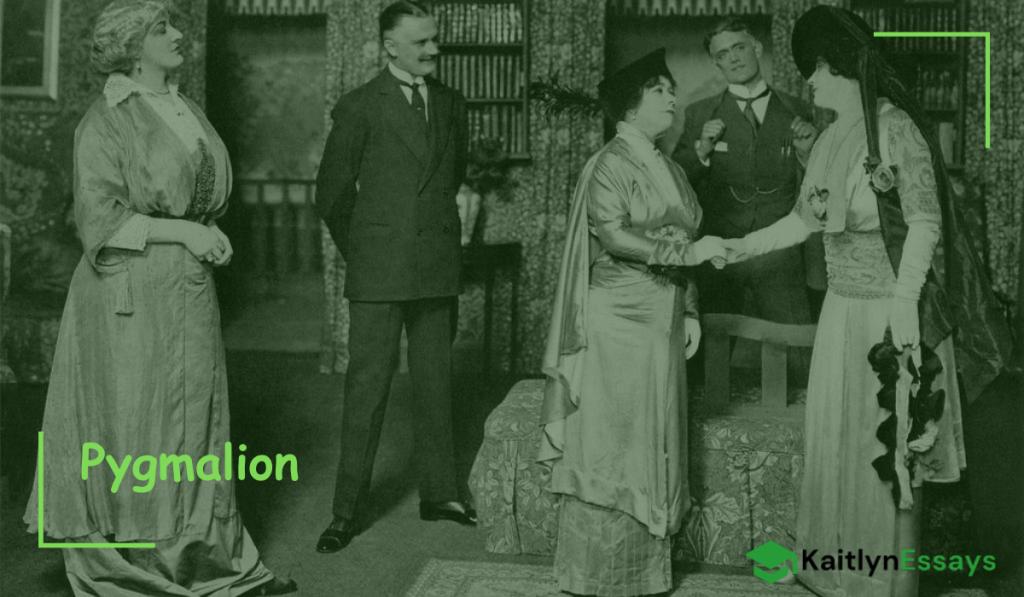
George Bernard Shaw’s “Pygmalion” is a classic play that continues to captivate audiences and readers alike. First performed in 1913, this witty and insightful work explores themes of social class, identity, and the power of language. The story follows phonetics professor Henry Higgins as he attempts to transform Eliza Doolittle, a Cockney flower girl, into a refined lady through speech lessons. Shaw’s brilliant dialogue and memorable characters bring to life the complexities of British society in the early 20th century.
This article will provide a comprehensive summary of the play’s plot, analyze its key themes and characters, literary devices, symbols and quotes to guide students and literature enthusiasts. Whether you’re studying “Pygmalion” for academic purposes or simply enjoying it as a timeless piece of theater, this exploration will enhance your understanding and appreciation of Shaw’s masterful work.
Summary
Act I: The Encounter The story begins outside Covent Garden, where Eliza Doolittle is selling flowers. A sudden rain shower forces people to seek shelter, including Professor Higgins, who is documenting the different dialects spoken around him. When he remarks on Eliza’s thick accent, she feels insulted and protests. This piques Higgins’s interest, and he boasts about his ability to transform anyone’s speech. Colonel Pickering, another phonetics enthusiast who coincidentally is in town to meet Higgins, is intrigued. Eliza, aspiring to improve her circumstances, decides to seek Higgins’s help to learn proper speech and manners.
To explore the surprising proposition Eliza makes to Higgins, more details are outlined: see more.
Act II: A Bet is Made The following day, Eliza arrives at Higgins’s laboratory, expressing her desire to take speech lessons. Higgins, although initially dismissive, is persuaded by Pickering, who bets that Higgins cannot transform Eliza into a duchess in six months. This wager sets the stage for Eliza’s rigorous training. Despite Higgins’s often harsh and condescending attitude, Eliza shows resilience and determination. She undergoes intense lessons in pronunciation, grammar, and etiquette, marking the beginning of her metamorphosis.
The dynamic between the characters evolves, showing the complexities of their relationships: continue reading.
Act III: A Test of Transformation After several months of hard work, Higgins decides to test Eliza’s progress by introducing her to high society. She attends a party at the home of Mrs. Higgins, Henry’s mother. The event becomes a pivotal moment, showcasing Eliza’s transformation and poise. However, the attendees, including Higgins’s former student, Nepommuck, who now works as a translator, suspect that she is not of noble birth. Nepommuck’s claim that Eliza must be a foreign princess, due to her peculiar pronunciation, amuses Higgins. It highlights the superficiality of societal judgments based on appearances and accents.
This social experiment raises questions about identity and authenticity, inviting further reflection: learn more.
Act IV: Crisis and Realization Back at Higgins’s home, the tension escalates. Despite her success, Eliza feels used and unappreciated. She confronts Higgins, accusing him of not caring for her feelings or future now that the experiment is over. Higgins is perplexed by her outburst, as he never considered her a permanent part of his life. Eliza’s realization that she has been a mere pawn in Higgins’s game of intellectual superiority causes a rift between them. She decides to leave, questioning her newfound identity and place in society.
Eliza’s confrontation with her mentor reveals the emotional stakes of her transformation: explore this scene.
Act V: Resolution and Independence The final act unfolds at Mrs. Higgins’s house, where Eliza has sought refuge. Higgins and Pickering arrive, concerned about Eliza’s whereabouts. In a heated exchange, Eliza asserts her independence, declaring that she will no longer be treated as a mere experiment. She reveals her intention to marry Freddy Eynsford-Hill, a young man smitten by her. Higgins, though initially dismissive, realizes that he has lost something precious in Eliza’s departure. Despite this, Eliza’s resolve to create her own path, free from Higgins’s control, remains firm.
The play concludes ambiguously, leaving the future of the characters open to interpretation: learn more about the ending.
Pygmalion: Characters
Eliza Doolittle
Eliza Doolittle is the heart of Pygmalion. She begins her journey as an impoverished flower girl with a strong Cockney accent, embodying the limitations imposed by her socio-economic status. However, Eliza is more than her circumstances; she possesses a fiery spirit and a deep desire for self-improvement. Her transformation under the guidance of Professor Higgins is not just superficial—her speech and manners may change, but so does her understanding of self-worth and identity.
Despite her initial eagerness to escape poverty, Eliza soon realizes that speaking like a duchess does not automatically earn her respect or happiness. Her struggle for self-respect and independence marks a significant departure from her initial portrayal, as she emerges as a strong, assertive woman, questioning the societal norms and the intentions of her so-called benefactors.
To explore the depths of Eliza’s evolution and her ultimate defiance of societal constraints, more details are provided: uncover more.
Professor Henry Higgins
Professor Henry Higgins, a renowned phonetics expert, is the creator of Eliza’s transformation. His character is modeled after the Greek myth of Pygmalion, the sculptor who fell in love with his own creation. However, unlike the myth, Higgins’s love is not romantic but intellectual. He is fascinated by the science of speech and views Eliza merely as a project—a subject for his experiment to prove his linguistic theories.
Higgins’s intellectual arrogance and lack of social graces often make him appear insensitive and callous, especially towards Eliza. He treats her as a ‘thing’ to be molded, failing to recognize her humanity. Throughout the play, Higgins remains largely unchanged, emphasizing Shaw’s critique of intellectual hubris and the dehumanizing effect of treating people as mere objects of study.
For a deeper examination of Higgins’s complex personality and his role in shaping Eliza’s fate, more insights are available: discover more.
Colonel Pickering
Colonel Pickering serves as a foil to Professor Higgins, embodying the qualities of kindness, respect, and decency that Higgins often lacks. A fellow phonetics enthusiast and a gentleman in the true sense of the word, Pickering’s role in Eliza’s transformation is crucial yet understated. He treats her with dignity from the very beginning, offering the financial support for her lessons and showing genuine concern for her well-being. Unlike Higgins, who sees the experiment as a testament to his expertise, Pickering is more interested in Eliza’s personal growth and happiness. His respectful demeanor significantly impacts Eliza’s development, as she learns what it truly means to be a lady—not just through her speech but through her treatment by others.
For a comprehensive analysis of Pickering’s influence on Eliza and his contrast with Higgins, further details are discussed: learn more.
Alfred Doolittle
Alfred Doolittle, Eliza’s father, is one of Shaw’s most intriguing characters, providing a sharp critique of middle-class morality. A dustman with a flair for the dramatic, Doolittle revels in his status as part of the “undeserving poor.” He openly rejects the traditional values of hard work and responsibility, preferring to live freely without the constraints of middle-class respectability. His unexpected inheritance, which forces him into the very lifestyle he despises, serves as a satire on the arbitrary nature of social class. Doolittle’s character is both comic and tragic—his newfound wealth strips him of his carefree life, leaving him trapped in the respectability he once scorned.
To learn more about Doolittle’s philosophical musings and the satirical role he plays in the narrative, more analysis is available: read further.
Mrs. Higgins
Mrs. Higgins, Henry’s mother, represents the voice of reason and compassion in the play. Unlike her son, she sees the potential consequences of transforming Eliza without considering her future. Her disapproval of Higgins’s experiment is not just about propriety but about her concern for Eliza’s well-being. Mrs. Higgins’s interactions with her son highlight her understanding of human nature and the ethical implications of his actions. She becomes a sanctuary for Eliza, offering her support and guidance when she feels lost and exploited by Higgins’s cold intellectualism. Mrs. Higgins’s empathy and wisdom provide a much-needed moral counterpoint to the other characters’ more selfish pursuits.
For a more nuanced understanding of Mrs. Higgins’s role and her influence on the story, further reading is available: explore more.
Freddy Eynsford-Hill
Freddy Eynsford-Hill is a young, idealistic man from an upper-class but financially troubled family. His infatuation with Eliza is immediate and genuine, yet his character is often seen as superficial compared to the other, more complex figures in the play. Freddy’s love for Eliza, while sincere, is somewhat naïve, as he remains oblivious to the societal implications of her transformation and the challenges she faces. He represents a romantic ideal that contrasts sharply with the more pragmatic perspectives of Higgins and Pickering. Freddy’s earnestness provides Eliza with a glimpse of genuine affection, albeit from a man who lacks the depth and understanding of her struggles.
To explore Freddy’s role as a romantic foil and his significance in Eliza’s journey, additional analysis is provided: continue reading.
Mrs. Pearce
Mrs. Pearce, Higgins’s housekeeper, is a minor but significant character. She is the voice of practical reason within Higgins’s household, often expressing concern over the ethics of his experiment. Mrs. Pearce’s warnings about Eliza’s welfare and her insistence on proper behavior highlight the moral implications of Higgins’s actions. While her role is largely functional, representing the everyday practicality that the other characters often overlook, Mrs. Pearce’s concern for Eliza’s future and her skepticism of Higgins’s intentions add a layer of depth to the play’s exploration of social responsibility.
For a deeper look into Mrs. Pearce’s pragmatic influence and her ethical stance, further details are explored: learn more.
Nepommuck
Nepommuck, a minor character in the play, is a former student of Higgins who now works as a translator. He is introduced during the party at Mrs. Higgins’s home, where he showcases his linguistic skills by identifying people’s nationalities through their accents. His encounter with Eliza is significant as he wrongly concludes that she is a foreign princess, revealing the absurdity and limitations of judging people solely by their speech. Nepommuck’s character serves as a comedic critique of the superficiality inherent in society’s obsession with appearances and language, underscoring Shaw’s larger commentary on identity and class.
For a further analysis of Nepommuck’s role and his symbolic significance in the play, additional insights are provided: discover more.
Clara Eynsford-Hill
Clara Eynsford-Hill, Freddy’s sister, is depicted as a young woman struggling to maintain her social status despite her family’s financial decline. Her fascination with middle-class manners and her disdain for the “lower” classes reflect the societal pretensions and snobbery that Shaw critiques throughout the play. Clara’s character is relatively minor but serves as a representation of the superficial aspirations that pervade the social structure. Her interactions with Eliza and her enthusiasm for her brother’s pursuit of the transformed flower girl highlight her desire to align herself with the perceived refinement and upward mobility Eliza represents.
For a more detailed exploration of Clara’s character and her role in the social dynamics of the play, further analysis is available: explore further.
Themes in Pygmalion
The Theme of Transformation and Identity
One of the most prominent themes in Pygmalion is transformation. The play’s title refers to the myth of Pygmalion, the sculptor who falls in love with a statue he carves, which then comes to life. In Shaw’s adaptation, Professor Henry Higgins plays the role of Pygmalion, attempting to sculpt Eliza Doolittle into his ideal of a refined lady. However, the play questions the true nature of transformation.
Is it merely a change in external appearance and behavior, or does it involve a deeper alteration of one’s identity? Eliza’s journey highlights the tension between external transformation and internal identity. Despite learning to speak and behave like a duchess, she struggles to reconcile her new identity with her true self. The play suggests that true transformation is not about changing one’s outward appearance but finding one’s inner worth and self-respect.
To explore how Eliza grapples with her identity and the limitations of societal transformation, more insights are available: discover further.
Class and Social Mobility
Class is a central theme in Pygmalion. Shaw critiques the rigid class structure of his time, using Eliza’s transformation as a way to challenge the idea that one’s worth is tied to their social standing. Through her metamorphosis, Shaw exposes the superficiality of class distinctions, suggesting that the markers of social status—such as speech and manners—are arbitrary and can be learned. However, while Eliza can mimic the behavior and speech of the upper class, she remains fundamentally unchanged in the eyes of society. This theme raises questions about the nature of social mobility and the extent to which one can truly escape their class origins.
For a deeper understanding of how Shaw critiques the class system and explores the limitations of social mobility, further analysis is provided: explore more.
The Power Dynamics in Relationships
Pygmalion also explores the power dynamics inherent in relationships, particularly between men and women, and between teacher and student. The relationship between Higgins and Eliza is central to this theme. While Higgins sees himself as the creator, molding Eliza into a refined lady, he fails to recognize her autonomy and humanity. His authoritarian approach reflects the power imbalance, as he often disregards Eliza’s feelings and desires. The play critiques this dynamic, particularly as Eliza grows to assert her independence and rejects the control exerted over her. The power struggle between them underscores the broader theme of individual agency and the right to self-determination.
To delve deeper into how Shaw portrays the complexities of power and control in relationships, additional details are discussed: learn more.
Language and Communication
Language is a key theme in Pygmalion, serving as both a tool for transformation and a marker of social identity. Shaw explores how language shapes our perceptions of others and ourselves. Eliza’s training in phonetics is not just about learning to speak properly; it is about navigating the social world. However, the play reveals the limitations of language as a true measure of worth. While Eliza learns to speak like a lady, this does not change her innate qualities or the way she is perceived by those who know her past. Shaw suggests that language, while powerful, cannot fully encapsulate a person’s identity or worth.
For a comprehensive look at the role of language in the play and its implications on identity and society, further reading is available: read more.
Gender Roles and Feminism
Pygmalion is often viewed through a feminist lens, as it addresses the theme of gender roles and the limitations placed on women by society. Eliza’s transformation can be seen as a rebellion against the limited roles available to women of her class. Throughout the play, she struggles to assert her independence in a male-dominated world. Higgins’s dismissive and often patronizing treatment of her highlights the gendered power dynamics at play. However, Eliza’s ultimate rejection of both Higgins and societal expectations serves as a powerful statement of self-assertion and autonomy. The play thus critiques the rigid gender roles of its time and advocates for the empowerment of women.
To explore how Shaw challenges traditional gender roles and presents a proto-feminist perspective, more analysis is provided: explore further.
The Illusion of Free Will
The theme of free will is subtly woven into the narrative of Pygmalion. Eliza’s decision to seek Higgins’s help appears to be an act of free will, but it is driven by her desire to escape her socioeconomic constraints. Similarly, while Higgins’s actions seem driven by scientific curiosity, they reveal his desire for control and dominance. The play questions the extent to which characters are truly free to make their own choices, or if they are simply products of societal and personal forces beyond their control. This theme is particularly evident in the ending, where Eliza must decide her future, challenging both Higgins’s authority and societal expectations.
For an in-depth exploration of the theme of free will and its implications for the characters, further insights are available: learn more.
The Satire of Social Hypocrisy
Shaw’s Pygmalion is a sharp satire of the social hypocrisy that values appearances over genuine worth. Through characters like Alfred Doolittle, Shaw critiques the absurdity of middle-class morality, which he sees as shallow and pretentious. Doolittle’s sudden rise to wealth and his transformation into a “respectable” man highlight the arbitrary nature of societal values. Similarly, the superficial judgments based on Eliza’s speech and manners reveal the hollow nature of social respectability. Shaw’s satire is not just directed at the upper classes but at the entire societal structure that perpetuates these illusions.
To learn more about Shaw’s satirical critique of society and its values, further analysis is discussed: discover more.
The Limitations of Education
Education is another prominent theme in Pygmalion, particularly in terms of its transformative potential and limitations. While Higgins’s teaching enables Eliza to change her social identity, it also highlights the limitations of education as a tool for personal empowerment. Education alone cannot change the inherent prejudices of society or erase Eliza’s past. Shaw suggests that true education should be holistic, encompassing not just academic or technical knowledge but also moral and ethical understanding. Higgins’s failure to understand this broader view of education is one of his key flaws.
For a comprehensive look at how Shaw portrays the complexities of education and its limitations, further details are explored: learn more.
Self-Realization and Independence
Eliza’s journey in Pygmalion is ultimately about self-realization and independence. While the play begins with her seeking transformation under Higgins’s guidance, it ends with her asserting her independence and rejecting the role he has cast for her. Eliza’s final decision to leave Higgins and carve out her own path symbolizes her growth from a passive participant in her own life to an active agent of her destiny. This theme of self-realization is central to Shaw’s message: true transformation comes not from external changes but from an internal awakening and the courage to assert one’s own identity.
For a deeper understanding of Eliza’s journey toward self-realization and independence, additional insights are provided: discover more.
The Search for Respect and Dignity
Throughout Pygmalion, characters grapple with the concept of respect and dignity, both self-earned and bestowed by others. Eliza’s struggle is not just for external validation but for self-respect. She seeks to be treated with dignity, not just because she has learned to speak properly, but because she is a human being worthy of respect. Her journey reflects the broader human desire for recognition and self-worth, a theme that resonates with audiences beyond the play’s specific social context.
For an in-depth exploration of the theme of respect and dignity in the play, further analysis is available: learn more.
Symbolism in Pygmalion
The Flower Shop
The flower shop, or more specifically, the act of selling flowers, symbolizes Eliza Doolittle’s initial social status and her aspirations for a better life. At the beginning of the play, Eliza sells flowers on the street, a job that signifies her place in the lower class. Her flowers are simple and accessible, representing both her poverty and her desire to rise above her circumstances. When she decides to seek phonetic lessons from Professor Higgins, she sees language as a way to transform herself, much like she hopes to transform her modest business into something more respectable. The flower shop symbolizes both the limitations imposed by her socio-economic status and her determination to transcend them.
To learn more about how the flower shop symbolizes Eliza’s social constraints and aspirations, further insights are available: explore further.
The Looking Glass
The looking glass, or mirror, is a potent symbol of self-perception and transformation in Pygmalion. Throughout the play, the mirror reflects Eliza’s changing identity as she transitions from a poor flower girl to a refined lady. The mirror scenes symbolize self-examination and the duality of Eliza’s transformation—while she may appear different on the outside, the reflection often serves as a reminder of her true self and origins. It represents the conflict between appearance and reality, emphasizing the superficial nature of her transformation. Shaw uses the mirror to illustrate the struggle between Eliza’s external change and her internal sense of self.
For a deeper look into how the mirror symbolizes Eliza’s internal conflict and transformation, more details are discussed: discover more.
Clothing and Costumes
Clothing and costumes in Pygmalion serve as symbols of identity and class. Throughout the play, Eliza’s transformation is marked by her changing wardrobe—from the tattered clothes of a flower girl to the elegant dresses of a lady. This transformation in appearance signifies her changing social status and the superficial nature of societal judgment based on looks. However, despite her new attire, Eliza struggles with the perception others have of her and her own self-worth. The costumes are thus symbolic of the thin veneer of respectability and the performative aspects of class. They highlight Shaw’s critique of the superficial markers of social standing and the limitations they impose on individual identity.
To explore how clothing symbolizes the fluidity and constraints of social identity, further analysis is provided: learn more.
The Phonograph and Recording Devices
The phonograph and recording devices used by Professor Higgins are symbolic of his scientific approach to language and his detachment from human emotion. These tools are a testament to his obsession with phonetics and his desire to control and dissect the human voice, reducing it to mere sounds devoid of context. For Higgins, these devices represent the power to transform, manipulate, and control speech, but they also signify his inability to see beyond the mechanical aspects of human interaction. The use of these recording devices symbolizes the dehumanizing nature of his experiment, as he treats Eliza more like an object of study than a living person with emotions and desires.
For a comprehensive look at how the phonograph symbolizes control and dehumanization, additional details are discussed: discover further.
The Rainstorm
The rainstorm at the beginning of the play serves as a symbolic cleansing and a precursor to change. Eliza’s encounter with Higgins and Pickering in the rain marks the beginning of her transformative journey. The rain can be seen as a metaphor for the washing away of her old life, setting the stage for her metamorphosis. It also symbolizes the unpredictable nature of life and the sudden opportunities and challenges that can arise. Just as rain brings nourishment and growth, it foreshadows the growth and development that Eliza will experience under Higgins’s tutelage, despite the challenges she faces.
To explore how the rainstorm sets the stage for Eliza’s transformation and its symbolic meaning, further insights are available: learn more.
The Phonetics Laboratory
Professor Higgins’s phonetics laboratory is more than just a setting; it symbolizes the intellectual and emotional coldness of his character and the sterile, scientific approach he takes toward human beings. The laboratory, filled with tools and instruments for analyzing speech, represents the mechanical and detached way Higgins views language and, by extension, people. It contrasts sharply with the warmth and vibrancy of Eliza’s character, emphasizing the conflict between human emotion and scientific objectivity. The laboratory serves as a metaphor for the limitations of viewing people solely through the lens of science and experimentation.
For a deeper understanding of how the phonetics laboratory symbolizes Higgins’s detachment and the limits of scientific inquiry, more analysis is provided: read further.
The Wimpole Street House
Higgins’s house on Wimpole Street represents the world of the upper class and the intellectual elite, a world that Eliza aspires to enter but ultimately finds alienating. The house is symbolic of the societal structures that enforce class boundaries and the cold, impersonal nature of the upper-class lifestyle. While it offers Eliza the comfort and security she never had, it also imposes a new kind of confinement. The house, with its grandeur and formality, serves as a physical manifestation of the rigid societal expectations that Eliza must navigate. It contrasts with the vibrancy and freedom of her previous life, underscoring the cost of her transformation.
To explore how the Wimpole Street house symbolizes the allure and constraints of upper-class life, additional insights are discussed: explore more.
Eliza’s Departure
Eliza’s final departure from Higgins’s house is laden with symbolic meaning. It represents her rejection of the role imposed on her and her assertion of independence. The act of leaving signifies her realization that true self-respect and dignity cannot be bestowed by another but must come from within. This moment symbolizes her emancipation from the control of Higgins and society’s expectations. It is a powerful statement of self-liberation, as Eliza takes control of her destiny, rejecting the objectification and manipulation she has endured.
For a comprehensive exploration of the symbolic significance of Eliza’s departure, further analysis is provided: discover further.
The Role of Speech and Language
In Pygmalion, speech and language function as symbols of power and social status. The way a person speaks can dictate their place in society, as demonstrated by Higgins’s ability to “transform” Eliza into a lady simply by changing her accent. This symbolizes the arbitrary nature of social distinctions and the superficiality of societal judgments based on speech. However, while language can serve as a tool for social mobility, it also becomes a symbol of the limitations and constraints imposed by society. Despite her mastery of “proper” speech, Eliza finds herself trapped in a new identity that she struggles to reconcile with her sense of self.
To delve deeper into the symbolism of language and its impact on identity, further details are discussed: explore more.
The Social Experiment
The entire plot of Pygmalion can be seen as a symbolic social experiment, with Higgins playing the role of the experimenter and Eliza as his subject. This setup symbolizes the broader societal experiment of trying to transform individuals through external changes like education and mannerisms. Shaw uses this symbolism to critique the notion that social reform can be achieved purely through superficial changes. The experiment serves as a metaphor for the artificiality of societal constructs and the dangers of treating people as mere objects of study.
For a comprehensive analysis of the symbolic implications of the social experiment in Pygmalion, further insights are available: discover further.
Literary Devices in Pygmalion
Irony
Irony is a pervasive literary device in Pygmalion. Shaw uses it to highlight the contradictions and hypocrisies of society. One of the most striking instances of irony is found in Professor Higgins’s character. Despite his impressive knowledge of language and his ability to transform Eliza into a “lady,” Higgins himself is uncouth, insensitive, and often displays a lack of the very refinement he imposes on others. This situational irony not only underscores the theme of superficiality but also satirizes the notion that true refinement is merely a matter of speech and manners.
To explore more instances of irony in the play and its impact on character development, further insights are available: discover further.
Satire
Satire is a powerful tool in Shaw’s Pygmalion, used to critique the rigid class structures and superficial social values of Edwardian society. Through exaggerated characters like Alfred Doolittle and situations such as Eliza’s transformation, Shaw exposes the absurdity of social pretensions and the arbitrary nature of class distinctions. Doolittle’s sudden rise to the middle class and his discomfort with the “morality” imposed on him satirize the middle-class obsession with respectability and highlight the hypocrisy inherent in societal norms.
For a deeper look into how Shaw uses satire to critique social conventions, additional details are discussed: explore more.
Symbolism
Shaw employs symbolism throughout Pygmalion to add depth to the characters and themes. Objects such as the mirror, the phonograph, and even the flowers Eliza sells are symbolic of the characters’ internal struggles and societal constraints. The mirror, for instance, symbolizes self-perception and the conflict between external transformation and internal identity. The phonograph represents Higgins’s scientific detachment and his tendency to view people as mere subjects of study rather than as individuals with emotions and desires.
For a comprehensive analysis of symbolism in Pygmalion and its thematic implications, further insights are available: read more.
Foreshadowing
Shaw uses foreshadowing to hint at future developments in the narrative and to build anticipation. An example of this is Eliza’s statement early in the play that she would like to become a lady. This seemingly naive aspiration foreshadows her transformation under Higgins’s tutelage. Additionally, Higgins’s assertion that he can pass Eliza off as a duchess foreshadows the dramatic success of her transformation and the ensuing complications that challenge both their expectations.
To delve deeper into instances of foreshadowing and their significance in the play, further analysis is discussed: explore more.
Dialogue and Wit
Shaw’s Pygmalion is renowned for its sharp, witty dialogue, which not only entertains but also serves to reveal character traits and social commentary. Higgins’s rapid, often cutting speech contrasts with Eliza’s initially coarse but earnest attempts to improve her language. Shaw uses witty dialogue to satirize social pretensions and to highlight the absurdities of his characters’ behavior. The verbal exchanges between Higgins and Eliza are particularly effective in showcasing their evolving relationship and the power dynamics between them.
To explore the role of dialogue and wit in character development and social critique, further insights are provided: discover more.
Allusion
Shaw makes several allusions to classical mythology, particularly in the play’s title, Pygmalion. The play’s title refers to the Greek myth of Pygmalion, a sculptor who falls in love with a statue he has carved, which then comes to life. This allusion parallels the relationship between Higgins and Eliza, as Higgins attempts to “sculpt” Eliza into his ideal of a refined lady. However, Shaw subverts the myth by giving Eliza agency and independence, thus challenging the traditional narrative of male dominance and control.
For a deeper exploration of classical allusions in the play and their impact on its themes, additional details are available: explore more.
Characterization
Shaw’s use of characterization is a key literary device in Pygmalion. Each character represents a particular social type or idea, serving as a vehicle for Shaw’s critique of society. Higgins, the brilliant but insensitive phonetics professor, embodies the intellectual elite’s detachment from human emotion. Eliza, on the other hand, represents the transformative potential of education and the struggle for self-realization. Characters like Alfred Doolittle are used to satirize the so-called “undeserving poor” and to expose the hypocrisy of middle-class morality.
To explore how Shaw’s use of characterization enhances the play’s themes and social commentary, further analysis is provided: learn more.
Hyperbole
Hyperbole, or deliberate exaggeration, is used throughout Pygmalion for comedic effect and to underscore the absurdity of certain social norms. For instance, Higgins’s boastful claims about his ability to transform Eliza into a duchess in a mere six months are exaggerated to highlight his hubris and the ridiculousness of judging people solely by their speech and manners. Similarly, Alfred Doolittle’s exaggerated complaints about the “undesirable” aspects of becoming wealthy satirize the contradictory attitudes toward class mobility.
For a deeper understanding of how hyperbole is used to enhance humor and social critique in the play, more insights are discussed: discover more.
Juxtaposition
Shaw uses juxtaposition to contrast characters and ideas, highlighting the absurdities and contradictions within society. The juxtaposition of Eliza’s coarse, lower-class speech with Higgins’s refined diction emphasizes the superficial nature of social distinctions. The pairing of Eliza and Higgins as teacher and student, and later as adversaries, serves to contrast their differing views on identity and respect. This device is also evident in the contrast between the lifestyles of Alfred Doolittle and the middle-class characters, exposing the inconsistencies and hypocrisies of societal values.
For a detailed analysis of how juxtaposition is used to highlight social contradictions, further exploration is available: explore further.
Metaphor
Metaphor is another significant literary device in Pygmalion. The central metaphor of the play, the transformation of Eliza from a flower girl to a lady, serves as a commentary on the power of education and the limitations of superficial change. Higgins’s laboratory is metaphorically depicted as a place of transformation, much like Pygmalion’s studio in the original myth. However, the metaphor extends beyond the physical transformation to include themes of personal growth and the struggle for self-definition. Shaw uses metaphors to deepen the audience’s understanding of the characters’ psychological and social journeys.
To explore how Shaw uses metaphor to enrich the narrative and underscore thematic elements, further insights are discussed: read more.
Repetition
Shaw employs repetition, particularly in the dialogue, to emphasize key ideas and to highlight the stubbornness or obsession of certain characters. For example, Higgins frequently repeats his disdain for society’s superficial judgments based on appearance and speech, underscoring his belief in the importance of individuality and intellect over social conventions. Eliza’s repeated assertions of her right to be treated with dignity and respect serve to reinforce her growing sense of self-worth and independence.
For a closer look at how repetition is used to emphasize key themes and character traits, additional details are provided: explore further.
Quotes in Pygmalion
“The moment I let you sit down in that chair and talk to me as if we were equals, you presume to give yourself airs.” — Henry Higgins
This quote from Professor Henry Higgins occurs during a heated confrontation with Eliza Doolittle. It reveals Higgins’s perception of social hierarchy and his belief in his own superiority. Despite his efforts to transform Eliza into a “lady,” he cannot see her as an equal. This statement exposes the hypocrisy in his character: while he preaches the irrelevance of social class, he himself cannot transcend those boundaries in his personal interactions. It underscores the theme of identity and the limitations of external transformation.
To explore how this quote highlights Higgins’s contradictions and the play’s critique of social hierarchy, further insights are available: discover more.
“I am a common ignorant girl, and in my station I have to be respectable.” — Eliza Doolittle
Eliza utters this line as she expresses her frustration with Higgins and her predicament. This quote reveals her awareness of the societal expectations placed upon her because of her class. While she may lack formal education, she possesses a keen sense of dignity and self-respect. This statement contrasts with the superficial values of the upper class, who often lack the very respectability they demand of others. Eliza’s words highlight the play’s exploration of class distinctions and the true nature of respectability.
For a deeper look at how this quote encapsulates Eliza’s struggle with societal expectations, more details are provided: explore more.
“The great secret, Eliza, is not having bad manners or good manners or any other particular sort of manners, but having the same manner for all human souls.” — Colonel Pickering
Colonel Pickering’s words to Eliza reflect his genuine respect for others, regardless of their social status. This quote encapsulates Pickering’s contrasting attitude to Higgins’s more arrogant and dismissive demeanor. It also serves as a critique of the superficiality of societal norms and underscores one of the central themes of the play: true respect and human dignity cannot be measured by external manners or social position, but by the equality of treatment extended to everyone.
To explore how this quote highlights the contrasting philosophies of Pickering and Higgins, additional insights are available: read more.
“The difference between a lady and a flower girl is not how she behaves, but how she is treated.” — Eliza Doolittle
Eliza delivers this powerful line during a confrontation with Higgins, encapsulating the central theme of identity and self-worth. Her statement challenges the notion that one’s social status is determined by behavior alone. Instead, she argues that it is the perception and treatment by others that truly define one’s place in society. This quote is pivotal in her assertion of self-respect and her demand to be recognized as an individual, not just a product of Higgins’s experiment.
For a deeper analysis of how this quote encapsulates Eliza’s struggle for identity and recognition, further exploration is available: discover more.
“I sold flowers. I didn’t sell myself. Now you’ve made a lady of me I’m not fit to sell anything else.” — Eliza Doolittle
This quote, spoken by Eliza to Higgins, highlights the paradox of her transformation. While Higgins has succeeded in changing her outward appearance and speech, he has also stripped her of her former sense of purpose and identity. This line underscores the play’s critique of superficial change and the emotional cost of such transformation. Eliza’s statement reveals her realization that her newfound status has come at the expense of her independence and self-worth.
To delve deeper into how this quote reflects the emotional consequences of Eliza’s transformation, further analysis is available: learn more.
“I have created this thing out of the squashed cabbage leaves of Covent Garden; and now she pretends to play the fine lady with me.” — Henry Higgins
Higgins’s frustration with Eliza is evident in this quote. His reference to “squashed cabbage leaves” emphasizes his view of Eliza’s humble origins and his role in her transformation. However, this line also reveals his possessive and patronizing attitude. He sees Eliza as his creation, dismissing her agency and the effort she has put into her transformation. This quote encapsulates the play’s exploration of power dynamics and the limits of Higgins’s understanding of human transformation.
For a deeper look at how this quote reveals Higgins’s character and the complexities of his relationship with Eliza, more insights are discussed: read more.
“I have to live for others and not for myself: that’s middle class morality.” — Alfred Doolittle
Alfred Doolittle’s lament about “middle class morality” is both humorous and insightful. This quote captures his discomfort with the expectations imposed upon him after his unexpected rise to wealth. He satirizes the notion of middle-class respectability, suggesting that it is a burden that forces individuals to live according to societal expectations rather than their own desires. Shaw uses Doolittle’s character and this quote to critique the hypocrisy and constraints of middle-class values.
To explore how this quote reflects Shaw’s satire of middle-class values and societal expectations, further insights are provided: explore further.
“You see, we’re all savages, more or less. We’re supposed to be civilized and cultured—to know all about poetry and philosophy and art and science, and so on; but how many of us know even the meanings of these names?” — Henry Higgins
Higgins’s observation about the superficiality of civilization is a scathing critique of society’s pretensions. This quote highlights the gap between outward appearances and true understanding. While people may adopt the trappings of culture and refinement, Higgins argues that many lack genuine knowledge or appreciation of these pursuits. His cynicism reflects Shaw’s own skepticism about the nature of societal progress and the hollowness of cultural pretensions.
For a deeper analysis of how this quote encapsulates Shaw’s critique of society and culture, additional insights are discussed: learn more.
“What is life but a series of inspired follies?” — Henry Higgins
This line from Higgins reflects his unconventional approach to life and his belief in the power of taking risks and embracing spontaneity. It captures his adventurous spirit and his disdain for societal norms and constraints. However, it also highlights the danger of his reckless disregard for the consequences of his actions on others, particularly Eliza. This quote encapsulates the tension between freedom and responsibility that runs throughout the play.
To delve deeper into how this quote reflects Higgins’s character and the play’s exploration of risk and consequence, further details are available: discover more.
“You certainly are a pair of babies, playing with your live doll.” — Mrs. Higgins
Mrs. Higgins’s sharp rebuke to her son and Colonel Pickering exposes the ethical implications of their experiment with Eliza. Her use of the term “live doll” emphasizes their objectification of Eliza, treating her as a mere subject of their experiment rather than a human being with emotions and agency. This quote serves as a moral indictment of Higgins and Pickering’s behavior, highlighting the dehumanizing aspects of their actions.
For a closer look at how this quote serves as a moral critique of Higgins and Pickering’s treatment of Eliza, further analysis is provided: read more.
The Pygmalion Effect, the Pygmalion and Galatea Relationship, and the Pygmalion Myth
The concept of the Pygmalion Effect, the narrative of Pygmalion and Galatea, and the ancient myth of Pygmalion all revolve around the power of expectations, transformation, and the intricate interplay between creator and creation. These interconnected themes have profound implications in psychology, literature, and mythology.
The Pygmalion Effect
The Pygmalion Effect, also known as the Rosenthal Effect, is a psychological phenomenon where higher expectations from others lead to improved performance in individuals. This concept is rooted in the idea that people’s performance is influenced not just by their own abilities but by the expectations placed upon them by those around them. The term derives its name from the Greek myth of Pygmalion, where the sculptor’s belief in his creation’s beauty and life brought it to reality.
Origins and Definition
The Pygmalion Effect was first identified by psychologist Robert Rosenthal and elementary school principal Lenore Jacobson in their groundbreaking 1968 study. They conducted an experiment in which they informed teachers that certain students were likely to show significant academic improvement based on fabricated test results. At the end of the school year, the students who had been singled out for “potential” growth did indeed show greater academic gains than their peers. This finding suggested that the teachers’ expectations had influenced the students’ performance.
The Pygmalion Effect can be understood as a self-fulfilling prophecy, where beliefs about an individual’s capabilities become reality due to changes in behavior and communication. When people are treated as if they are capable and intelligent, they are more likely to act in ways that validate those expectations. Conversely, low expectations can lead to poorer performance, as individuals may internalize and act in accordance with those negative beliefs.
Applications in Education and the Workplace
In education, the Pygmalion Effect has been extensively studied to understand the impact of teacher expectations on student performance. When teachers believe in their students’ abilities and potential, they tend to provide more encouragement, engage more meaningfully, and offer more opportunities for students to succeed. This positive reinforcement can significantly enhance student outcomes, particularly for those who might otherwise struggle academically.
In the workplace, the Pygmalion Effect also plays a crucial role. Managers and leaders who have high expectations for their employees tend to foster a more productive and motivated workforce. Employees who are perceived as high achievers often receive more support, challenging assignments, and positive feedback, which in turn boosts their performance and confidence. This phenomenon emphasizes the importance of leadership style and the power of positive reinforcement in organizational success.
Limitations and Criticisms
While the Pygmalion Effect highlights the power of expectations, it is not without its limitations and criticisms. One major critique is that the effect may not be universally applicable across all individuals or settings. For instance, overly high expectations can sometimes lead to undue pressure, anxiety, and burnout, especially if the individual lacks the resources or support to meet those expectations.
Moreover, the effect is influenced by various factors such as the individual’s self-concept, cultural background, and prior experiences. It is important to recognize that while expectations can shape behavior, they are not the sole determinant of an individual’s performance. External circumstances, personal motivation, and innate abilities also play significant roles.
Pygmalion and Galatea
The story of Pygmalion and Galatea is a narrative that explores the dynamics between creator and creation, love, and transformation. It has been interpreted and reinterpreted across different cultures and time periods, often serving as a metaphor for various aspects of human experience.
The Mythological Background
In Greek mythology, Pygmalion was a sculptor from Cyprus who, disillusioned by the flaws he perceived in women, decided to remain unmarried. Instead, he channeled his passion into creating a perfect ivory statue of a woman, whom he named Galatea. So exquisite was the statue that Pygmalion fell deeply in love with it, treating it as though it were a living being.
During the festival of Aphrodite, the goddess of love, Pygmalion prayed for a wife as perfect as his statue. Moved by his devotion, Aphrodite granted his wish, bringing the statue to life. Pygmalion and the now-living Galatea married and lived happily ever after. This myth is a testament to the transformative power of love and belief, as well as the complexities of human desire and creativity.
Symbolic Interpretations
The story of Pygmalion and Galatea has been interpreted in numerous ways, each highlighting different aspects of the human condition. One common interpretation is that it represents the idea of idealized love and the dangers of seeking perfection. Pygmalion’s creation of Galatea reflects his desire for an ideal that does not exist in the real world, and his infatuation with the statue suggests a form of narcissistic love, where he is enamored with his own creation rather than another person.
Another interpretation focuses on the theme of transformation and creation. The myth can be seen as a metaphor for the artist’s creative process, where the act of creation is intertwined with personal investment and emotional attachment. Galatea’s transformation from inanimate object to living being can also symbolize the transformative potential of art and imagination.
The Pygmalion-Galatea Relationship in Literature and Art
The Pygmalion and Galatea narrative has inspired countless works of literature, art, and theater. One of the most famous adaptations is George Bernard Shaw’s play Pygmalion, where Professor Henry Higgins transforms the flower girl Eliza Doolittle into a refined lady. Shaw’s version, however, adds complexity by questioning the ethics of such transformation and the autonomy of the “creation.”
In visual art, the story has been depicted by artists like Jean-Léon Gérôme and François Boucher, who capture the moment of Galatea’s transformation with exquisite detail and emotion. These artistic interpretations emphasize the tension between reality and idealism, creator and creation, and the human desire to transcend limitations through art and love.
The Pygmalion Myth
The Pygmalion myth, as recounted in Ovid’s Metamorphoses, is one of the most enduring stories from ancient mythology, resonating with audiences for centuries due to its themes of transformation, idealism, and the power of belief. The myth has transcended its original context to become a powerful metaphor in psychology, literature, and popular culture.
Ovid’s Version of the Myth
In Ovid’s Metamorphoses, Pygmalion is portrayed as a gifted sculptor who, repelled by the immoral behavior of the women around him, decides to dedicate himself to his art. He creates a statue of a woman so beautiful and perfect that he falls in love with it, naming her Galatea. Pygmalion’s obsession with the statue is evident as he dresses it, adorns it with jewels, and even places it in his bed, treating it as though it were alive.
During the festival of Aphrodite, Pygmalion prays to the goddess for a wife like his statue. Touched by his sincere plea, Aphrodite brings the statue to life. Pygmalion marries Galatea, and they have a child named Paphos. The myth highlights themes of creation, desire, and the power of the divine to transform dreams into reality.
Thematic Significance
The Pygmalion myth explores the relationship between creator and creation, highlighting the human desire to shape and control one’s environment. Pygmalion’s attempt to create the perfect woman can be seen as a reflection of the pursuit of idealism, as well as the limitations and dangers of such endeavors. The myth also delves into the theme of transformation, both literal and metaphorical, as Galatea moves from being an object of art to a living, breathing human being.
The story raises questions about the nature of love and objectification. Is Pygmalion truly in love with Galatea, or is he in love with the idea of perfection she represents? The myth suggests that creation is inherently tied to the creator’s desires and projections, making true autonomy for the creation almost impossible.
Modern Adaptations and Interpretations
The Pygmalion myth has been adapted and reimagined in various forms, each bringing a unique perspective to the story. George Bernard Shaw’s Pygmalion is perhaps the most well-known adaptation, where the focus shifts from romantic love to social critique. Shaw’s play questions the ethical implications of transformation and the power dynamics between the creator (Higgins) and the creation (Eliza).
In cinema, the story has inspired films like My Fair Lady, which, while more lighthearted, still explores themes of transformation and identity. The Pygmalion myth also finds echoes in modern discussions of artificial intelligence and robotics, where the line between creator and creation becomes increasingly blurred.
Interconnections Between the Pygmalion Effect, Pygmalion and Galatea, and the Pygmalion Myth
The Pygmalion Effect, the relationship between Pygmalion and Galatea, and the original Pygmalion myth are all linked by the central theme of transformation through belief and expectation. In the psychological context, the Pygmalion Effect demonstrates how expectations can shape reality, much like how Pygmalion’s belief in the beauty and life of his creation brought Galatea to life.
The narrative of Pygmalion and Galatea highlights the power dynamics between creator and creation, a theme that resonates in educational and organizational settings where authority figures wield significant influence over others’ development. The Pygmalion myth itself, with its emphasis on the artist’s desire to create and the transformative power of love and belief, serves as a powerful metaphor for the creative process and the human need to shape and control one’s reality.
FAQs
What is the significance of the title “Pygmalion”?
The title refers to a Greek myth in which a sculptor named Pygmalion falls in love with a statue he has created. In Shaw’s play, Professor Higgins is seen as a modern Pygmalion who ‘sculpts’ Eliza into a new person through his teachings.
Is “Pygmalion” the basis for the musical “My Fair Lady”?
Yes, the play was adapted into the musical My Fair Lady by Alan Jay Lerner and Frederick Loewe in 1956. The musical closely follows the plot of the play but adds musical numbers and some changes to the ending.
Why did Shaw write “Pygmalion”?
Shaw wrote the play to critique and satirize the British class system and the superficiality of social distinctions. He also wanted to explore the role of language in shaping identity and societal perceptions.
How has “Pygmalion” been received historically?
Pygmalion has been well-received for its witty dialogue, social critique, and memorable characters. It has been praised for challenging societal norms and remains a popular and influential work in literature and theater.