


Peer review is a valuable practice in academic settings, allowing students to give and receive constructive feedback that improves the quality of their work. By evaluating each other’s assignments, students develop critical thinking skills, learn to identify strengths and weaknesses, and gain fresh perspectives on their writing or projects. Effective peer feedback not only helps improve grades but also fosters collaboration and communication within the classroom.
Understanding how to provide clear, respectful, and actionable comments is essential for making the process beneficial for everyone involved. This article will present practical examples of academic student peer review feedback, showing different ways to address issues such as clarity, structure, argument strength, and use of evidence. Whether you are new to peer reviewing or looking to refine your feedback skills, these examples will guide you in offering comments that are both encouraging and helpful for academic growth.
Purpose of Peer Review Feedback
Primary Educational Purposes
Enhances Learning Through Active Engagement Peer review transforms students from passive recipients to active participants in the learning process. When students evaluate others’ work, they must apply course concepts and criteria, deepening their understanding of the subject matter.
Develops Critical Thinking Skills Students learn to analyze, evaluate, and synthesize information systematically. They practice identifying strengths, weaknesses, and areas for improvement, which strengthens their analytical capabilities.
Improves Writing and Communication By reviewing others’ work, students become more aware of effective communication strategies and common pitfalls. This awareness transfers to their own writing and presentation skills.
Skill Development Benefits
Builds Evaluation and Assessment Abilities Students develop the capacity to make informed judgments about quality, accuracy, and effectiveness. These skills are valuable in academic, professional, and personal contexts.
Fosters Self-Reflection The process of critiquing others’ work often leads students to reflect on their own approaches and methods, promoting metacognitive awareness and self-improvement.
Encourages Collaborative Learning Peer review creates a community of learners who support each other’s growth, moving away from competitive individualism toward collaborative knowledge building.
Practical Advantages
Provides Multiple Perspectives Students receive diverse viewpoints on their work, which can reveal blind spots and suggest alternative approaches they might not have considered.
Increases Feedback Volume In large classes, peer review allows every student to receive detailed feedback, which would be impossible with instructor-only review.
Prepares for Professional Environments Most careers involve collaborative review processes, peer consultation, and giving/receiving constructive criticism. Peer review develops these essential workplace skills.
Promotes Ownership of Learning When students take responsibility for evaluating and improving each other’s work, they become more invested in the learning process and outcomes.
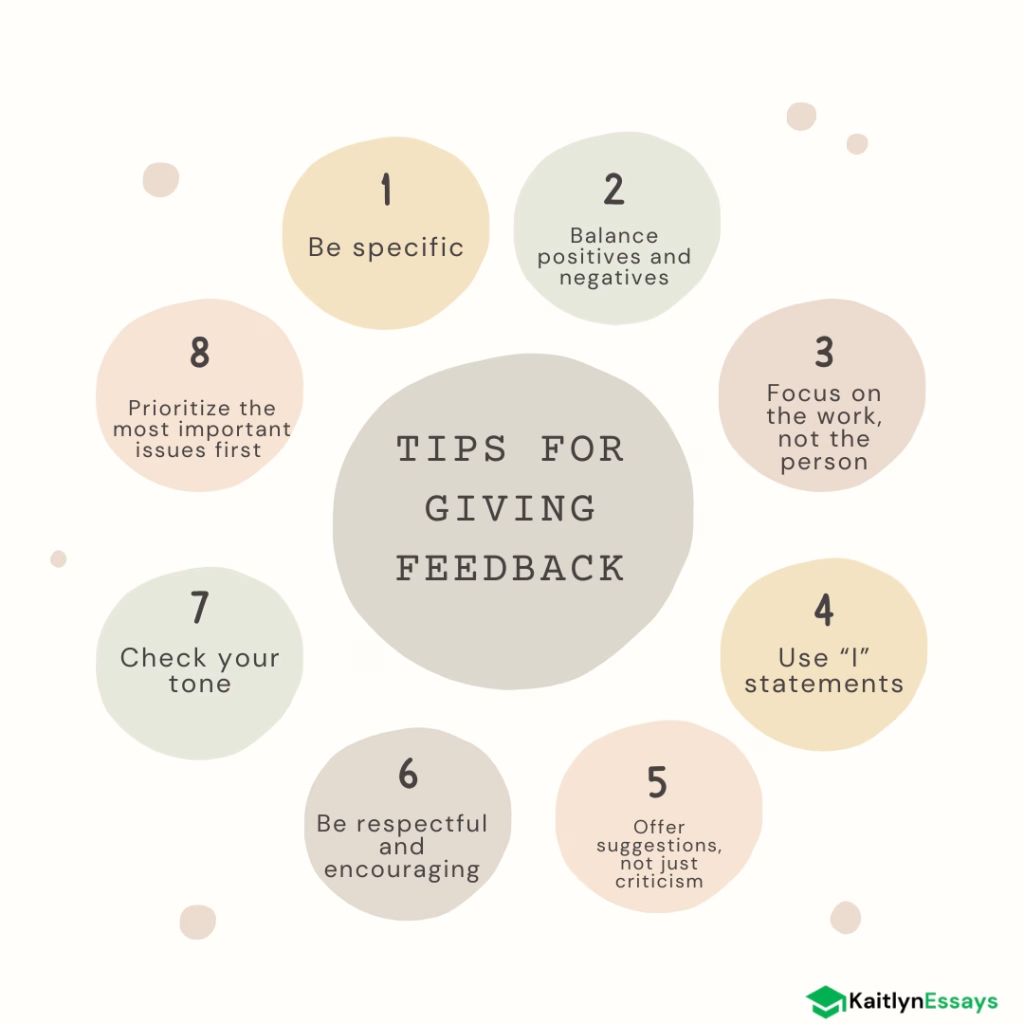
Elements of Effective Peer Review Feedback
Specificity and Detail
Concrete Examples Effective feedback points to specific passages, sections, or elements rather than making vague generalizations. Instead of saying “this is unclear,” reviewers should identify exactly which sentences or concepts need clarification.
Evidence-Based Comments Feedback should reference specific criteria, rubrics, or assignment requirements. This grounds the review in objective standards rather than personal preferences.
Actionable Suggestions The most valuable feedback provides clear, implementable recommendations. Rather than simply identifying problems, effective reviews offer potential solutions or strategies for improvement.
Balance and Tone
Constructive Balance Quality peer review includes both strengths and areas for improvement. Acknowledging what works well helps build confidence while highlighting weaknesses guides development.
Respectful and Supportive Language Feedback should be delivered with empathy and encouragement. The tone should convey that the reviewer wants to help the author succeed, not criticize for its own sake.
Focus on the Work, Not the Person Effective feedback addresses the assignment, argument, or presentation rather than making judgments about the author’s abilities or character.
Structural Components
Clear Organization Well-structured feedback follows a logical sequence, often addressing major issues before minor ones, or following the organization of the original work.
Prioritized Comments Not all feedback points are equally important. Effective reviews help authors understand which issues are most critical to address first.
Summary and Overall Assessment A brief overview that synthesizes the main points helps authors understand the reviewer’s overall perspective and key takeaways.
Pedagogical Elements
Question-Based Feedback Thoughtful questions can guide authors toward their own discoveries and solutions rather than simply providing answers.
Connection to Learning Objectives Effective feedback relates comments back to course goals, assignment objectives, or disciplinary standards.
Encouragement of Critical Thinking The best peer review challenges authors to think more deeply about their choices, assumptions, and reasoning.
Practical Considerations
Timeliness Feedback is most valuable when provided promptly, while the work and learning process are still fresh in the author’s mind.
Appropriate Depth The level of detail should match the assignment’s scope and the students’ developmental stage. Beginning students need different types of feedback than advanced learners.
Follow-Up Potential Effective feedback opens doors for continued dialogue and clarification between peers, fostering ongoing collaborative learning.
Technical Quality
Accuracy Reviewers should ensure their feedback is factually correct and based on sound understanding of the subject matter and assignment requirements.
Clarity Feedback itself should be well-written and easy to understand, modeling the communication standards expected in the discipline.
Completeness While not every aspect needs commentary, effective feedback addresses the major elements identified in the assignment guidelines or rubric.
Examples of Peer Review Feedback
Positive Feedback Examples
Example 1: Research Paper
“Your thesis statement in the introduction is exceptionally clear and well-positioned. The way you articulated your main argument in the second sentence immediately tells the reader what to expect from your paper. This strong foundation makes the entire argument easy to follow. Additionally, your use of transitions between paragraphs creates a smooth logical flow that guides the reader naturally from one point to the next.”
Example 2: Presentation Review
“Your opening hook with the statistical comparison was brilliant—it immediately grabbed attention and established the significance of your topic. The visual aids you created, particularly the infographic on slide 4, effectively simplified complex data without losing important details. Your conclusion tied back perfectly to your introduction, creating a satisfying sense of completeness.”
Example 3: Creative Writing
“The dialogue in your story feels authentic and natural. Each character has a distinct voice that comes through clearly in their speech patterns and word choices. Your descriptive passage in the third paragraph creates vivid imagery that really helps readers visualize the setting. The pacing builds tension effectively toward the climax.”
Constructive Criticism Examples
Example 1: Academic Essay
“While your argument about climate policy is interesting, the second paragraph needs stronger evidence to support your claims. Consider adding peer-reviewed sources rather than relying primarily on news articles. The current sources don’t provide the scientific credibility your argument requires. Also, the connection between your first and third main points isn’t clear—you might add a transitional sentence explaining how these ideas relate to strengthen your overall argument.”
Example 2: Lab Report
“Your methodology section lacks sufficient detail for replication. Specifically, you mention ‘heating the solution’ but don’t specify the temperature or duration. The results section would benefit from explaining what the data means rather than just presenting numbers. Consider adding a sentence after each major finding that interprets its significance for your hypothesis.”
Example 3: Group Project Proposal
“The timeline in your project plan seems overly ambitious given the scope of research required. Breaking down the literature review phase into smaller, more manageable segments would make the schedule more realistic. Your budget section needs more detailed justification—explain why certain expenses are necessary and how you calculated the amounts.”
Balanced Feedback Examples
Example 1: Research Paper
“Your paper demonstrates strong research skills and thorough understanding of the topic. The literature review section effectively synthesizes multiple sources and identifies key debates in the field. Your analysis of the primary source material shows critical thinking and original insight.
However, the paper would benefit from reorganization. Consider moving your strongest evidence to support your main argument earlier in the paper, perhaps in the second section rather than the fourth. The conclusion feels rushed compared to the detailed development in your body paragraphs—expanding it to more fully explore the implications of your findings would strengthen the overall impact. Additionally, some citations need formatting corrections according to APA style, particularly the in-text citations on pages 3 and 7.”
Example 2: Class Presentation
“Your presentation showed excellent preparation and deep knowledge of the subject matter. The research you conducted was thorough, and your passion for the topic came through clearly. The interactive element where you had the class participate in the thought experiment was engaging and helped illustrate your main point effectively.
To improve future presentations, consider slowing down your delivery pace—some important points got lost when you spoke quickly. The slides were informative but quite text-heavy; using more visuals and bullet points would help the audience follow along more easily. Your conclusion was strong, but you might benefit from practicing transitions between main points to create smoother flow throughout the presentation.”
Example 3: Creative Writing Assignment
“Your story has a compelling premise and well-developed characters. The protagonist’s internal conflict is believable and engaging, and you’ve created genuine emotional stakes that make readers care about the outcome. Your descriptive writing, particularly in the opening scene, creates a strong sense of place and atmosphere.
The middle section loses some momentum due to lengthy exposition. Consider weaving background information more gradually throughout the story rather than presenting it all at once. The dialogue generally works well, but the conversation on page 4 feels slightly forced—these characters might express the same ideas more naturally using different words. Your ending is satisfying, though you might consider adding one final image or thought that reinforces your central theme.”
Example 4: Scientific Poster
“Your poster effectively communicates complex research in an accessible format. The visual hierarchy guides viewers through your findings logically, and the color scheme enhances readability without being distracting. Your abstract clearly summarizes the key points, and the graphs effectively illustrate your data trends.
Consider reducing the text density in the methods section—some details could be moved to a supplementary handout, allowing you to increase font size for better visibility. The implications section could be expanded to more clearly explain why these findings matter to the broader field. Also, adding error bars to your graphs would strengthen the scientific rigor of your data presentation.”
Peer Review Feedback Templates
General Academic Paper Template
Opening Summary
“This [paper/essay/report] addresses [main topic/research question]. The author’s primary argument is that [summarize thesis/main claim]. Overall, this work demonstrates [general assessment of strengths].”
Strengths Section
Content & Ideas:
- The strongest aspect of this work is…
- Your argument about [specific point] is particularly compelling because…
- The evidence you provide for [claim] effectively supports your position…
Organization & Structure:
- The paper flows logically from…
- Your introduction successfully…
- The conclusion effectively…
Writing & Style:
- Your writing is clear and engaging, particularly…
- The tone is appropriate for…
- Your use of [specific technique] enhances…
Areas for Improvement
Content Issues:
- Consider strengthening your argument by…
- The section on [topic] would benefit from…
- Additional evidence is needed to support…
Structural Concerns:
- The transition between [sections] could be smoother if…
- Consider reorganizing [specific part] to…
- The [introduction/conclusion/body] might be more effective if…
Technical Elements:
- Check [citation format/grammar/formatting] in…
- Clarify the meaning of…
- Expand on the explanation of…
Specific Questions for the Author
- What led you to choose [specific approach/source/argument]?
- Have you considered [alternative perspective/counterargument]?
- Could you elaborate on [unclear point]?
Priority Recommendations
“If you could only make three changes, I would suggest: 1) [most important], 2) [second priority], 3) [third priority].”
Research Paper Template
Research & Methodology
Literature Review:
- [ ] Comprehensive coverage of relevant sources
- [ ] Appropriate balance of current and foundational research
- [ ] Clear identification of research gaps
- Comments:
Research Question/Hypothesis:
- [ ] Clearly stated and focused
- [ ] Appropriately narrow in scope
- [ ] Addresses significant issue
- Comments:
Methodology:
- [ ] Appropriate for research question
- [ ] Sufficient detail for replication
- [ ] Limitations acknowledged
- Comments:
Analysis & Results
Data Presentation:
- [ ] Clear and organized
- [ ] Appropriate use of tables/figures
- [ ] Supports main arguments
- Comments:
Interpretation:
- [ ] Logical connections between data and conclusions
- [ ] Acknowledges alternative explanations
- [ ] Relates findings to broader context
- Comments:
Creative Writing Template
Story Elements
Plot & Structure:
- The most engaging part of your story is…
- The pacing works well when…
- Consider developing [specific plot element] further…
Character Development:
- [Character name] feels authentic because…
- The protagonist’s motivation becomes clear when…
- [Character] could be strengthened by…
Setting & Atmosphere:
- Your description of [setting] effectively creates…
- The mood you establish in [scene] enhances…
- Consider adding more sensory details to…
Dialogue:
- The conversation between [characters] feels natural because…
- Your dialogue effectively reveals character when…
- Some exchanges might sound more authentic if…
Writing Craft
Voice & Style:
- Your narrative voice is [describe qualities]…
- The tone shifts effectively when…
- Consider maintaining consistency in…
Language & Imagery:
- Particularly effective phrases include…
- Your use of [literary device] creates…
- Some descriptions might be strengthened by…
Presentation Review Template
Content & Organization
Opening:
- [ ] Engaging hook/attention-grabber
- [ ] Clear preview of main points
- [ ] Establishes credibility
- Feedback:
Body:
- [ ] Logical flow between ideas
- [ ] Sufficient supporting evidence
- [ ] Appropriate depth for time limit
- Feedback:
Conclusion:
- [ ] Summarizes key points
- [ ] Provides closure
- [ ] Includes call to action (if appropriate)
- Feedback:
Delivery & Visual Aids
Verbal Communication:
- [ ] Clear articulation
- [ ] Appropriate pace
- [ ] Effective use of vocal variety
- Feedback:
Nonverbal Communication:
- [ ] Confident posture
- [ ] Appropriate gestures
- [ ] Good eye contact
- Feedback:
Visual Aids:
- [ ] Support rather than distract
- [ ] Readable and well-designed
- [ ] Integrated smoothly
- Feedback:
Quick Feedback Template (For Short Assignments)
Two Stars and a Wish
Star 1: What I found most effective… Star 2: Another strength is… Wish: One thing that would make this even stronger…
Three-Column Format
| What’s Working Well | Questions I Have | Suggestions |
|---|---|---|
| [Specific strengths] | [Clarifying questions] | [Actionable advice] |
Self-Reflection Prompt Template
“Before receiving peer feedback, consider:
- What aspects of your work are you most confident about?
- What areas do you think need the most improvement?
- What specific feedback would be most helpful to you?
- How will you use this feedback for revision?”
Peer Review Rubric Template
Scoring Guide
Excellent (4): Exceeds expectations, demonstrates mastery Proficient (3): Meets expectations, solid work Developing (2): Approaching expectations, needs improvement Beginning (1): Below expectations, significant revision needed
| Criteria | Score | Comments |
|---|---|---|
| Content Knowledge | _/4 | |
| Organization | _/4 | |
| Evidence/Support | _/4 | |
| Writing Quality | _/4 | |
| Creativity/Originality | _/4 |
Overall Score: ___/20
Most Significant Strength:
Priority Area for Improvement:
One Specific Suggestion:
FAQs
What does a peer review include?
Constructive comments on strengths, weaknesses, and suggestions for improvement.
What are two examples of peer review?
Reviewing a classmate’s essay and giving feedback on a research presentation.
What are three questions for peer review?
Is the main idea clear?
Is the evidence strong and relevant?
Are there areas that need more detail or clarity?
What is checked during peer review?
Clarity, organization, accuracy, grammar, and use of evidence.