

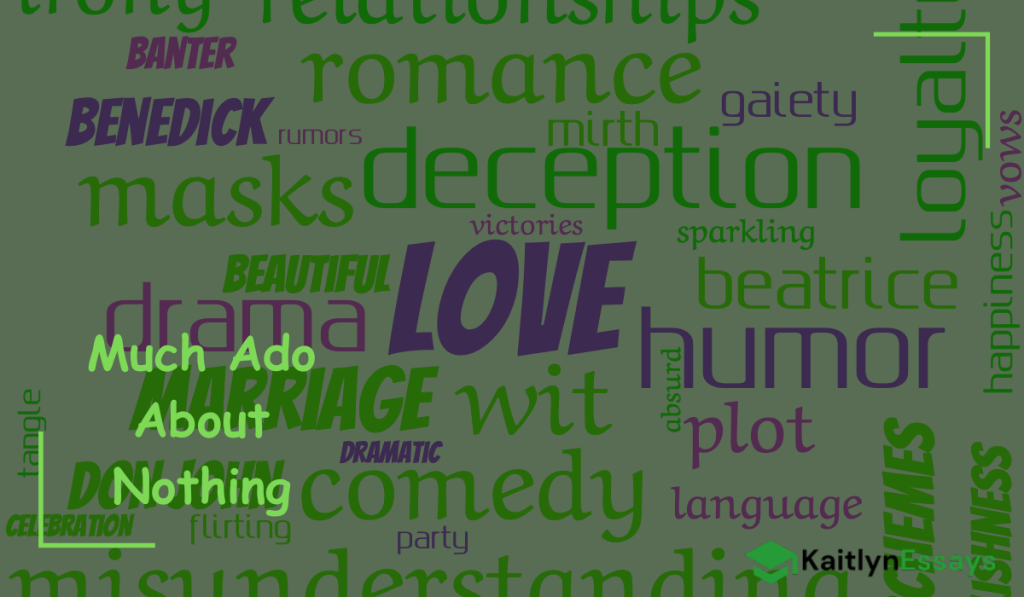
Much Ado About Nothing is one of William Shakespeare’s most celebrated comedies, known for its sharp wit, complex characters, and exploration of love and deception. Set in Messina, the play primarily revolves around two pairs of lovers: the witty, sharp-tongued Beatrice and Benedick, and the more traditional, romantic couple, Hero and Claudio.
The story unfolds as soldiers return victorious from war to the home of Leonato, the governor of Messina. Among them are Benedick and Claudio, two contrasting figures when it comes to love. Claudio quickly falls for Hero, Leonato’s daughter, while Benedick and Beatrice engage in a battle of wits, with each proclaiming their disdain for love and marriage. However, despite their mutual declarations, their friends conspire to make them fall in love with each other.
Summary
Setting the Stage
The play opens with the arrival of Don Pedro, Prince of Aragon, and his entourage in Messina. They are welcomed by Leonato, the governor of Messina, his daughter Hero, and his niece Beatrice. Among Don Pedro’s companions are the young lords Claudio and Benedick, as well as Don Pedro’s illegitimate brother, Don John.
Uncover more about the play’s setting and historical context
The Plot Unfolds
Act I: Love at First Sight
The play begins with Claudio falling deeply in love with Hero. He confides in his friend Benedick, who scoffs at the idea of marriage. Meanwhile, Beatrice and Benedick engage in their usual battle of wits, each declaring their disdain for love and marriage.
Don Pedro, upon learning of Claudio’s feelings, offers to woo Hero on Claudio’s behalf at a masquerade ball. This sets the stage for the first of many instances of mistaken identity and deception in the play.
Act II: A Plan in Motion
During the masquerade, Don Pedro successfully woos Hero for Claudio. However, Don John, ever the troublemaker, falsely informs Claudio that Don Pedro has betrayed him and wooed Hero for himself. This misunderstanding is quickly resolved, but it foreshadows the more serious deception to come.
The other major plot of the play is set in motion when Don Pedro, Claudio, and Leonato decide to trick Benedick and Beatrice into falling in love with each other. They stage conversations for Benedick to overhear, convincing him that Beatrice is secretly in love with him. Similarly, Hero and her waiting woman, Ursula, do the same for Beatrice.
Read about the comic elements in Act II
Act III: Deceptions and Revelations
As Benedick and Beatrice begin to contemplate their feelings for each other, Don John puts his villainous plan into action. He arranges for Claudio and Don Pedro to witness what appears to be Hero being unfaithful on the eve of her wedding. In reality, they see Hero’s waiting woman, Margaret, with Don John’s associate, Borachio.
Meanwhile, the night watchmen, led by the comically inept Dogberry, overhear Borachio boasting about the deception and arrest him.
Analyze the play’s use of dramatic irony
Act IV: The Wedding Disaster
At Hero and Claudio’s wedding, Claudio publicly shames Hero, accusing her of infidelity. Hero faints, and Claudio, Don Pedro, and Don John leave. The Friar, suspecting foul play, suggests that Hero’s family pretend she has died of shock while they investigate the accusation.
Beatrice, convinced of Hero’s innocence, asks Benedick to challenge Claudio to a duel. This request leads to Benedick and Beatrice confessing their love for each other.
Examine the themes of honor and shame in Act IV
Act V: Justice and Reconciliation
Dogberry and his men bring Borachio before Leonato, and the truth about Don John’s plot is revealed. Claudio, realizing his terrible mistake, begs Leonato’s forgiveness. Leonato demands that Claudio marry his “niece” (actually Hero in disguise) as penance.
At the second wedding, Hero is unveiled, and the couple is joyfully reunited. Beatrice and Benedick, meanwhile, finally admit their love for each other in front of everyone, albeit still maintaining their witty banter.
The play ends with news that Don John has been captured and will face punishment, and everyone celebrates the double wedding with dancing.
Explore the resolution and its implications
Historical Context and Interpretation
“Much Ado About Nothing” was likely written in 1598-1599, during the reign of Queen Elizabeth I. The play reflects some of the social norms and concerns of Elizabethan society, particularly regarding marriage, honor, and social status.
Over the centuries, the play has been interpreted and performed in various ways, with different productions emphasizing different aspects of the story. Modern interpretations often focus on the gender dynamics and the play’s exploration of rumor and social perception.
Investigate the play’s historical significance
Adaptations and Cultural Impact
“Much Ado About Nothing” has been adapted numerous times for stage, screen, and other media. Notable adaptations include:
- Kenneth Branagh’s 1993 film, starring Branagh as Benedick and Emma Thompson as Beatrice.
- Joss Whedon’s 2012 modern-day adaptation, filmed in black and white.
- Various stage productions, including gender-swapped versions and settings in different historical periods.
The play’s themes and characters continue to resonate with modern audiences, inspiring adaptations and reinterpretations across various cultures.
Explore the play’s enduring influence
Much Ado About Nothing: Characters
Beatrice
Beatrice, one of the most captivating characters in Shakespeare’s oeuvre, is witty, sharp-tongued, and fiercely independent. She is a woman ahead of her time, challenging the conventions of submissiveness and docility that were often expected of women in the Elizabethan era. Beatrice openly mocks the idea of marriage, declaring she would rather hear her dog bark than hear a man swear he loves her. Her strong aversion to marriage, however, masks a vulnerability and a deep fear of being hurt. Despite her verbal sparring with Benedick, it is clear that she harbors feelings for him.
Beatrice’s character brings a modern sensibility to the play, questioning the roles of women and the institution of marriage. To explore how her relationship with Benedick evolves from animosity to affection, consider reading this deeper analysis.
Benedick
Benedick, much like Beatrice, is quick with his words and sees himself as a confirmed bachelor. He frequently ridicules marriage and claims he will never be tied down. However, his wit and bravado mask a fear of vulnerability. His character undergoes a significant transformation throughout the play, as his banter with Beatrice shifts from mockery to affection. His love for Beatrice is sincere, and by the end of the play, he openly embraces marriage, contradicting his earlier stance.
Benedick’s journey from a proud bachelor to a committed lover is one of the most charming aspects of the play. For more on how Benedick’s character reflects themes of masculinity and emotional growth, look further into the full exploration.
Hero
Hero, the daughter of Leonato and cousin of Beatrice, is often viewed as the embodiment of traditional female virtues—she is quiet, obedient, and modest. She is the polar opposite of Beatrice, and her silence is often mistaken for passivity. However, Hero is central to the dramatic tension of the play, as her supposed infidelity, orchestrated by the villainous Don John, leads to her public disgrace. Despite her gentle nature, Hero shows great resilience when she is falsely accused and remains a symbol of virtue and patience.
Hero’s character highlights the fragility of a woman’s reputation during the era, and how easily it could be destroyed by slander. To uncover the complexities of Hero’s role, including her redemption, explore further analysis.
Claudio
Claudio is a young soldier who quickly falls in love with Hero upon his return to Messina. He is idealistic and deeply romantic, but also easily swayed by appearances and prone to jealousy. His love for Hero turns into rage when he is tricked into believing she has been unfaithful. His decision to shame Hero at their wedding is harsh, reflecting both his immaturity and the societal pressures placed on men to guard their honor. However, Claudio’s remorse after discovering the truth shows his capacity for growth and redemption.
Claudio’s character arc is a reflection of the play’s themes of honor, trust, and redemption. To dive deeper into Claudio’s development and his role in the plot’s conflict, see the complete character study.
Don John
Every Shakespearean comedy needs a villain, and Don John fits the role perfectly in Much Ado About Nothing. As Don Pedro’s illegitimate brother, he is consumed by jealousy and bitterness. Don John’s motivations are driven by his desire to bring misery to others, particularly his brother’s close friends, Claudio and Hero. His plot to destroy Hero’s reputation and ruin her relationship with Claudio showcases his malicious nature. Unlike other Shakespearean villains, Don John remains largely unrepentant, embodying a deep-rooted cynicism.
Don John’s character serves as a catalyst for much of the play’s conflict. To examine how his actions fuel the drama, access more details.
Don Pedro
Don Pedro, the Prince of Aragon, is a key figure in the social circle of Messina. He is a generous and well-respected leader, often acting as a matchmaker and mediator among his friends. It is Don Pedro who assists Claudio in winning Hero’s hand, and he later devises the plan to bring Beatrice and Benedick together. However, his involvement in the plot to expose Hero’s alleged infidelity—despite being tricked by Don John—highlights his vulnerability to manipulation. Still, Don Pedro remains an important figure of authority and moral standing by the play’s conclusion.
Don Pedro’s role as a leader and a friend adds complexity to his character. For an extended discussion of Don Pedro’s influence on the events of the play, explore the in-depth review.
Dogberry
Dogberry, the bumbling constable of Messina, provides much of the comic relief in Much Ado About Nothing. His malapropisms, or misuse of words, make him a source of humor, yet he unwittingly plays a critical role in unraveling Don John’s scheme. Dogberry’s incompetence is endearing, and his accidental success in apprehending Borachio and uncovering the truth behind Hero’s disgrace underscores the comedic nature of the play.
To look deeper into Dogberry’s role as both a comedic and crucial character, you can discover more.
Leonato
Leonato, Hero’s father and the governor of Messina, is an important figure of authority in the play. He is kind, generous, and deeply concerned with his daughter’s happiness and honor. However, when Hero is accused of infidelity, Leonato is quick to believe the accusations and is devastated by the blow to his family’s honor. His anger reflects the societal importance placed on female virtue. Nonetheless, Leonato is a loving father, and when the truth is revealed, he supports Hero’s eventual redemption and reconciliation with Claudio.
Leonato’s character embodies the tension between paternal love and societal expectations. To understand his role in the family dynamics and larger plot, explore the detailed character profile.
Margaret
Margaret, Hero’s maid, is an innocent yet pivotal figure in Don John’s plot. She unknowingly aids Borachio in the scheme that leads Claudio and Don Pedro to believe Hero has been unfaithful. Though Margaret is not malicious, her actions have severe consequences. Her role is a reminder of how easily the truth can be distorted by manipulation.
Margaret’s involvement in the deception adds complexity to her character. To explore her significance in the story, you can access more insights.
Borachio
Borachio, one of Don John’s followers, is instrumental in the plot to defame Hero. He orchestrates the ruse involving Margaret and boasts about his deception afterward, leading to his eventual capture. Unlike Don John, Borachio shows some remorse for his actions, particularly when he learns of Hero’s supposed death. His role highlights the ease with which trust can be broken and reputations ruined in a society obsessed with honor.
For a more comprehensive look at Borachio’s motivations and role in the plot, you can discover more.
Themes in Much Ado About Nothing
Theme of Deception
At the heart of Much Ado About Nothing lies the theme of deception. This play is brimming with both malicious and benign deceit. The characters frequently manipulate one another’s perceptions, sometimes for humorous purposes and other times for more sinister goals. For example, the malevolent deception of Don John aims to destroy Claudio and Hero’s relationship by making Claudio believe that Hero has been unfaithful. Conversely, the humorous trick played on Benedick and Beatrice, making each believe that the other is in love with them, leads to the evolution of their relationship from adversaries to lovers.
Deception in this play serves as a device to propel the plot forward, demonstrating the thin line between misunderstanding and tragedy. It also reflects the delicate nature of human relationships, which can be easily manipulated, leading to both heartache and joy. Explore the details of these deceptions in further detail: investigate deception’s dual role.
Theme of Honor and Social Expectations
Honor is another central theme in Much Ado About Nothing, particularly when it comes to female virtue. The accusation against Hero underscores the fragile nature of a woman’s honor in Renaissance society. Claudio’s quick judgment of Hero’s chastity—and the consequent public shaming—illustrates how deeply social norms regarding female purity were ingrained in the culture. The consequences of losing one’s honor could be devastating, as Hero’s “death” following the slanderous attack against her suggests.
The concept of male honor also plays a role, particularly through the character of Benedick, who finds himself caught between his loyalty to Claudio and his love for Beatrice. The play challenges traditional ideas of honor by juxtaposing the seriousness of Hero’s public shame with the more playful and evolving relationship between Benedick and Beatrice, which defies conventional norms. Discover more about how honor shapes the characters’ decisions and relationships.
Theme of Gender Roles
Gender roles and expectations are vividly portrayed throughout the play. Women, especially Hero, are expected to be passive and virtuous, while men are often portrayed as active and authoritative figures. Beatrice, however, stands out as a progressive character who challenges these norms with her wit and refusal to conform to traditional expectations of women. She mocks the idea of marriage and actively questions the established roles that society has assigned to both men and women.
Shakespeare presents the tension between gender roles, particularly through the contrast between Hero’s meekness and Beatrice’s boldness. While Hero embodies the ideal woman of the time, submissive and silent, Beatrice’s independence and sharp tongue provide a counterpoint, suggesting that Shakespeare might be questioning the rigid gender expectations of his time. Explore how Shakespeare uses these two characters to challenge gender dynamics.
Theme of Love and Relationships
At its core, Much Ado About Nothing is a love story. Shakespeare explores both the darker, more fragile side of love, as seen in Claudio and Hero’s relationship, and the playful, more skeptical version of love between Benedick and Beatrice. Claudio and Hero’s love is almost instantaneous and idealized, yet it falters at the first sign of trouble. Their relationship is largely based on social conventions and appearances.
In contrast, Benedick and Beatrice’s relationship is more mature, grounded in mutual respect and wit. Their constant bickering and denial of romantic interest in each other gradually give way to genuine affection. Through these two couples, Shakespeare juxtaposes different kinds of love and courtship, questioning whether love is a romantic ideal or a more realistic partnership built on communication and respect. Uncover more about the play’s portrayal of love’s complexities.
Theme of Appearance vs. Reality
Shakespeare frequently explores the theme of appearance versus reality in Much Ado About Nothing, particularly through acts of deception and disguise. The masked ball, where characters’ true feelings and identities are hidden, is a perfect example of how appearances can be misleading. Similarly, the fake death of Hero and the staged “evidence” of her unfaithfulness illustrate how characters in the play often take things at face value without investigating further.
This theme invites the audience to question what is real and what is merely a construction, both within the play and in life. Characters’ decisions based on superficial appearances often lead to misunderstanding and chaos, suggesting that truth is often harder to discern than it seems. Dive deeper into the concept of appearances deceiving reality.
Theme of Redemption and Forgiveness
Another vital theme in the play is redemption. Claudio’s mistaken belief that Hero has wronged him leads him to publicly disgrace her. However, after learning the truth, Claudio expresses genuine remorse and seeks redemption by agreeing to marry Leonato’s “niece,” whom he later learns is actually Hero. This act symbolizes forgiveness and the potential for healing after betrayal and misunderstanding.
Benedick and Beatrice’s relationship also follows a redemptive arc. Both are initially cynical about love, but through their growing affection for one another, they find a sense of fulfillment that redeems their previous skepticism. Shakespeare suggests that love, in its truest form, has the power to redeem even the most hardened hearts. Explore the role of redemption in the resolution of the play’s conflicts.
Symbols in Much Ado About Nothing
Masks and Masquerade
Masks and masquerades play a crucial symbolic role in Much Ado About Nothing. These symbols emphasize the theme of deception—both self-deception and the deception of others. Characters in the play often hide their true emotions or intentions behind metaphorical masks, pretending to be something they are not. For example, during the masquerade ball, Beatrice speaks harshly of Benedick, not knowing she is speaking directly to him, as he is wearing a mask. The masks in the play symbolize the barriers to true communication and understanding between characters, as they hide their identities from one another and even from themselves. The masked ball also hints at the fluid nature of identity and perception.
Further exploration of how these symbols intertwine with the characters’ emotional arcs awaits: look deeper into the significance of masquerades. Discover more.
The Garden and Nature
Throughout Much Ado About Nothing, gardens and nature symbolize fertility, love, and transformation. Much of the action in the play takes place in gardens, emphasizing the connection between the natural world and human emotions. Benedick, in particular, has several key moments of introspection while in a garden. In a literal and metaphorical sense, the garden becomes a place for characters to grow and transform, much like the flora within them. Gardens also serve as a backdrop for deception, as seen when Benedick and Beatrice overhear conversations about each other’s supposed feelings of love while hiding in the gardens.
Understanding the relationship between nature and the characters’ emotional development is essential to grasping the depth of Shakespeare’s symbolism: explore further. Learn more.
Letters and Written Communication
In Much Ado About Nothing, letters serve as a symbolic representation of miscommunication and manipulation. The play features several instances where letters are used to deceive or convey manipulated truths. For instance, the fake letter orchestrated by Don John leads to the mistaken belief in Hero’s infidelity. Additionally, the letters between Beatrice and Benedick are used as a humorous device, as both characters are manipulated into believing the other loves them. These written forms of communication further symbolize the gap between true intentions and perceived meaning. Shakespeare uses letters as a metaphor for the disconnect between appearance and reality.
Uncover more layers of meaning behind Shakespeare’s use of letters in Much Ado About Nothing: gain insight. Read on.
The Battle of Wits
The verbal sparring between Beatrice and Benedick, often referred to as a “battle of wits,” is one of the play’s most prominent symbols. Their sharp-tongued exchanges symbolize not only their mutual attraction but also the tension between social norms and individual desire. In Renaissance society, men and women were expected to adhere to strict roles within romantic relationships. Beatrice and Benedick’s constant verbal dueling represents their resistance to these societal expectations. Their witty banter is a defense mechanism, protecting them from vulnerability and true emotional connection. The “battle” also serves as a symbol of the delicate balance between love and power in relationships.
Dive into a detailed analysis of how this battle shapes the narrative of Much Ado About Nothing: investigate further. Explore here.
Infidelity and Honor
Honor is a central theme in Much Ado About Nothing, particularly concerning Hero’s chastity and fidelity. Hero’s alleged infidelity and the public shaming she endures highlight the rigid social codes of the time. Her honor, a symbol of her worth and value in society, is questioned based on false information, leading to her humiliation. Claudio’s willingness to believe the worst of Hero without question symbolizes the fragility of a woman’s honor in a patriarchal society. The concept of honor is explored in various ways throughout the play, not only through Hero but also through the male characters’ obsession with their own reputations.
For more insights into how honor shapes the characters and themes of the play, go into further analysis. Find out more.
The Role of Eavesdropping
Eavesdropping, or “noting,” plays a pivotal symbolic role in the play, and is even reflected in the title itself. Characters frequently overhear conversations or are misled by overheard information. This act of “noting” symbolizes the play’s exploration of perception versus reality. Eavesdropping drives much of the plot, including Benedick and Beatrice’s realization of their love for one another, as well as the tragic misunderstanding between Claudio and Hero. Through this symbol, Shakespeare highlights how easily truth can be distorted and how often people rely on incomplete or false information to form judgments.
Explore the profound implications of eavesdropping in Shakespeare’s comedy: gain further understanding. Find more.
Beatrice’s Language and Outspokenness
Beatrice’s sharp wit and refusal to conform to traditional female roles make her one of Shakespeare’s most memorable characters. Her language serves as a symbol of her independence and unwillingness to submit to societal expectations. In a time when women were expected to be silent and obedient, Beatrice’s outspoken nature defies those norms. She uses language not only to challenge the men around her but also to shield herself from the vulnerability of love. Her verbal skill allows her to navigate a male-dominated world while maintaining her autonomy. However, her eventual admission of love for Benedick demonstrates that even the strongest defenses can be lowered.
For a comprehensive understanding of Beatrice’s character development and symbolic significance, go deeper into the analysis. Examine more.
Deception and Misunderstanding
Deception is one of the most prominent motifs in Much Ado About Nothing. From masked balls to overheard conversations, deception drives much of the plot. However, not all deception in the play is malicious. Some instances of deception, such as the trick played on Benedick and Beatrice, are meant to bring about positive outcomes. In contrast, Don John’s deception concerning Hero’s fidelity leads to tragedy. The play’s exploration of deception raises questions about the nature of truth and how easily it can be manipulated. Deception, in Much Ado About Nothing, becomes a symbol for the complexity of human relationships, where appearances often mask deeper truths.
Explore how deception functions as both a tool of comedy and tragedy in the play: investigate further. Look into it.
The Duality of Love and War
Throughout Much Ado About Nothing, Shakespeare draws parallels between love and war, symbolizing the often combative nature of romantic relationships. Benedick and Beatrice’s relationship, in particular, is framed as a battle, with each attempting to outwit the other. This metaphorical war of words highlights the tensions between affection and autonomy, love and power. Similarly, Claudio and Hero’s relationship is framed by the themes of honor and betrayal, which echo the consequences of war. The duality of love and war serves as a reminder that both emotions can be unpredictable, intense, and transformative.
For a more in-depth examination of how love and war intertwine in the play, continue the exploration. Learn further.
Social Status and Class
Social status and class distinctions are subtly yet significantly symbolized throughout Much Ado About Nothing. Characters are acutely aware of their social standing, and this influences their behavior and decisions. For instance, Claudio’s obsession with Hero’s honor is tied to his desire to maintain his status and reputation. The play’s portrayal of Dogberry, a character from a lower social class, provides comic relief but also highlights the class differences in Renaissance society. Despite Dogberry’s lack of sophistication, his actions play a crucial role in uncovering the truth about Don John’s deception. Shakespeare uses social status as a symbol to critique the rigid class structures of his time.
Discover how class distinctions impact the plot and themes of Much Ado About Nothing: explore deeper. Investigate here.
Literary Devices in Much Ado About Nothing
Irony
Irony is one of the most frequently used literary devices in Much Ado About Nothing, particularly dramatic irony. Dramatic irony occurs when the audience knows something that the characters do not. For instance, the audience is aware of Don John’s plot to slander Hero before the other characters discover it, which creates a sense of anticipation and tension. Similarly, when Benedick and Beatrice are tricked into believing that the other loves them, the audience is in on the joke, heightening the comedic effect. Irony also functions to expose the contradictions between appearance and reality, a key theme in the play.
For a deeper examination of irony’s impact on the narrative and characters in Much Ado About Nothing, explore further. Learn more.
Wordplay and Puns
Shakespeare is famous for his use of wordplay, and Much Ado About Nothing is no exception. The play is filled with clever puns and double entendres, particularly in the dialogue between Beatrice and Benedick. Their verbal sparring is one of the most entertaining aspects of the play, as they constantly try to outwit one another with their use of language. For example, when Beatrice refers to Benedick as “Signior Mountanto,” a pun on “montanto,” a fencing term, she is both insulting him and demonstrating her linguistic prowess. This wordplay adds humor to the play while also revealing character traits, such as Beatrice’s sharp wit and Benedick’s pride.
For more examples and analysis of Shakespeare’s masterful use of wordplay, take a closer look. Discover more.
Foreshadowing
Foreshadowing is a device Shakespeare uses to build tension and anticipation in the plot of Much Ado About Nothing. Throughout the play, there are subtle hints that events may not unfold as smoothly as the characters hope. For example, Don John’s early remarks about his discontent foreshadow his malicious plot to ruin Hero’s reputation. Additionally, Claudio’s quickness to believe in Hero’s infidelity early in the play foreshadows his later decision to publicly shame her. This use of foreshadowing prepares the audience for the conflicts and misunderstandings that arise, creating suspense even in a comedic context.
Explore how foreshadowing contributes to the intricate plot structure of the play: uncover further insights. Learn more.
Metaphor
Shakespeare frequently uses metaphor to enhance the emotional depth of Much Ado About Nothing. Characters often speak in metaphorical terms to express their feelings, particularly when it comes to love. For instance, Benedick’s transformation from a bachelor to a lover is described through metaphors of hunting, as he is initially “hunted” by Beatrice’s words and later “captured” by love. Additionally, the metaphor of war is used to describe the relationship between Beatrice and Benedick, with their verbal battles likened to military conflict. This metaphor highlights the tension between love and power, as both characters struggle to maintain their independence while falling in love.
Look deeper into how metaphor shapes the relationships and themes of the play. Explore further.
Allusion
Shakespeare uses allusions throughout Much Ado About Nothing to reference classical mythology, the Bible, and other works of literature. These allusions enrich the dialogue and provide layers of meaning for those familiar with the references. For instance, Benedick’s remark about Beatrice being “too curst” and comparing her to “a shrew” is an allusion to the common stereotype of the nagging or difficult woman, as seen in Shakespeare’s earlier play The Taming of the Shrew. Allusions to mythology also appear, such as when Beatrice compares Benedick to Cupid, the Roman god of love, in a sarcastic manner, further emphasizing her disdain for romantic clichés.
For a closer look at the significance of allusions in Much Ado About Nothing, continue the exploration. Learn more.
Hyperbole
Hyperbole, or exaggerated statements, is used extensively in the dialogue of Much Ado About Nothing to create humor and highlight the intensity of characters’ emotions. Benedick and Beatrice are especially prone to hyperbolic expressions when discussing their disdain for love and marriage. For example, Benedick claims that he would rather hear a dog bark than listen to a man profess his love, an exaggerated statement that underscores his initial resistance to romance. Hyperbole serves to make the characters’ eventual transformation all the more striking when they fall in love, as it contrasts their earlier extreme views.
Discover how hyperbole amplifies the comedic and emotional aspects of the play. Learn more.
Soliloquy and Aside
Shakespeare employs soliloquies and asides in Much Ado About Nothing to give the audience direct access to the thoughts and motivations of his characters. Soliloquies, in which characters speak their thoughts aloud when alone on stage, reveal their inner conflicts and desires. Benedick’s soliloquy about his changing feelings for Beatrice, for example, allows the audience to witness his transformation from skeptic to lover. Asides, in which a character speaks directly to the audience without the other characters hearing, are also used to create humor and irony. Don John’s asides, in particular, reveal his villainous nature and his schemes, offering a stark contrast to the other, more comedic asides in the play.
To gain a fuller understanding of how soliloquies and asides function in the play, explore more. Investigate further.
Symbolism
While Much Ado About Nothing is a comedy, it also employs a range of symbolic imagery to enhance its themes. Masks, for instance, symbolize the deception that pervades the play, both in the literal sense (characters wearing masks at the masquerade) and the figurative sense (characters hiding their true feelings). The garden, often a setting for key moments in the plot, symbolizes the natural growth of love and the place where characters undergo personal transformations. Letters and messages are also symbolic, representing both communication and miscommunication in the relationships between characters.
Explore how Shakespeare’s use of symbolism deepens the themes of love and deception. Learn more.
Personification
Personification, the attribution of human characteristics to non-human entities, is another literary device Shakespeare uses to add depth to the imagery in Much Ado About Nothing. For example, in the famous scene where Benedick overhears his friends speaking of Beatrice’s love for him, love is personified as a character that sneaks up on him and forces him to reconsider his feelings. Similarly, Beatrice often personifies love as something treacherous or dangerous, reflecting her fears of vulnerability and emotional pain. Through personification, abstract concepts like love and honor are made tangible, allowing the characters and audience to interact with them in more meaningful ways.
Uncover more examples of personification in Much Ado About Nothing and their significance to the story. Discover more.
Oxymoron
Shakespeare’s use of oxymorons—phrases that combine contradictory terms—is prominent in Much Ado About Nothing. This device is particularly effective in highlighting the contradictions within characters’ feelings and relationships. For instance, Benedick and Beatrice’s relationship is filled with contradictions: they both claim to hate love, yet their verbal sparring is laced with affection. When characters use oxymorons, such as “merry war” or “pleasant torment,” it reflects the complexity of love and relationships in the play. These contradictions also contribute to the comedic tone, as they illustrate the tension between what characters say and what they truly feel.
For a more detailed analysis of oxymoron and its role in the play’s humor and themes, look further. Learn more.
Repetition
Repetition is frequently used in Much Ado About Nothing to emphasize key ideas or emotions. In particular, the repetition of certain phrases or words underscores the comedic and dramatic elements of the play. For instance, the repeated questioning of Hero’s honor throughout the play highlights the importance of reputation in the society of Messina. Similarly, Beatrice and Benedick’s repeated exchanges about their disdain for love emphasize the depth of their feelings, even as they attempt to deny them. The use of repetition not only reinforces important themes but also enhances the rhythm and pacing of the dialogue.
To explore how repetition contributes to the play’s overall structure, continue the analysis. Investigate more.
Quotes from Much Ado About Nothing and Their Significance
“I do love nothing in the world so well as you: is not that strange?”
This line, spoken by Benedick to Beatrice in Act 4, Scene 1, marks a turning point in their relationship. After much verbal sparring and denial of their feelings, Benedick finally admits his love for Beatrice, a declaration that comes as a surprise given his previous stance on romance. The phrase “is not that strange?” highlights Benedick’s own disbelief at his transformation from a sworn bachelor to a man in love. It reflects one of the play’s central themes: the unpredictability and transformative power of love.
For further exploration of this pivotal moment in the play, find the full analysis. Discover more.
“Some Cupid kills with arrows, some with traps.”
Beatrice delivers this witty line in Act 3, Scene 1, after overhearing a staged conversation meant to trick her into believing that Benedick loves her. The line is an allusion to Cupid, the Roman god of love, who traditionally uses arrows to make people fall in love. However, Beatrice’s reference to “traps” acknowledges that love can also be manipulated through deception, as is happening in this scene. The quote encapsulates one of the play’s major motifs: the thin line between genuine emotion and trickery.
To explore the deeper implications of this metaphorical “trap,” dive into the detailed analysis. Read on.
“In mine eye she is the sweetest lady that ever I looked on.”
In Act 1, Scene 1, Claudio expresses his admiration for Hero with this line. His declaration of love is based primarily on Hero’s appearance, illustrating the superficiality of his feelings at this early stage. This quote is significant because it foreshadows the misunderstandings and conflicts that arise later in the play. Claudio’s view of Hero, based on appearances and reputation, is easily shattered when he is deceived by Don John into believing she is unfaithful.
For more on how this quote sets up Claudio’s character arc and the central conflict of the play, learn more. Explore here.
“I had rather hear my dog bark at a crow than a man swear he loves me.”
Beatrice’s sharp tongue and aversion to romantic declarations are perfectly encapsulated in this famous line from Act 1, Scene 1. Her exaggerated statement reflects her disdain for the traditional notions of love and marriage. At the same time, it hints at her vulnerability, as her harsh words are a defense mechanism to protect herself from potential emotional pain. This quote is one of many that highlights the theme of verbal sparring and the tension between love and pride in the play.
To examine Beatrice’s character and her relationship with Benedick, explore further. Find out more.
“Friendship is constant in all other things / Save in the office and affairs of love.”
Claudio speaks these lines in Act 2, Scene 1, after he is misled into believing that Don Pedro is wooing Hero for himself. The quote reflects Claudio’s distrust and insecurity, as he quickly assumes the worst about his friend. This line also touches on the theme of jealousy and the fragility of trust in relationships, particularly when love is involved. Claudio’s quickness to doubt his friend foreshadows his later readiness to believe in Hero’s infidelity.
For a more in-depth analysis of how friendship and trust are portrayed in the play, read further. Learn more.
“As merry as the day is long.”
This line, spoken by Beatrice in Act 2, Scene 1, is a reflection of her lively and carefree nature. The phrase has since become a common idiom, but in the context of the play, it captures Beatrice’s wit and her determination to remain independent and joyful, even in the face of societal expectations for women to marry. The quote is significant because it contrasts with the more serious issues of honor and deception that arise later in the play.
For more on how this quote reflects Beatrice’s personality and role in the play, explore further. Investigate more.
“The world must be peopled!”
Benedick speaks this humorous line in Act 2, Scene 3, as he begins to reconsider his stance on love and marriage. After overhearing a conversation that convinces him Beatrice loves him, Benedick justifies his change of heart by arguing that it is necessary for the world to continue through procreation. This line, while lighthearted, marks a shift in Benedick’s character from someone who scorns marriage to someone who accepts its inevitability.
To explore Benedick’s character development and how this quote fits into the larger themes of the play, read on. Discover more.
“O that I were a man for his sake!”
In Act 4, Scene 1, Beatrice delivers this powerful line in response to Claudio’s public shaming of Hero. Frustrated by her inability to defend Hero due to the limitations placed on women, Beatrice wishes she were a man so she could challenge Claudio directly. This quote highlights the theme of gender roles and the powerlessness of women in a patriarchal society. It also demonstrates Beatrice’s loyalty to Hero and her fierce sense of justice.
For more on how this quote reflects the play’s commentary on gender and power, find the full analysis. Learn further.
“For man is a giddy thing, and this is my conclusion.”
Benedick speaks this line in Act 5, Scene 4, after agreeing to marry Beatrice. The quote is a reflection on the fickle nature of human behavior, particularly in matters of love. Benedick acknowledges that people often change their minds, as he himself has done, going from a staunch bachelor to a willing participant in marriage. This line encapsulates one of the play’s key messages: love and relationships are unpredictable, but they are also a fundamental part of human experience.
For a closer look at the themes of change and human nature in Much Ado About Nothing, explore more. Investigate here.
“I can see yet without spectacles and I see no such matter.”
In Act 1, Scene 3, Benedick makes this witty remark to suggest that he is not blind to love or marriage. He uses “spectacles” (glasses) as a metaphor for needing help to see something that isn’t there—namely, the love that others claim is developing between him and Beatrice. This quote reflects Benedick’s initial skepticism about love, and it contrasts with his eventual realization that he has fallen for Beatrice.
To gain further insight into Benedick’s attitude toward love and how it evolves throughout the play, learn more. Discover further.
Much Ado About Nothing: Jeopardy
Category 1: Characters
$100
Answer: This character is known for his witty banter and starts the play swearing off love, only to fall for Beatrice.
Question: Who is Benedick?
$200
Answer: She is wrongly accused of being unfaithful but is eventually vindicated and marries Claudio.
Question: Who is Hero?
$300
Answer: This villain masterminds the plot to slander Hero and disrupt the wedding.
Question: Who is Don John?
$400
Answer: This sharp-tongued woman is Benedick’s verbal sparring partner and eventual lover.
Question: Who is Beatrice?
$500
Answer: He is the Prince of Aragon and helps orchestrate the trick to bring Benedick and Beatrice together.
Question: Who is Don Pedro?
Category 2: Quotes
$100
Answer: “I do love nothing in the world so well as you: is not that strange?”
Question: Who is Benedick?
$200
Answer: “I had rather hear my dog bark at a crow than a man swear he loves me.”
Question: Who is Beatrice?
$300
Answer: “O that I were a man for his sake! Or that I had any friend would be a man for my sake!”
Question: Who is Beatrice?
$400
Answer: “Friendship is constant in all other things / Save in the office and affairs of love.”
Question: Who is Claudio?
$500
Answer: “Some Cupid kills with arrows, some with traps.”
Question: Who is Hero?
Category 3: Themes
$100
Answer: This theme is explored through the misunderstandings and deceptions that drive the plot forward, especially in relation to love.
Question: What is deception?
$200
Answer: Claudio’s public shaming of Hero illustrates this central theme, particularly concerning a woman’s reputation.
Question: What is honor?
$300
Answer: The relationship between Beatrice and Benedick highlights this theme, showing how verbal sparring can lead to deeper emotions.
Question: What is love and war?
$400
Answer: Don John’s actions reveal this theme, as he acts out of bitterness and a desire to manipulate others.
Question: What is jealousy?
$500
Answer: The misunderstandings involving Hero and Claudio show this theme’s fragility in relationships.
Question: What is trust?
Category 4: Literary Devices
$100
Answer: When Benedick overhears his friends speaking of Beatrice’s love for him, this type of irony is used to create humor.
Question: What is dramatic irony?
$200
Answer: “Merry war” is an example of this literary device, which combines contradictory terms to describe Beatrice and Benedick’s relationship.
Question: What is an oxymoron?
$300
Answer: Benedick refers to being “hunted” by Beatrice’s words, using this literary device to compare love to a chase.
Question: What is a metaphor?
$400
Answer: Don John’s early dissatisfaction with the world foreshadows his later malicious plot, using this literary device.
Question: What is foreshadowing?
$500
Answer: The garden scenes, where key moments of transformation happen, symbolize this aspect of love and personal growth.
Question: What is symbolism?
Category 5: Plot
$100
Answer: This couple is tricked into falling in love by their friends after much bantering and denying their feelings.
Question: Who are Beatrice and Benedick?
$200
Answer: Don John convinces Claudio and Don Pedro that Hero is unfaithful by showing them this at her window.
Question: What is another woman pretending to be Hero?
$300
Answer: Claudio agrees to marry Hero’s “cousin” as penance for his accusations, but she is actually this person.
Question: Who is Hero?
$400
Answer: At the masquerade ball, this character woos Hero on behalf of Claudio.
Question: Who is Don Pedro?
$500
Answer: After Hero’s honor is restored, these two characters confess their love for each other and agree to marry.
Question: Who are Benedick and Beatrice?
Category 6: Symbolism
$100
Answer: These are worn by characters at the masquerade ball and symbolize the theme of deception.
Question: What are masks?
$200
Answer: This setting, where Benedick and Beatrice are tricked into falling in love, symbolizes natural growth and transformation.
Question: What is the garden?
$300
Answer: This object symbolizes both communication and miscommunication, especially in the scene where Claudio misinterprets Don John’s message.
Question: What is a letter?
$400
Answer: Hero’s public shaming and false accusations symbolize this theme, particularly concerning a woman’s virtue and reputation.
Question: What is honor?
$500
Answer: The physical space where the characters frequently meet and plot their schemes symbolizes this larger theme of social interaction and manipulation.
Question: What is Messina?
FAQs
How does Shakespeare use humor in Much Ado About Nothing?
Shakespeare uses various types of humor, including witty banter (especially between Beatrice and Benedick), puns, malapropisms (mostly from Dogberry), and situational comedy. The humor lightens the mood of the play and emphasizes the absurdity of some of the characters’ actions and deceptions.
Why is Much Ado About Nothing considered a comedy?
The play is classified as a comedy because of its light-hearted tone, humorous characters, witty dialogue, and the resolution of conflicts with happy endings—especially the reconciliations and marriages at the end. Although the plot has moments of tension and drama, it ultimately revolves around misunderstandings and ends on a positive note.
How does the play end?
The play ends with two marriages: Claudio and Hero, who are reunited after the truth is revealed, and Benedick and Beatrice, who finally admit their love for each other after being tricked by their friends. Don John is captured, and the play concludes with celebration and dancing.
What is the role of Dogberry and the Watch in the play?
Dogberry, the constable, and his group of bumbling Watchmen provide comic relief in the play. Despite their incompetence, they accidentally uncover Don John’s plot against Hero and Claudio, which ultimately leads to the truth being revealed and the resolution of the central conflict.