

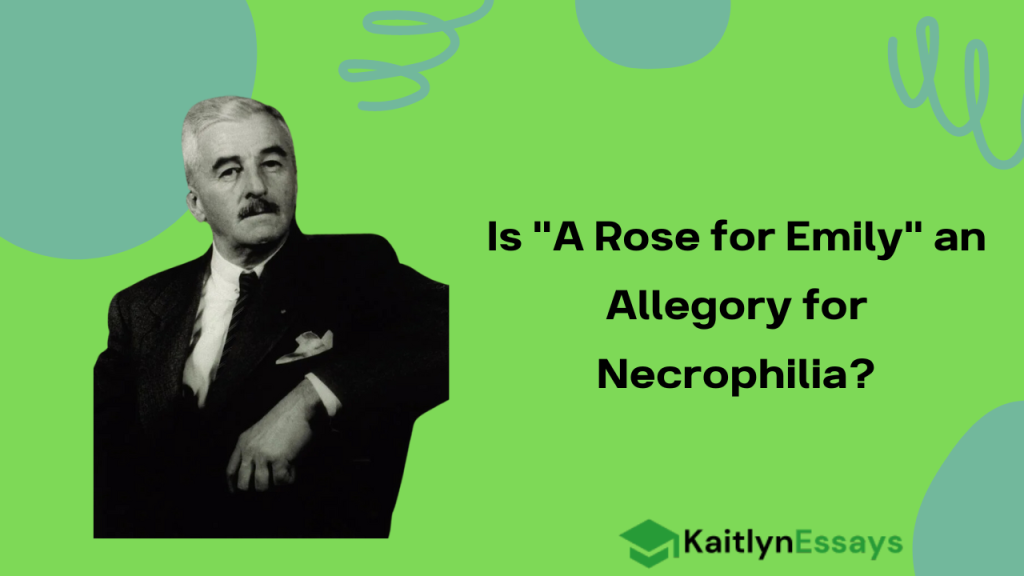
William Faulkner’s “A Rose for Emily” has sparked intense debate and speculation among literary scholars regarding its underlying themes and symbolism. One of the most controversial interpretations suggests that the story serves as an allegory for necrophilia, the sexual attraction to corpses. This reading of the text explores deep and dark aspects of human psychology and societal taboos. It challenges readers to face uncomfortable truths about desire, death, and the lengths people might go to keep their illusions of love and companionship. Supporters of this view believe that Faulkner purposely created a story filled with symbolic elements and subtle hints pointing to necrophilic themes.
However, it’s important to remember that not everyone agrees with this interpretation. It is still a topic of much debate among scholars and critics. They continue to discuss Faulkner’s intentions, the historical and cultural context of the story, and the different layers of meaning that can be found in the text. In this paper, we will critically examine the allegory for necrophilia interpretation, carefully exploring the textual evidence that supports this reading.
Overview of “A Rose for Emily”
“A Rose for Emily” is a short story by American author William Faulkner, first published in 1930. The story is set in the fictional town of Jefferson, Mississippi, and revolves around the life and death of Miss Emily Grierson, a reclusive figure in the community.
Key elements of the story include:
- Narrative structure: The story is told in a non-linear fashion, jumping back and forth in time. This fragmented narrative style contributes to the mystery surrounding Emily and her life.
- Point of view: The narrator speaks in the first-person plural (“we”), representing the collective voice of the townspeople. This unique perspective allows readers to see Emily through the lens of community gossip and speculation.
- Setting: The story takes place in the post-Civil War American South, a time of significant social and economic change. This backdrop is crucial to understanding Emily’s character and her resistance to change.
- Main character: Emily Grierson is portrayed as a tragic figure, clinging to the past and unable to adapt to the changing world around her. She comes from a once-prominent family that has fallen into decline.
- Plot: The story spans several decades, covering key events in Emily’s life, including her father’s death, her brief relationship with Homer Barron, and her increasing isolation from the town. The shocking revelation at the end of the story – the discovery of Homer’s corpse in Emily’s bed – is the culmination of years of mystery and speculation.
- Themes: The story explores themes such as the decay of the Old South, the struggle between tradition and progress, isolation and mental illness, the power of denial, and the morbid fascination of the townspeople with Emily’s life.
- Symbolism: Various elements in the story carry symbolic weight, from Emily’s house representing the decaying Old South to the strand of gray hair found on the pillow next to Homer’s corpse, symbolizing love and death intertwined.
Struggling to find the time to write your literature assignment?
If you’re finding it difficult to carve out the time needed to research, analyze, and write a comprehensive literature review, our academic writing service is here to assist.
What is Necrophilia
Necrophilia is a paraphilia characterized by sexual attraction to or sexual acts involving corpses. It’s a complex and disturbing psychological phenomenon that is widely considered taboo and is illegal in most jurisdictions. Here’s a more detailed explanation:
- Definition: Necrophilia, also known as thanatophilia or necrolagnia, involves a sexual attraction to or sexual activity with dead bodies.
- Classification: It’s classified as a paraphilia, which is a condition characterized by atypical sexual interests or behaviors.
- Types: Researchers have identified various types of necrophilia, ranging from fantasies about dead bodies to actually engaging in sexual acts with corpses.
- Psychological Aspects: The motivations behind necrophilia can be complex and may involve issues of control, fear of rejection, or a desire for an unresisting partner.
- Legal Status: Necrophilia is illegal in most countries and is generally considered a form of corpse desecration or abuse.
- Cultural Representations: While taboo, the concept has appeared in literature, film, and other media, often as a symbol of extreme deviance or psychological disturbance.
- Diagnosis and Treatment: As with other paraphilias, diagnosis and treatment typically involve psychological evaluation and therapy.
- Rarity: True necrophilia is considered extremely rare, with very few documented cases.
Analysis of Allegations
Allegation 1: The Corpse in Emily’s Home
The discovery of Homer Barron’s corpse in Emily’s home is undoubtedly the most shocking and pivotal moment in “A Rose for Emily.” This revelation, which occurs at the very end of the story, serves as the linchpin for the necrophilia interpretation. Let’s examine this allegation in more detail:
- The Discovery: After Emily’s death, the townspeople enter a room in her house that had been locked for decades. There, they find Homer Barron’s corpse lying on the bed, in an advanced state of decay. This discovery is described in chilling detail: “The body had apparently once lain in the attitude of an embrace, but now the long sleep that outlasts love, that conquers even the grimace of love, had cuckolded him.”
- Time Frame: The story suggests that Homer disappeared shortly after his last public appearance with Emily, which occurred many years before her death. This implies that Emily had kept Homer’s corpse in her home for an extended period, possibly decades.
- Evidence of Continued Presence: The narration notes that the room was set up as a bridal chamber, with items laid out as if for a newlywed couple. This includes men’s toiletries and a suit of clothing, suggesting a disturbing attempt at maintaining the illusion of Homer’s living presence.
- The Indentation and the Hair: Perhaps the most unsettling detail is the description of “a long strand of iron-gray hair” found on the pillow next to Homer’s corpse. This implies that Emily had been lying next to the body, possibly engaging in some form of intimate contact.
- Psychological Implications: Proponents of the necrophilia interpretation argue that Emily’s actions go beyond mere preservation of the body. They suggest that her behavior indicates a sexual or romantic attachment to the corpse, stemming from her inability to let go of Homer and her desire to maintain control over him.
- Historical Context: Some scholars have drawn parallels between Emily’s actions and historical accounts of necrophilia, particularly in the context of 19th-century attitudes towards death and corpse preservation.
- Alternative Interpretations: It’s important to note that while the presence of the corpse is undeniable, its meaning is open to interpretation. Some argue that Emily’s actions represent extreme grief or mental illness rather than sexual deviance. Others see it as a metaphor for the South’s inability to let go of the past.
- Textual Ambiguity: Faulkner’s narrative style, which relies heavily on implication rather than explicit statement, leaves room for multiple interpretations. The story never directly states that Emily engaged in necrophilic acts, allowing readers to draw their own conclusions.
This allegation forms the cornerstone of the necrophilia interpretation, but it’s crucial to consider it in the context of the entire story and to recognize that while it’s a compelling argument, it’s not the only possible reading of these events. The ambiguity Faulkner maintains throughout the story ensures that this remains a topic of ongoing debate among literary scholars and readers.
Allegation 2: Emily’s Obsession with Death

Emily Grierson’s apparent fixation on death is a recurring theme throughout “A Rose for Emily,” and it forms a crucial part of the argument for the necrophilia interpretation. This obsession manifests in various ways throughout the narrative:
- Denial of Her Father’s Death: When Emily’s father dies, she refuses to acknowledge his death for three days, insisting to the townspeople that he is still alive. The narrator describes how she “told them that her father was not dead. She did this for three days.” This denial of death foreshadows her later behavior with Homer’s corpse.
- The Portrait of Her Father: Even after her father’s burial, Emily keeps a “crayon portrait” of him prominently displayed. This suggests an inability to let go of the past and those who have died.
- Purchase of Arsenic: Emily’s purchase of arsenic, ostensibly to kill rats, takes on a sinister tone when considered in light of Homer’s subsequent disappearance. Her calm demeanor when buying a deadly poison implies a comfort with the concept of death.
- Refusal to Accept Change: Emily’s resistance to change, such as refusing to have a mailbox or to pay taxes, can be seen as a metaphorical denial of the passage of time and, by extension, mortality itself.
- Isolation After Homer’s Disappearance: Following Homer’s presumed death, Emily becomes increasingly reclusive. This withdrawal from society could be interpreted as a retreat into a world where death holds no power, where she can maintain the illusion of Homer’s presence.
- The “Bridal” Chamber: The preservation of the room where Homer’s body is found, set up like a bridal chamber, suggests a macabre attempt to freeze time at the moment of their intended union, denying the reality of death.
- Emily’s Own Death: Even Emily’s death is shrouded in mystery, with the old servant admitting people to the funeral and then disappearing, as if completing a long-planned scenario.
- Psychological Interpretation: From a psychological perspective, Emily’s obsession with death could be seen as a coping mechanism for dealing with loss and change. Unable to accept the natural progression of life and death, she attempts to control and preserve what she can.
- Symbolic Interpretation: On a symbolic level, Emily’s fixation on death could represent the South’s inability to let go of its past, clinging to outdated ideals and resisting the changes brought by modernization.
- Cultural Context: It’s worth considering the Victorian-era fascination with death and mourning rituals, which might have influenced Faulkner’s portrayal of Emily’s behavior.
- Narrative Ambiguity: As with other aspects of the story, Faulkner never explicitly states that Emily is obsessed with death. Instead, he presents a series of actions and behaviors that lead the reader to this conclusion.
While Emily’s apparent obsession with death is evident throughout the story, it’s important to note that this behavior could be interpreted in multiple ways. It could indeed support the necrophilia theory, but it could also be seen as a manifestation of severe grief, mental illness, or a metaphor for broader themes about the Old South’s resistance to change. The ambiguity in Faulkner’s narrative allows for these multiple interpretations, contributing to the story’s enduring intrigue and debate.
Allegation 3: Symbolism and Imagery
Faulkner’s use of symbolism and imagery in “A Rose for Emily” is rich and complex, providing fertile ground for various interpretations, including the necrophilia theory. Let’s examine the key elements:
- The Grierson Mansion:
- Symbol of Decay: The once-grand house falls into disrepair, mirroring Emily’s own decline and the decay of the Old South.
- Isolation: The house stands apart from the modernizing town, representing Emily’s isolation from society and her resistance to change.
- Hidden Secrets: The locked upstairs room symbolizes the dark secrets hidden within Emily’s life.
- The Pervasive Odor:
- Physical Decay: The “strong and nauseating” smell emanating from Emily’s house is later revealed to be Homer’s decomposing body.
- Moral Decay: The odor could symbolize the moral corruption underlying the seemingly respectable facade of Southern society.
- Willful Ignorance: The townspeople’s response to the odor (sprinkling lime around the house rather than investigating) represents their willingness to ignore uncomfortable truths.
- Dust and Decay:
- Time’s Passage: The omnipresent dust in Emily’s house symbolizes the passage of time and Emily’s attempt to stop it.
- Preservation and Death: The “thin, acrid pall as of the tomb” that hangs in the house links preservation with death.
- The Portrait of Emily’s Father:
- Control and Oppression: The portrait symbolizes the lasting influence of Emily’s domineering father, even after his death.
- Past vs. Present: Its prominent display represents Emily’s inability to move beyond the past.
- The Strand of Gray Hair:
- Love and Death Intertwined: The hair found on the pillow next to Homer’s corpse is a potent symbol of the intertwining of love and death in Emily’s mind.
- Passage of Time: The gray color of the hair indicates the years Emily spent lying next to the corpse.
- The Rose:
- While never explicitly mentioned in the story, the title’s “rose” could symbolize love, respect, or pity for Emily.
- In the context of necrophilia, it might represent a perversion of romantic love.
- The Watch and Ticking:
- The invisible watch ticking in Emily’s chest symbolizes the relentless passage of time that Emily tries to resist.
- The Tableau of Emily in the Window:
- The image of Emily and her father silhouetted in the window represents the stasis Emily tries to maintain in her life.
- The Crayon Portrait:
- The outdated medium of the portrait symbolizes Emily’s attachment to obsolete ways of life.
- Colors:
- The contrast between the “light” of modernity and progress and the “darkness” of Emily’s house and life is a recurring motif.
Interpretation: Proponents of the necrophilia theory argue that these symbols and images collectively create an atmosphere of death, decay, and morbid preservation that supports their interpretation. They suggest that Faulkner deliberately constructed this imagery to hint at the darker themes of necrophilia without explicitly stating them.
However, it’s important to note that these symbols and images are open to multiple interpretations. They could equally support readings focused on the decay of the Old South, the psychological effects of isolation and oppression, or the conflict between tradition and progress.
The richness and ambiguity of Faulkner’s symbolism allow for multiple valid interpretations, which contributes to the enduring fascination and debate surrounding “A Rose for Emily.” While these elements can support the necrophilia interpretation, they don’t conclusively prove it, leaving room for ongoing scholarly discussion and analysis.
Alternative Interpretations
While the necrophilia interpretation of “A Rose for Emily” has gained traction among some scholars, it is essential to consider alternative interpretations that offer different perspectives on the text.
Psychological Trauma and Isolation
While the necrophilia interpretation of “A Rose for Emily” is provocative, many scholars and readers argue for alternative readings that focus on psychological trauma and isolation. This perspective offers a good understanding of Emily’s character and actions without resorting to more extreme explanations. Let’s explore this interpretation in depth:
- Troubled Upbringing:
- Domineering Father: Emily’s father is described as a controlling figure who drove away all of Emily’s suitors. This overbearing presence likely stunted Emily’s emotional and social development.
- Isolation from Peers: The text suggests that Emily had few, if any, close relationships outside her family, depriving her of normal social experiences and emotional support.
- Societal Expectations and Pressure:
- Class Expectations: As a member of the once-prominent Grierson family, Emily would have faced intense pressure to maintain appearances and uphold family honor.
- Gender Roles: In the post-Civil War South, women of Emily’s class were expected to marry and fulfill specific social duties, creating additional stress for the unmarried Emily.
- Grief and Loss:
- Father’s Death: Emily’s refusal to acknowledge her father’s death for three days suggests an inability to process grief healthily.
- Loss of Status: The decline of the Grierson family’s prominence may have been a source of ongoing distress for Emily.
- Symptoms of Mental Illness:
- Denial: Emily’s rejection of reality (e.g., refusing to accept her father’s death, denying the passage of time) could indicate a dissociative disorder.
- Paranoia: Her increasing isolation and refusal to engage with the changing world around her might suggest paranoid tendencies.
- Possible Depression: Emily’s withdrawal from society and neglect of her home and appearance could be symptoms of depression.
- Coping Mechanisms:
- Control: Keeping Homer’s body could be seen as an extreme attempt to maintain control in a world where Emily felt powerless.
- Preservation of the Past: Emily’s actions might represent a desperate attempt to freeze time and preserve a moment when she felt happiest or most secure.
- Trauma Response:
- PTSD: Emily’s behavior could be interpreted as a response to trauma, possibly stemming from her oppressive upbringing or the rapid changes in her society.
- Complicated Grief: Her inability to let go of Homer might indicate a severe, pathological form of grief.
- Social Isolation:
- Lack of Support System: Without friends or family to provide emotional support, Emily may have developed maladaptive coping strategies.
- Reinforcing Cycle: As Emily became more isolated, her behavior likely became more eccentric, leading to further isolation from the community.
- Historical Context:
- Changing Society: The rapid changes in the post-Civil War South may have been particularly distressing for someone like Emily, who was ill-equipped to adapt.
- Limited Mental Health Understanding: In Emily’s time, mental health issues were poorly understood and often stigmatized, leaving her without proper support or treatment.
This interpretation views Emily as a tragic figure, shaped by trauma, societal pressures, and isolation rather than as someone driven by deviant sexual desires. It suggests that her actions, while extreme, stem from deep-seated psychological issues and a desperate need to maintain control and connection in a world that had left her behind.
This perspective allows for a more sympathetic reading of Emily’s character while still acknowledging the disturbing nature of her actions. It also opens up broader discussions about mental health, societal pressures, and the long-term effects of isolation and trauma.
Social Commentary on Tradition and Decay

Another interpretation posits that “A Rose for Emily” serves as a social commentary on the decline of the Old South and the fading aristocracy. The decay and decline depicted in the story symbolize broader societal changes, with Emily serving as a tragic figure caught in the grip of tradition and decay.
Gothic Horror and Macabre Atmosphere
The Southern Gothic interpretation of “A Rose for Emily” places the story firmly within a literary tradition that emphasizes the dark, grotesque, and mysterious aspects of the American South. This perspective views Emily’s actions and the story’s events as elements of a broader Gothic narrative rather than evidence of necrophilia. Let’s explore this interpretation in detail:
- Elements of Southern Gothic:
- Decay and Ruin: The Grierson house, once grand but now dilapidated, embodies the decay of the Old South.
- Eccentric Characters: Emily herself is the quintessential Southern Gothic character – reclusive, mysterious, and psychologically complex.
- Dark Family Secrets: The revelation of Homer’s corpse represents the hidden secrets often found in Southern Gothic tales.
- Oppressive Atmosphere: The story’s setting, with its sense of stagnation and decay, contributes to an overall feeling of oppression.
- The Macabre:
- Death Obsession: Emily’s refusal to part with her father’s body and her preservation of Homer’s corpse reflect the genre’s preoccupation with death.
- Grotesque Imagery: The description of the corpse and the “long strand of iron-gray hair” are classic examples of macabre imagery.
- Psychological Horror:
- Emily as a Living Ghost: Her spectral presence in the town, rarely seen but often discussed, adds to the eerie atmosphere.
- Mental Deterioration: The gradual revelation of Emily’s mental state creates a sense of psychological horror.
- Symbolism:
- The Rose: In Gothic literature, roses often symbolize love tainted by death or the passage of time.
- The House: Emily’s home serves as a Gothic castle, a place of mystery and potential danger.
- Narrative Technique:
- Non-linear Storytelling: The fragmented, non-chronological narrative adds to the sense of disorientation and mystery.
- Unreliable Narration: The collective voice of the town leaves room for speculation and unreliability, enhancing the Gothic feel.
- Themes of Entrapment:
- Physical Isolation: Emily’s self-imposed seclusion in her home mirrors Gothic themes of imprisonment.
- Psychological Entrapment: Emily’s inability to move beyond her past represents mental confinement.
- The Uncanny:
- Familiar Made Strange: The transformation of Emily’s house from a symbol of aristocracy to a place of horror exemplifies the Gothic concept of the uncanny.
- Historical Context:
- Post-Civil War Setting: The story’s setting in a changing South adds to the sense of a world in decay, a common Gothic theme.
- Faulkner’s Literary Influences:
- Edgar Allan Poe: Faulkner’s story shares themes with Poe’s works, particularly in its exploration of love, death, and madness.
- Subversion of Romanticism:
- Dark Romance: The preservation of Homer’s body can be seen as a grotesque subversion of romantic ideals, a common Gothic trope.
This Gothic horror interpretation views Emily’s actions not as evidence of necrophilia, but as part of a larger tapestry of macabre elements designed to create an atmosphere of unease and horror. Her preservation of Homer’s body becomes less about sexual deviance and more about the story’s overall exploration of themes like the inability to let go of the past, the decay of the Old South, and the horrors that can lurk behind respectable facades.
This reading allows for a rich analysis of the story’s literary techniques and its place within the Southern Gothic tradition. It acknowledges the disturbing nature of Emily’s actions while contextualizing them within a broader literary framework focused on creating a sense of horror and unease.
Conclusion: The Complexity of Interpretation
While the necrophilia interpretation of “A Rose for Emily” offers a provocative lens through which to view the text, it is essential to approach such allegations with caution and skepticism. Faulkner’s story is a complex and multi-layered work of literature that invites multiple interpretations, and reducing it to a single allegory oversimplifies its richness and depth. Ultimately, whether “A Rose for Emily” is an allegory for necrophilia or not remains open to interpretation, highlighting the complexity of Faulkner’s storytelling and the enduring fascination with his work.
Running out of time to complete your literature review?
If you’re feeling the pressure of a looming deadline, our team of professional writers can step in and provide the support you need. We’ll work efficiently to gather the relevant sources, analyze the key findings, and write a polished literature review that showcases your understanding of the topic.
FAQs
What is “A Rose for Emily” about?
“A Rose for Emily” is a short story written by William Faulkner. It explores the life of Emily Grierson, a reclusive woman from a once-prominent family in the town of Jefferson. The story examines the themes of tradition, decay, and the human condition.
Who is the author of “A Rose for Emily”?
“A Rose for Emily” was written by William Faulkner, an American author renowned for his contributions to Southern Gothic literature. Faulkner was awarded the Nobel Prize in Literature in 1949 for his literary achievements.
What genre does “A Rose for Emily” belong to?
“A Rose for Emily” is often categorized as Southern Gothic literature, a subgenre of Gothic fiction that explores themes of decay, madness, and the macabre. It is also considered a work of modernist literature due to its experimental narrative structure and thematic complexity.
When was “A Rose for Emily” published?
“A Rose for Emily” was first published in 1930 in the literary magazine “The Forum.” It later appeared in Faulkner’s collection of short stories titled “Collected Stories of William Faulkner,” published by Random House in 1950.
What are some common themes in “A Rose for Emily”?
Some common themes in “A Rose for Emily” include decay, isolation, tradition versus change, the passage of time, and the complexities of human relationships. These themes are explored through the character of Emily Grierson and the town of Jefferson.
Is “A Rose for Emily” based on a true story?
“A Rose for Emily” is a work of fiction and is not based on a true story. However, Faulkner drew inspiration from various sources, including his own experiences growing up in the American South, to create the narrative and characters in the story.
What is the significance of the title “A Rose for Emily”?
The title “A Rose for Emily” carries multiple layers of meaning. It can be interpreted as a tribute to Emily Grierson, symbolizing both beauty and decay. Additionally, the title hints at the theme of lost love and the passage of time, as roses are often associated with romance and mortality.
Why is “A Rose for Emily” considered a classic?
“A Rose for Emily” is considered a classic of American literature due to its thematic depth, complex characters, and innovative narrative structure. Faulkner’s exploration of Southern identity, tradition, and the human psyche has cemented the story’s status as a timeless masterpiece.
What are some literary devices used in “A Rose for Emily”?
Faulkner employs various literary devices in “A Rose for Emily,” including symbolism, imagery, foreshadowing, and nonlinear narrative structure. These devices enhance the story’s themes and create a rich and immersive reading experience.
Where can I read “A Rose for Emily”?
“A Rose for Emily” is widely available in anthologies of Faulkner’s works, as well as in many literature textbooks and online databases. It is also in the public domain, so it can be found for free on websites dedicated to classic literature.
What is the controversy surrounding the interpretation of “A Rose for Emily” as an allegory for necrophilia?
The controversy arises from interpretations of certain elements in the story, such as the discovery of Homer Barron’s corpse in Emily’s home and Emily’s morbid fascination with death, as evidence of necrophilic themes.
What evidence supports the necrophilia interpretation of “A Rose for Emily”?
Supporters of this interpretation point to the discovery of Homer Barron’s decomposed corpse in Emily’s home, Emily’s refusal to let go of the dead, and her obsession with preserving the memory of her deceased loved ones as evidence of necrophilic tendencies.
Works Cited
Faulkner, William. “A Rose for Emily.” Collected Stories of William Faulkner. Random House, 1950.