

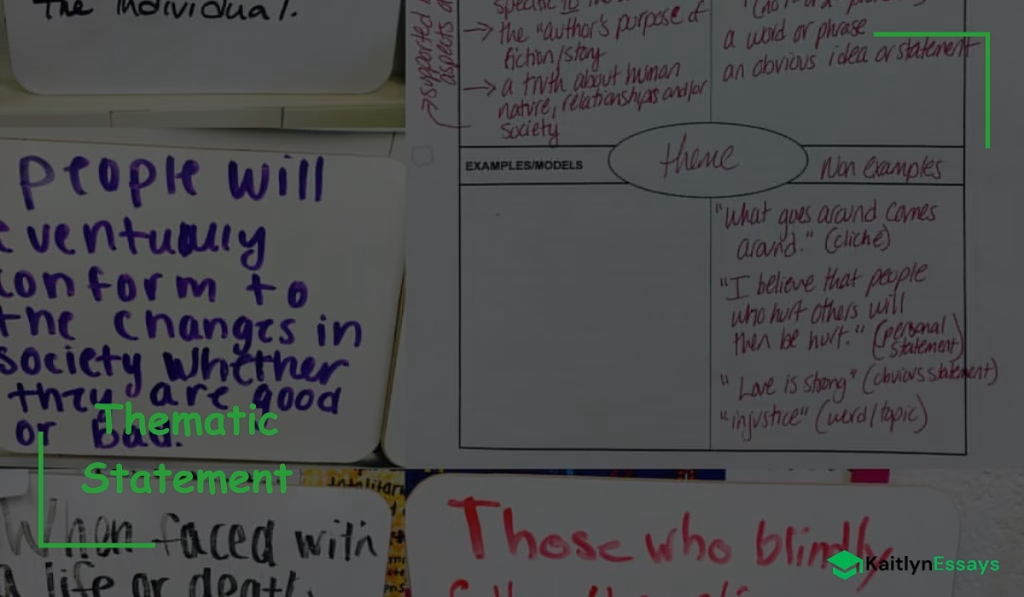
A thematic statement is a clear expression of the central idea or message in a literary work. It captures what the author is saying about life, society, or human nature through the story’s characters, events, and outcomes. Writing a strong thematic statement requires more than identifying a topic like love, power, or freedom—it involves explaining what the text says about that topic. This skill is essential for students, writers, and readers who want to engage with literature on a deeper level. A well-crafted thematic statement provides direction for essays, helps uncover meaning in texts, and strengthens critical thinking. In this article, we will explain what a thematic statement is, how to write one effectively, and common mistakes to avoid.
What is a Thematic Statement?
A thematic statement is a complete sentence that expresses the central message, lesson, or insight about life that a work of literature, film, or other artistic work conveys. It goes beyond simply identifying a theme (like “love” or “revenge”) to articulate what the work is actually saying about that theme.
Characteristics of a Good Thematic Statement
1. Complete Sentence Structure
A good thematic statement must be expressed as a complete, grammatically correct sentence rather than a phrase or fragment. This completeness ensures that the statement makes a clear assertion about the human condition or life experience.
Weak example: “Love and sacrifice” Strong example: “Love often requires personal sacrifice that ultimately leads to deeper fulfillment”
The complete sentence structure forces the writer to move beyond mere topic identification to actual analysis of what the work communicates about that topic.
2. Specificity and Precision
Effective thematic statements avoid vague generalities and instead offer specific insights. They should be precise enough to distinguish the particular work’s message from generic platitudes about life.
Vague: “Good always triumphs over evil” Specific: “True victory over corruption comes through maintaining personal integrity rather than adopting the enemy’s methods”
The specific version captures nuance and reflects careful analysis of how the theme actually develops within the text, rather than relying on oversimplified moral absolutes.
3. Universal Relevance
While being specific to the work, a good thematic statement should express insights that resonate with universal human experiences. It should speak to truths that extend beyond the particular characters and situations in the text.
Too narrow: “Hamlet’s indecision leads to his downfall” Universal: “Excessive contemplation without decisive action can result in missed opportunities and tragic consequences”
The universal version allows readers to connect the theme to their own lives while remaining true to the text’s specific exploration of the concept.
4. Avoidance of Absolute Language
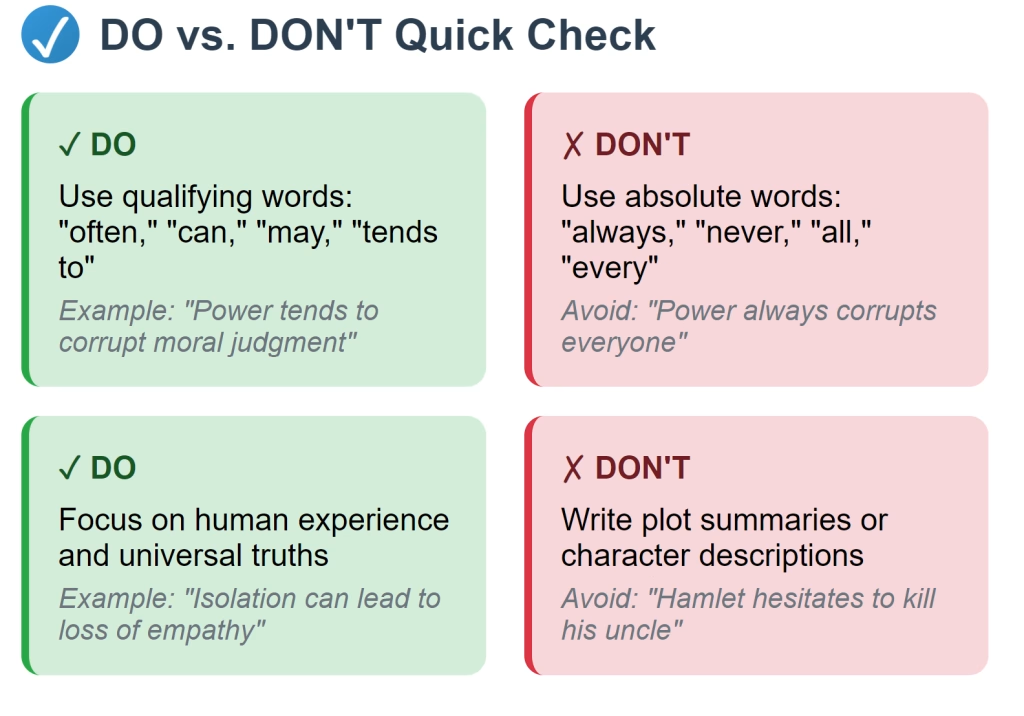
Strong thematic statements typically avoid words like “always,” “never,” “all,” or “every” because literature rarely presents absolute truths. Instead, they use qualified language that acknowledges complexity and nuance.
Absolute: “Power always corrupts completely” Nuanced: “Unchecked power tends to compromise moral judgment and personal relationships”
The nuanced version better reflects how literature actually explores themes—with complexity rather than simple moral pronouncements.
5. Textual Support and Evidence
A good thematic statement should be demonstrable through multiple elements within the work, including plot events, character development, symbolism, setting, and literary devices. It should emerge from the text rather than being imposed upon it.
Unsupported: “The story shows that technology is evil” Supported: “Excessive reliance on technology can diminish human connection and authentic experience”
The supported version can be backed up with specific examples from character interactions, plot developments, and symbolic elements throughout the work.
6. Focus on Human Experience
Effective thematic statements center on aspects of human nature, relationships, society, or the human condition. They address questions about how people live, what motivates behavior, or what gives life meaning.
Non-human focused: “The setting creates a dark atmosphere” Human-focused: “Isolation from community can lead to moral decay and loss of identity”
The human-focused version connects the literary elements to broader questions about human experience and behavior.
7. Originality and Insight
A strong thematic statement offers fresh perspective rather than restating obvious or clichéd observations. It should demonstrate genuine analytical thinking about the work’s deeper meanings.
Clichéd: “Crime doesn’t pay” Insightful: “The pursuit of justice through illegal means often creates moral ambiguity that undermines the original noble intentions”
The insightful version reveals sophisticated thinking about moral complexity rather than settling for surface-level observations.
8. Appropriate Scope
Good thematic statements match their scope to the work being analyzed. They shouldn’t be so broad as to apply to any work, nor so narrow as to miss the work’s larger significance.
Too broad: “People face challenges in life” Too narrow: “Jay Gatsby throws parties to impress Daisy” Appropriate scope: “The pursuit of an idealized past can prevent individuals from accepting present realities and finding genuine fulfillment”
The appropriately scoped version captures the specific way the work explores universal human tendencies without being overly general or restrictively specific.
9. Analytical Rather Than Plot-Based
Strong thematic statements focus on meaning and insight rather than simply describing what happens in the story. They interpret rather than summarize.
Plot-based: “Romeo and Juliet die because of their families’ feud” Analytical: “Blind hatred and prejudice can destroy innocent love and perpetuate cycles of violence across generations”
The analytical version explains the significance of events rather than merely describing them.
10. Complexity and Sophistication
Effective thematic statements acknowledge the sophisticated nature of literary works by avoiding oversimplification. They may incorporate multiple related ideas or acknowledge tensions and contradictions within the theme.
Oversimplified: “Friendship is important” Complex: “True friendship requires both loyalty and the courage to challenge friends when they make harmful choices”
The complex version recognizes that meaningful themes often involve tensions between competing values or ideas.
How to Identify the Theme in a Text
1. Read Actively and Annotate
Begin with a careful, active reading of the text. Take notes on significant passages, recurring images, and moments that seem particularly meaningful or emotionally resonant.
What to look for:
- Moments of conflict or tension
- Character revelations or changes
- Symbolic elements
- Repeated words, phrases, or images
- The climax and resolution
2. Analyze Character Development
Characters are often the primary vehicles through which themes are explored. Examine how characters change, what they learn, and what their experiences reveal about human nature.
Key questions to ask:
- How do the main characters change from beginning to end?
- What do characters learn about themselves or life?
- What do characters’ choices reveal about values and priorities?
- How do characters’ flaws or strengths drive the plot?
3. Examine Conflict and Resolution
The central conflicts in a story often point directly toward its themes. Analyze both external conflicts (character vs. society, nature, or other characters) and internal conflicts (character vs. self).
Consider:
- What is the primary conflict in the story?
- How is the conflict resolved, if at all?
- What does the resolution suggest about the human condition?
- Are there unresolved conflicts, and what might they signify?
4. Look for Patterns and Repetition
Authors often emphasize themes through repetition of symbols, motifs, imagery, or situations. These recurring elements create patterns that point toward central meanings.
Elements to track:
- Repeated symbols or metaphors
- Recurring situations or scenarios
- Patterns in character behavior
- Cyclical events or structures
5. Analyze the Title and Epigraphs
Titles often provide direct clues to a work’s central themes. Similarly, epigraphs (quotations at the beginning of a work) frequently hint at the author’s thematic intentions.
Questions to consider:
- How does the title relate to the story’s events and meanings?
- What additional insight does the title provide after reading the complete work?
- If present, how do epigraphs illuminate the work’s themes?
6. Examine Setting and Atmosphere
The time, place, and mood of a story can reinforce or symbolize its themes. Consider how the setting contributes to the overall meaning.
Analytical approaches:
- How does the physical setting reflect characters’ internal states?
- What does the historical or social context contribute to the theme?
- How does the atmosphere support or contrast with the action?
7. Study Dialogue and Internal Monologue
Characters’ words and thoughts often contain explicit or implicit commentary on the work’s themes. Pay attention to moments of reflection, argument, or revelation.
Focus areas:
- Philosophical discussions between characters
- Moments of self-reflection or realization
- Arguments that reveal conflicting values
- Final words or thoughts of significant characters
8. Consider the Author’s Style and Tone
The way an author tells a story—their tone, style, and narrative choices—can reinforce thematic content. Consider how technical elements support meaning.
Technical elements to analyze:
- Point of view and its effects
- Narrative structure and organization
- Language choices and diction
- Pacing and emphasis
Common Thematic Categories
While themes are unique to each work, certain categories appear frequently in literature:
Universal Human Experiences
- Coming of age and maturation
- Love and relationships
- Death and mortality
- Good versus evil
- Individual versus society
Social and Political Themes
- Justice and injustice
- Power and corruption
- Class and social mobility
- Prejudice and discrimination
- Freedom and oppression
Psychological and Philosophical Themes
- Identity and self-discovery
- Appearance versus reality
- Knowledge and ignorance
- Fate versus free will
- Isolation and belonging
Strategies for Complex or Ambiguous Texts
Multiple Theme Identification
Many sophisticated works contain multiple, interconnected themes. Don’t assume a text has only one central message.
Approach:
- Identify several potential themes
- Examine how they relate to each other
- Consider which theme seems most central or unifying
Dealing with Ambiguity
Some texts deliberately resist simple thematic interpretation. This ambiguity itself may be part of the work’s meaning.
When encountering ambiguity:
- Acknowledge multiple possible interpretations
- Consider why the author might have chosen ambiguity
- Look for themes about uncertainty, complexity, or the nature of truth itself
Research and Context
Historical and Biographical Context
Understanding the author’s life, historical period, and cultural context can illuminate thematic concerns.
Useful resources:
- The Literature Network – Provides biographical and historical context for classic authors
- Literary History – Comprehensive overview of literary periods and movements
Critical Perspectives
Reading scholarly analyses can provide insights into how others have interpreted a work’s themes, though personal analysis should come first.
Academic resources:
- JSTOR – Academic articles and literary criticism
- Project MUSE – Scholarly literature database
- MLA International Bibliography – Comprehensive database of literary scholarship
Common Pitfalls to Avoid
1. Confusing Theme with Topic
Remember that a theme is a complete statement about life, not just a subject area.
2. Being Too Literal
Themes often operate on symbolic or metaphorical levels rather than literal ones.
3. Imposing External Beliefs
Let themes emerge from the text rather than forcing your own beliefs onto the work.
4. Oversimplification
Avoid reducing complex works to simple moral lessons or clichés.
5. Ignoring Contradictions
Many great works contain thematic tensions or contradictions that should be acknowledged rather than resolved artificially.
Tools and Techniques for Organization
Theme Tracking Charts
Create visual aids to track how themes develop throughout a work:
- Character development charts
- Symbol and motif trackers
- Conflict analysis diagrams
Close Reading Techniques
Practice detailed analysis of specific passages that seem thematically significant:
- Annotate word choices and their connotations
- Analyze sentence structure and rhythm
- Examine figurative language and its implications
Digital Resources and Tools
Online Literary Databases
- Literature Online (LION) – Comprehensive literary database
- Gale Literature Criticism – Critical essays and analysis
Educational Websites
- Shmoop – Accessible literary analysis and themes
- SparkNotes – Study guides with thematic analysis
- CliffsNotes – Detailed literary analysis guides
Academic Writing Resources
- Purdue OWL – Guidelines for literary analysis writing
- Writing Center at UNC – Literary analysis techniques
How to Write a Thematic Statement

The Formula Approach
Basic Structure
Subject + Assertion = Thematic Statement
- Subject: The thematic topic (love, power, justice, etc.)
- Assertion: What the work says about that subject
Example:
- Subject: Ambition
- Assertion: Unchecked ambition leads to moral corruption and self-destruction
- Thematic Statement: “Unchecked ambition leads to moral corruption and self-destruction.”
Step-by-Step Writing Process
Step 1: Identify the Thematic Topic
Begin by determining what broad human experience or concept the work explores. Common thematic topics include:
Personal Growth Topics:
- Identity and self-discovery
- Coming of age
- Moral development
- Personal responsibility
Relationship Topics:
- Love and sacrifice
- Family dynamics
- Friendship and loyalty
- Betrayal and trust
Social Topics:
- Justice and injustice
- Power and corruption
- Class and social mobility
- Tradition versus change
Philosophical Topics:
- Appearance versus reality
- Fate versus free will
- Knowledge and ignorance
- Good versus evil
Step 2: Analyze How the Topic Develops
Examine how the chosen topic unfolds throughout the work:
Character Analysis:
- How do characters embody or struggle with the theme?
- What do their choices reveal about the thematic concept?
- How do character arcs illuminate the theme?
Plot Analysis:
- What events highlight the thematic concept?
- How does the conflict relate to the theme?
- What does the resolution suggest about the theme?
Literary Device Analysis:
- What symbols reinforce the theme?
- How do metaphors and imagery support thematic development?
- What does the setting contribute to thematic meaning?
Step 3: Formulate Your Assertion
Based on your analysis, determine what the work specifically says about your chosen topic. Ask yourself:
- What lesson does the work teach about this aspect of life?
- What insight does it offer about human nature or experience?
- What conclusion can readers draw about this topic from the work?
Step 4: Write and Refine
Combine your topic and assertion into a clear, complete sentence. Then refine it using the characteristics of effective thematic statements.
Writing Techniques and Strategies
Use Active Voice
Active voice creates stronger, more direct statements that clearly attribute agency and causation.
Weak (Passive): “Revenge is shown to be destructive” Strong (Active): “The pursuit of revenge ultimately destroys both the seeker and the target”
Choose Precise Language
Select specific, meaningful words that capture the nuance of your interpretation.
Vague: “Love is complicated” Precise: “True love requires accepting both the strengths and flaws of another person”
Include Cause and Effect
Strong thematic statements often express relationships between actions and consequences, revealing the work’s insights about how life operates.
Simple: “War changes people” Cause and Effect: “Extended exposure to violence and death in war erodes soldiers’ capacity for compassion and connection”
Acknowledge Complexity
Sophisticated thematic statements recognize that literature rarely presents simple answers to complex human questions.
Oversimplified: “Hard work leads to success” Complex: “While dedication and effort are necessary for achievement, success also depends on circumstances beyond individual control”
Common Formulation Patterns
The Conditional Pattern
“When [condition], [result occurs]”
Example: “When individuals prioritize personal gain over community welfare, society becomes fragmented and morally corrupt.”
The Consequence Pattern
“[Action/Behavior] leads to/results in [outcome]”
Example: “The refusal to confront uncomfortable truths about oneself leads to continued suffering and missed opportunities for growth.”
The Comparison Pattern
“[Concept A] versus [Concept B] reveals [insight]”
Example: “The tension between individual desires and social expectations reveals the difficulty of maintaining authentic identity in conformist societies.”
The Process Pattern
“[Process/Journey] teaches/reveals [insight]”
Example: “The journey from innocence to experience teaches that moral maturity requires accepting responsibility for one’s choices and their consequences.”
Revision and Refinement Strategies
Test for Specificity
Ask yourself: Could this statement apply to multiple works, or is it specific to the text you’re analyzing?
Too general: “People make mistakes” More specific: “Pride and stubbornness prevent individuals from acknowledging their errors until the consequences become irreversible”
Check for Support
Ensure your statement can be supported with multiple examples from the text:
- Can you identify at least three specific scenes or passages that support your statement?
- Do major characters’ experiences align with your thematic statement?
- Does the work’s resolution reinforce your assertion?
Evaluate Sophistication
Consider whether your statement reflects the complexity and depth of the literary work:
- Does it acknowledge nuance and avoid oversimplification?
- Does it capture something meaningful about human experience?
- Would it generate interesting discussion and analysis?
Assess Clarity
Ensure your statement communicates clearly to readers:
- Is the sentence grammatically correct and well-structured?
- Are your word choices precise and meaningful?
- Would someone unfamiliar with the text understand your assertion?
Examples from Classic Literature
Romeo and Juliet
Weak: “The play is about love” Strong: “Passionate love, while capable of transcending social barriers, can become destructive when it exists in isolation from wisdom and restraint”
The Great Gatsby
Weak: “Money doesn’t buy happiness” Strong: “The pursuit of an idealized past prevents individuals from accepting present realities and finding genuine fulfillment”
To Kill a Mockingbird
Weak: “Prejudice is wrong” Strong: “Moral courage requires individuals to stand against popular opinion and social pressure, even when doing so brings personal cost”
1984
Weak: “Totalitarianism is bad” Strong: “Totalitarian power maintains itself by destroying individuals’ capacity for independent thought and authentic human connection”
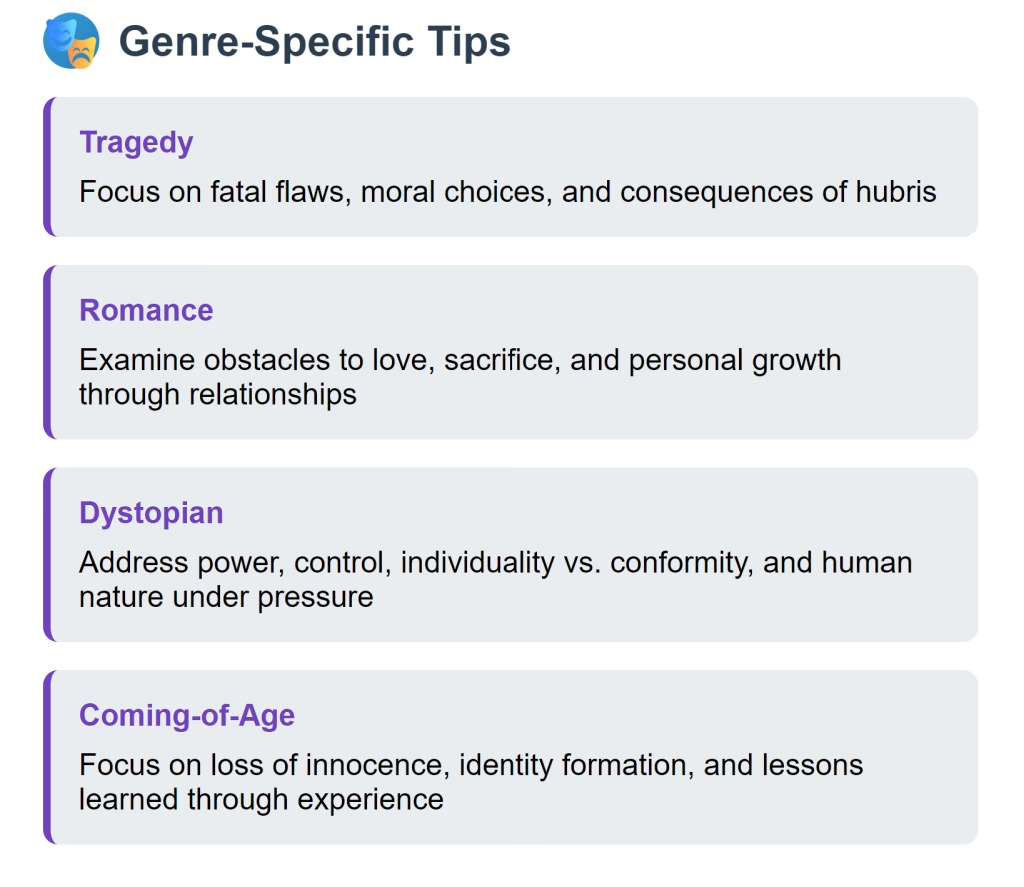
Advanced Techniques
Incorporating Paradox
Some thematic statements benefit from acknowledging apparent contradictions that the work explores:
Example: “True strength often emerges through accepting vulnerability and dependence on others”
Multi-layered Statements
Complex works may require thematic statements that address multiple related concepts:
Example: “The search for identity in a rapidly changing world reveals both the necessity of adapting to new circumstances and the importance of maintaining core values”
Universal Application with Specific Insight
Craft statements that speak to universal human experiences while offering unique perspectives:
Example: “The desire to belong can lead individuals to compromise their authentic selves, yet complete isolation prevents the growth that comes through meaningful relationships”
Common Mistakes to Avoid
1. Plot Summary Disguised as Theme
Mistake: “Macbeth kills Duncan and becomes king” Correction: “Unchecked ambition corrupts moral judgment and leads to spiritual destruction”
2. Moral Preaching
Mistake: “People should always tell the truth” Correction: “The choice between truth and kindness often reveals the complexity of ethical decision-making”
3. Biographical Fallacy
Mistake: “Hemingway shows that war is terrible because he fought in World War I” Correction: “The experience of war reveals both the fragility of human ideals and the resilience of the human spirit”
4. Cultural Assumptions
Mistake: “The novel proves that American values are superior” Correction: “Cultural conflicts reveal both the limitations and strengths inherent in different value systems”
5. Absolute Statements
Mistake: “Power always corrupts everyone completely” Correction: “Power tends to corrupt moral judgment, particularly when unchecked by accountability and self-reflection”
Integration with Literary Analysis
Using Thematic Statements as Essay Foundations
A strong thematic statement can serve as the thesis for a literary analysis essay:
- Introduction: Present the thematic statement as your thesis
- Body Paragraphs: Support the statement with textual evidence
- Analysis: Explain how literary devices develop the theme
- Conclusion: Reinforce the statement’s significance
Connecting to Broader Contexts
Consider how your thematic statement relates to:
- Historical contexts and social issues
- Other works by the same author
- Universal human experiences
- Contemporary relevance
Practice Exercises
Exercise 1: Topic to Statement Transformation
Transform these topics into complete thematic statements:
- Topic: Friendship Your Statement: ________________
- Topic: Social class Your Statement: ________________
- Topic: Growing up Your Statement: ________________
Exercise 2: Statement Improvement
Revise these weak statements to make them stronger:
- Weak: “The story is about good versus evil” Improved: ________________
- Weak: “Characters learn important lessons” Improved: ________________
Exercise 3: Evidence Gathering
For your thematic statement, identify:
- Three scenes that support your statement
- Two character examples that illustrate the theme
- One symbol that reinforces the thematic concept
FAQs
What is the difference between a theme and a thematic statement?
A theme is a broad idea or topic explored in a text (e.g., love, freedom, betrayal), while a thematic statement is a complete sentence that expresses the author’s message or insight about that theme (e.g., “True love requires sacrifice and understanding.”).
Can a story have more than one thematic statement?
Yes. Most stories explore multiple themes, and each theme can be expressed through its own thematic statement. For example, a novel might explore both justice and forgiveness, each with its own message.
Do I need to mention characters or plot details in a thematic statement?
No. A good thematic statement is general and does not mention specific characters, events, or plot points. It should reflect a universal idea that applies beyond the story.
Are thematic statements only used in literature classes?
While they are common in literature studies, thematic statements are also useful in writing essays, creating speeches, analyzing films, and even in everyday conversations about media and storytelling.