

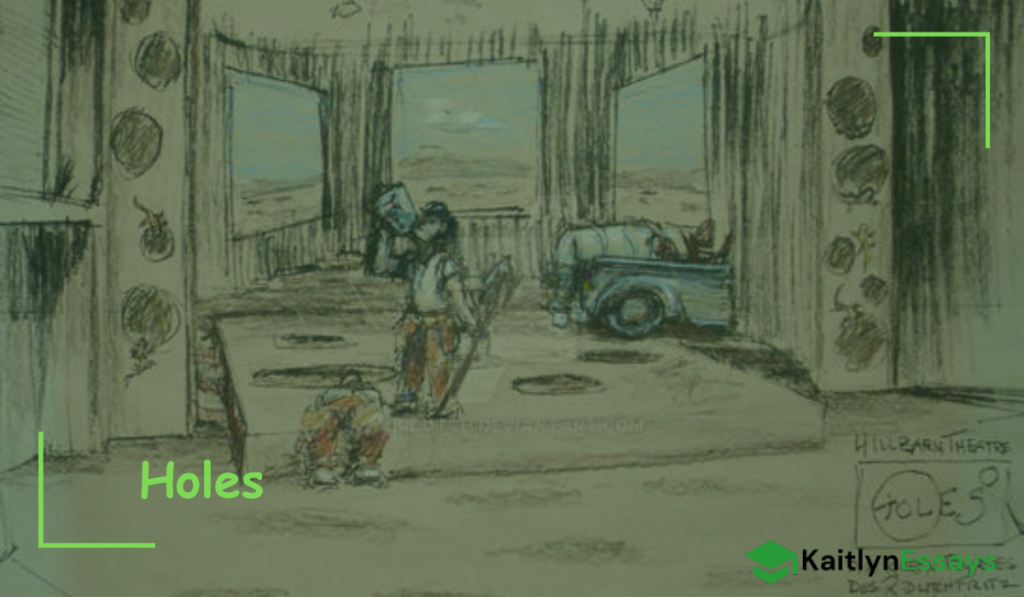
Holes is a fascinating young adult novel written by Louis Sachar, which won the Newbery Medal in 1999. The story follows the life of Stanley Yelnats, a young boy who is wrongly accused of a crime and sent to a juvenile detention camp called Camp Green Lake. As Stanley digs holes in the desert as part of his punishment, he uncovers not only the secrets of the camp but also the history of his own family.
The novel weaves together multiple storylines, touching on themes of justice, fate, friendship, and redemption. This guide examines the novel’s main characters, plot developments, and important symbols. By using this resource, students and readers can gain a deeper appreciation for the story’s layers and Sachar’s storytelling skills.
Summary
The Curse of the Yelnats Family
The story begins by explaining the Yelnats family curse, which allegedly began when Stanley’s “no-good-dirty-rotten-pig-stealing-great-great-grandfather” failed to fulfill a promise to a fortune teller named Madame Zeroni. As a result, every generation of Yelnats has been plagued by bad luck. This misfortune ultimately leads to Stanley’s wrongful conviction for stealing a pair of sneakers donated by a famous athlete.
Life at Camp Green Lake
Camp Green Lake is anything but a camp or a lake. It’s a barren desert where the juvenile delinquents are forced to dig large holes every day under the supervision of the warden and camp counselors. The warden claims that digging the holes builds character, but Stanley quickly realizes that there’s more to the activity. Each boy is tasked with finding something significant buried in the dried-up lakebed, leading Stanley to suspect that they are searching for something specific.
The History of Green Lake
Sachar weaves in the history of Green Lake, which once was a thriving community until a tragic event turned it into a wasteland. The narrative introduces Katherine “Kissin’ Kate” Barlow, a schoolteacher-turned-outlaw after her love interest, Sam the onion seller, is murdered due to racial prejudice. Kate’s transformation into a bandit, robbing banks and burying treasure, becomes a crucial subplot that ties into the present-day events at Camp Green Lake.
Stanley’s Friendship with Zero
While digging holes, Stanley befriends Zero, another boy at the camp who is quiet and often underestimated by the others. Their friendship deepens as they share secrets and help each other survive the harsh conditions. Zero reveals that he is illiterate, and Stanley offers to teach him how to read in exchange for help digging his holes. This relationship becomes pivotal, as it leads to their discovery of the true reason behind the camp’s digging activities.
The Resolution: Breaking the Curse
The climax of Holes comes when Stanley and Zero escape the camp and climb a mountain, where they find water and onions growing. In a symbolic act, Stanley unknowingly carries Zero up the mountain, fulfilling his great-great-grandfather’s promise to Madame Zeroni. This action lifts the curse on the Yelnats family. Upon returning to the camp, Stanley and Zero unearth a treasure chest that once belonged to Kate Barlow. The treasure contains wealth that rightfully belongs to Stanley’s family, and the discovery leads to the closure of Camp Green Lake.
Characters
Stanley Yelnats IV
Stanley Yelnats IV is the central character of “Holes”, a young boy who finds himself unjustly sentenced to Camp Green Lake, a juvenile detention center. Stanley’s character is a masterful blend of vulnerability and resilience, making him instantly relatable to readers.
At the beginning of the novel, Stanley is portrayed as an overweight, socially awkward teenager who’s often bullied at school. His lack of confidence is palpable, stemming from a combination of his physical appearance and the perceived “curse” that has plagued his family for generations. This curse, attributed to his “no-good-dirty-rotten-pig-stealing great-great-grandfather”, has seemingly brought bad luck to the Yelnats family for decades.
Despite his initial timidity, Stanley’s character undergoes significant growth throughout the novel. His experiences at Camp Green Lake, though harsh and often unfair, serve as a catalyst for his personal development. As he faces the grueling task of digging holes day after day under the scorching sun, Stanley begins to discover inner strength he never knew he possessed.
One of Stanley’s most endearing qualities is his inherent kindness and loyalty. This is particularly evident in his friendship with Zero, another camper at Green Lake. Stanley’s decision to teach Zero how to read, and later to risk his own life to save Zero, demonstrates a depth of character that goes beyond mere self-preservation.
Stanley’s intelligence and problem-solving skills also come to the forefront as the story progresses. His ability to piece together the mystery of Camp Green Lake, connecting the dots between the past and the present, showcases his analytical mind and curiosity.
Perhaps most importantly, Stanley’s journey is one of self-discovery and breaking free from perceived limitations. As he loses weight, gains strength, and overcomes challenges, he slowly sheds the self-doubt that has held him back. By the end of the novel, Stanley has transformed into a confident young man who’s capable of standing up for himself and others.
Get an in-depth analysis of Stanley’s character arc and its significance in young adult literature
Hector Zeroni (Zero)
Hector Zeroni, known throughout most of the novel by his nickname “Zero”, is a character of profound depth and complexity. Initially presented as a silent, seemingly slow-witted boy, Zero gradually emerges as one of the most crucial and compelling characters in the story.
Zero’s background is one of hardship and neglect. As a homeless child who has been fending for himself on the streets, he has developed a tough exterior and a deep-seated distrust of others. His inability to read and his reluctance to speak lead many at Camp Green Lake to dismiss him as unintelligent, earning him the derogatory nickname “Zero”.
However, as the story unfolds, it becomes clear that Zero’s silence is not a sign of stupidity, but rather a defense mechanism born from years of being overlooked and underestimated. When Stanley begins to teach him to read, Zero reveals a quick mind and an eagerness to learn that defies everyone’s expectations.
Zero’s character serves as a powerful commentary on the dangers of prejudice and the importance of looking beyond surface appearances. His mathematical prowess, revealed later in the novel, further underscores the theme that intelligence comes in many forms and cannot be judged by conventional standards alone.
The friendship that develops between Zero and Stanley is one of the novel’s most poignant elements. Zero’s loyalty to Stanley, demonstrated when he hits Mr. Pendanski with a shovel to defend his friend, is both touching and pivotal to the plot. This act of rebellion marks a turning point for Zero, showing his willingness to stand up against injustice.
Zero’s resilience is perhaps his most remarkable trait. His survival in the harsh, barren landscape after escaping from Camp Green Lake is a testament to his strength and determination. The revelation that he has been surviving by eating onions growing on the mountainside not only ties into the novel’s intricate plot but also symbolizes Zero’s ability to find sustenance and hope in the most unlikely places.
Explore the symbolism behind Zero’s character and his impact on the novel’s themes.
Mr. Sir
Mr. Sir, one of the adult supervisors at Camp Green Lake, serves as a primary antagonist in “Holes”. His character is a study in the corrupting influence of power and the dangers of unchecked authority.
From his first appearance, Mr. Sir is presented as an intimidating figure. His gruff demeanor, constant sunflower seed chewing, and the gun he carries at his hip all contribute to an aura of menace. His chosen name, “Mr. Sir”, speaks volumes about his desire to be respected and feared by the boys under his supervision.
Throughout the novel, Mr. Sir’s actions reveal a complex character driven by bitterness, insecurity, and a need for control. His treatment of the boys is harsh and often cruel, reflecting a worldview that sees punishment as the primary means of dealing with troubled youth. The way he relishes in the discomfort and suffering of the campers suggests a man who finds satisfaction in exerting power over those weaker than himself.
However, Sachar doesn’t paint Mr. Sir as a one-dimensional villain. Glimpses into his past, such as his struggle with addiction and his efforts to quit smoking, add layers to his character. These details hint at a man grappling with his own demons, using his position of authority as a way to feel in control of his life.
Mr. Sir’s interactions with Stanley are particularly revealing. His disproportionate reaction to being hit by Stanley’s sneaker – intentionally depriving Stanley of water in the desert heat – showcases both his vindictiveness and his abuse of power. This incident serves as a turning point, escalating the conflict and pushing Stanley towards his eventual escape.
The Warden (Ms. Walker)
The Warden, later revealed to be Ms. Walker, is perhaps the most enigmatic character in “Holes”. As the unseen authority behind Camp Green Lake, her presence looms large over the story long before she physically appears.
When the Warden is finally introduced, she subverts expectations. Instead of the intimidating male figure one might expect, she is described as a tall, red-haired woman with freckles and a charming Southern accent. This disarming appearance belies her true nature as the most dangerous character in the novel.
The Warden’s character is defined by her single-minded obsession with finding the lost treasure of Kissin’ Kate Barlow. This fixation has warped her sense of morality, leading her to exploit child labor and perpetuate a system of cruelty and neglect. Her use of rattlesnake venom in her nail polish is a chilling metaphor for her toxic nature hidden beneath a veneer of femininity.
What makes the Warden particularly unsettling is her ability to switch between charm and menace. Her polite Southern mannerisms can quickly give way to threats and violence when she doesn’t get what she wants. This unpredictability makes her a formidable antagonist, keeping both the characters and the readers on edge.
The Warden’s backstory, revealed towards the end of the novel, adds another layer to her character. As a descendant of Trout Walker, she has inherited not just the family’s obsession with the treasure, but also their legacy of racism and exploitation. Her actions are driven by a misguided sense of entitlement, believing that the treasure is rightfully hers.
Explore the Warden’s complex motivations and her role as a symbol of generational corruption.
X-Ray
X-Ray, whose real name is Rex, is a key supporting character in “Holes” and serves as the unofficial leader of the boys in Group D at Camp Green Lake. His nickname, a play on his initials R.E.X., also alludes to his ability to “see” the social dynamics of the camp clearly.
Despite being one of the smallest and physically weakest boys in the group, X-Ray maintains his position through a combination of street smarts, manipulation, and a keen understanding of power dynamics. He’s established a hierarchy within the group, which he enforces through a mixture of charisma and subtle intimidation.
X-Ray’s character provides insight into how social structures form even in the harshest of environments. His insistence on the order in which boys receive their daily rations of water, with himself always being first, demonstrates how he uses small privileges to reinforce his authority.
One of X-Ray’s most significant moments in the novel is when he convinces Stanley to give him credit for finding the gold tube with the initials KB. This action reveals X-Ray’s shrewdness and his ability to exploit others for his own gain. He recognizes the potential value of the find and manipulates the situation to his advantage, securing an extra day off from digging.
However, X-Ray is not portrayed as entirely unsympathetic. His actions can be seen as survival strategies in the harsh environment of Camp Green Lake. His leadership, while self-serving, also provides a sense of order and stability for the group.
Squid, Armpit, Zigzag, and Magnet
The other boys at Camp Green Lake – Alan (Squid), Theodore (Armpit), Ricky (Zigzag), and José (Magnet) – form a crucial part of the novel’s ensemble cast. Each of these characters, while not as deeply developed as Stanley or Zero, adds depth and texture to the world of Camp Green Lake.
Squid, known for his tall, thin build and confrontational attitude, often serves as X-Ray’s right-hand man. His tough exterior masks a vulnerability that’s hinted at when he asks Stanley to call his mother, revealing a longing for connection with his family.
Armpit, nicknamed for obvious reasons, is one of the physically strongest boys in the group. Despite his imposing presence, he often follows rather than leads, usually backing up X-Ray’s decisions. His character suggests that physical strength alone doesn’t determine leadership in their social hierarchy.
Zigzag is portrayed as possibly the most psychologically damaged of the group. His paranoia and erratic behavior make him unpredictable and sometimes dangerous, as seen when he attacks Stanley over the theft of his sunflower seeds. Zigzag’s character highlights the potential long-term effects of the harsh treatment at Camp Green Lake.
Magnet, whose nickname comes from his skill at stealing, provides some moments of levity in the story. His theft of Mr. Sir’s sunflower seeds sets off a chain of events that significantly impacts the plot. Magnet’s character serves as a reminder of the various reasons why boys might end up at a place like Camp Green Lake.
These supporting characters, with their distinct personalities and backstories, create a vivid picture of life at Camp Green Lake. They also serve to highlight Stanley’s growth and changing position within the group dynamic.
Mr. Pendanski
Mr. Pendanski, the counselor for Group D, is one of the most deceptive characters in “Holes”. Initially presented as a more sympathetic adult figure compared to Mr. Sir, Mr. Pendanski’s true nature is gradually revealed throughout the novel.
On the surface, Mr. Pendanski appears to be a caring counselor who wants to help the boys. He encourages them to use their real names instead of their nicknames and talks about rehabilitation and making good choices. His friendly demeanor and the fact that the boys call him “Mom” suggest a nurturing presence in the harsh environment of Camp Green Lake.
However, as the story progresses, it becomes clear that Mr. Pendanski’s benevolent facade hides a more insidious character. His treatment of Zero, consistently belittling him and declaring him worthless, reveals a cruel streak that contradicts his supposed role as a mentor. This behavior exposes the hypocrisy in his professed desire to help the boys.
Mr. Pendanski’s true colors are fully displayed when he abandons Zero in the desert, showing a callous disregard for the boy’s life. This action starkly contrasts with his earlier presentations of concern and care, underlining the theme of appearance versus reality that runs throughout the novel.
In many ways, Mr. Pendanski is more dangerous than the openly harsh Mr. Sir, because his betrayal of the trust placed in him as a counselor is particularly devastating. His character serves as a warning about the dangers of assuming that those in positions of authority always have others’ best interests at heart.
Elya Yelnats and Madame Zeroni
Elya Yelnats and Madame Zeroni, while not present in the main timeline of the novel, are crucial to understanding the overarching narrative of “Holes”. Their story, set in Latvia generations before Stanley’s time, sets in motion the chain of events that leads to the supposed family curse.
Elya Yelnats, Stanley’s great-great-grandfather, is portrayed as a well-meaning but somewhat naive young man. His desire to win the hand of Myra Menke leads him to make a rash promise to Madame Zeroni, setting up the central conflict that echoes through generations.
Madame Zeroni, an old Egyptian woman with a crippled leg, is a mysterious and powerful figure. Her role in the story blends elements of a fairy tale wise woman and a curse-giver. The piglet she gives Elya, along with specific instructions to carry her up a mountain, becomes the catalyst for the Yelnats family’s misfortunes.
These characters introduce the element of magical realism into the novel. The curse that Madame Zeroni places on Elya for breaking his promise adds a layer of fate and destiny to the story, suggesting that Stanley’s presence at Camp Green Lake is more than mere coincidence.
The relationship between Elya and Madame Zeroni also foreshadows the friendship between Stanley and Zero. Just as Elya was meant to carry Madame Zeroni up the mountain, Stanley ultimately carries Zero up God’s Thumb, breaking the curse and bringing the story full circle.
Katherine Barlow (Kissin’ Kate Barlow)
Katherine Barlow, who later becomes known as the outlaw Kissin’ Kate Barlow, is one of the most tragic and complex characters in “Holes”. Her story, told through flashbacks, provides crucial historical context and ties together many of the novel’s themes.
Initially introduced as the sweet, intelligent schoolteacher of Green Lake, Katherine’s transformation into a notorious outlaw is a powerful narrative of love, loss, and injustice. Her romance with Sam, the onion man, challenges the racial prejudices of her time and ultimately leads to devastating consequences.
The murder of Sam serves as the catalyst for Katherine’s transformation. Her decision to kill the sheriff and embark on a life of crime is presented not as a fall from grace, but as a rebellion against a profoundly unjust system. The fact that she kisses each of her victims before killing them becomes her trademark, a dark reminder of the love she lost.
Katherine’s story intertwines with the main narrative in several ways. The treasure she buries is the object of the Warden’s obsession and the real reason behind the boys digging holes. Moreover, her interaction with Stanley’s great-grandfather adds another layer to the Yelnats family’s story.
As Kissin’ Kate Barlow, Katherine becomes a symbol of both the destructive power of injustice and the strength of the human spirit in the face of overwhelming odds. Her final scene, where she faces down Trout Walker and dies from a lizard bite, is a powerful moment that resonates throughout the rest of the novel.
Sam the Onion Man
Sam, known as the onion man in the Green Lake of the past, plays a pivotal role in the novel despite his relatively brief appearance. His character serves as a catalyst for many of the events that shape the story’s background.
Sam is portrayed as a kind, hardworking, and intelligent man. His knowledge of onions and their medicinal properties makes him an important figure in the town of Green Lake. Sam’s gentle nature and his ability to fix things make him well-liked by many in the community, especially Katherine Barlow.
However, Sam’s race becomes the central issue that drives the tragic events of the past. His growing closeness with Katherine Barlow transgresses the strict racial boundaries of the time, leading to violent repercussions. Sam’s murder at the hands of the townspeople serves as a stark illustration of the destructive power of racism and mob mentality.
Sam’s legacy lives on long after his death. The onions he grew on God’s Thumb become crucial to Zero’s survival, and the location plays a significant role in Stanley and Zero’s journey. In this way, Sam’s influence extends far beyond his lifetime, impacting the main narrative in surprising ways. His story serves as a powerful commentary on racial injustice and the long-lasting effects of prejudice.
Trout Walker
Trout Walker serves as the primary antagonist in the historical narrative of Green Lake. His character represents the ugly face of privilege, racism, and entitlement that forms a dark undercurrent in the novel’s exploration of the past.
Described as the son of the wealthiest man in the county, Trout is used to getting whatever he wants. His nickname, derived from his feet smelling like fish, adds an element of ridicule to an otherwise intimidating character. This detail serves to undermine his perceived superiority, suggesting that even those in positions of power have their flaws.
Trout’s infatuation with Katherine Barlow and his subsequent rage when she rejects him for Sam reveal the dangerous combination of entitlement and prejudice. His actions – leading the mob that kills Sam and burns down the schoolhouse – serve as the turning point in Katherine’s life and, by extension, the history of Green Lake.
In the later parts of the historical narrative, Trout’s obsessive search for Kate’s treasure showcases how greed can consume a person. This obsession is passed down to his descendants, notably the Warden, linking the past and present narratives of the novel.
Trout Walker’s character is crucial in understanding the cycle of hatred and greed that plagues Green Lake. His actions set in motion a chain of events that resonate through generations, affecting not just his family but the entire community.
Get a detailed analysis of Trout Walker’s role as a catalyst for the novel’s central conflicts.
Stanley Yelnats III
Stanley Yelnats III, the protagonist’s father, plays a significant role in shaping Stanley’s character and the overall narrative, despite his limited appearances in the main storyline.
Described as an inventor who is perpetually on the brink of a breakthrough, Stanley’s father embodies both the hope and the frustration of the Yelnats family curse. His ongoing attempts to invent a cure for foot odor, while seemingly trivial, speak to a larger theme of perseverance in the face of constant setbacks.
Stanley III’s unwavering belief in his eventual success, despite repeated failures, provides an important contrast to his son’s initial lack of confidence. This optimism, bordering on delusion, is both endearing and frustrating, much like the Yelnats family’s relationship with their perceived curse.
Interestingly, it’s Stanley III’s latest invention – a compound to recycle old sneakers – that indirectly leads to Stanley IV’s wrongful conviction. This plot point underscores the novel’s recurring theme of interconnectedness and the sometimes arbitrary nature of fate.
The resolution of Stanley III’s storyline, with his invention finally succeeding thanks to the unique properties of Sam’s onions, ties together multiple narrative threads. It serves as a satisfying conclusion to the Yelnats family’s string of bad luck and reinforces the novel’s messages about perseverance and the unexpected ways in which past and present can intersect.
Clyde Livingston (Sweet Feet)
Clyde “Sweet Feet” Livingston, while not physically present for most of the novel, plays a crucial role in setting the main plot in motion. As a famous baseball player and Stanley’s hero, Livingston represents the allure of celebrity and the American dream of success through sport.
Livingston’s donated sneakers, intended to raise money for a homeless shelter, become the focal point of Stanley’s legal troubles. The irony of Stanley being convicted of stealing the shoes of his idol adds another layer to the novel’s exploration of fate and coincidence.
The revelation that Livingston suffers from terrible foot odor, which he manages to keep secret from the public, serves multiple purposes in the narrative. It humanizes a seemingly perfect celebrity figure, connects to Stanley III’s inventions, and ultimately plays a role in the resolution of the Yelnats family’s troubles.
Livingston’s brief appearance at the end of the novel, where he acknowledges Stanley’s innocence and the effectiveness of the odor-eliminating spray, provides a satisfying closure to this subplot. It also reinforces the theme that truth and justice can prevail, even in seemingly hopeless situations.
The Yellow-Spotted Lizards
While not characters in the traditional sense, the yellow-spotted lizards play a crucial role in the novel, almost functioning as agents of fate or karmic justice.
These deadly creatures are described in vivid detail, with their “yellow-spotted” bodies, “red” eyes, “black” teeth, and “white” tongue. Their venomous bite, said to be always fatal, creates a constant sense of danger at Camp Green Lake.
The lizards serve multiple functions in the narrative. They act as a very real threat to the boys as they dig their holes, adding tension and danger to their daily routine. They also play a crucial role in the historical narrative, being the instrument of Kissin’ Kate Barlow’s death.
Most significantly, the lizards become unwitting allies to Stanley and Zero in the novel’s climax. The boys’ immunity to the lizards’ venom, granted by their onion-rich diet, allows them to survive a seemingly impossible situation and ultimately secure their freedom.
This turn of events ties together multiple threads of the story – Sam’s onions, the history of Kissin’ Kate Barlow, and the resolution of the present-day conflict. It also serves as a powerful metaphor for how something perceived as a threat can become a salvation when viewed from a different perspective.
The Yelnats and Zeroni Families
While individual members of the Yelnats and Zeroni families have been discussed, it’s worth examining these family lines as collective “characters” in their own right. The intertwining fates of these two families form the backbone of the novel’s exploration of curses, fate, and redemption.
The Yelnats family, with its tradition of naming the firstborn son Stanley, represents the idea of patterns repeating through generations. Their perceived curse, stemming from Elya Yelnats’ broken promise, has shaped the family’s identity and outlook on life. Despite their constant bad luck, the Yelnats maintain a certain optimism and inventiveness, as seen in Stanley III’s persistent attempts at creating successful inventions.
The Zeroni family, on the other hand, is largely absent from the main narrative until the connection between Zero and Madame Zeroni is revealed. This family line represents the long-reaching consequences of broken promises and the possibility of redemption. The friendship between Stanley IV and Zero serves as a mirror to the relationship between Elya Yelnats and Madame Zeroni, offering a chance to right past wrongs.
The resolution of the novel, where the actions of Stanley IV and Zero break the curse and bring prosperity to both families, speaks to themes of friendship, loyalty, and the power of individuals to change seemingly immutable fates.
Miss Katherine’s Students
Though they appear only briefly in the historical sections of the novel, Miss Katherine’s students play a significant role in establishing the character of Green Lake’s past and the changes that sweep through the town.
These children, of various ages and backgrounds, represent the promise of education and the potential for social change. Their eager participation in Miss Katherine’s classes, particularly their excitement about learning to read and write, stands in stark contrast to the ignorance and prejudice displayed by many of the adult characters in the historical narrative.
The students’ acceptance of Sam, inviting him to read and participate in class discussions, highlights the potential for a more inclusive society. Their innocence and openness serve as a counterpoint to the entrenched racism of characters like Trout Walker.
The tragedy of Sam’s murder and the burning of the schoolhouse is made all the more poignant by the loss of this promise. The students’ fate after these events is left largely unexplored, leaving the reader to contemplate the long-term effects of such violent prejudice on a community.
The Attorney General and Judge
While these characters have limited appearances in the novel, the unnamed Attorney General and Judge who preside over Stanley’s case represent the flaws in the justice system that forms a critical backdrop to the story.
Their quick conviction of Stanley, based on circumstantial evidence and without thorough investigation, highlights the theme of injustice that runs throughout the novel. The ease with which they accept the testimony of the witnesses against Stanley, despite his protestations of innocence, speaks to the challenges faced by those without power or influence in the face of the legal system.
The resolution of Stanley’s legal troubles at the end of the novel, where the Attorney General is forced to acknowledge the mistake and clear Stanley’s name, provides a satisfying conclusion to this subplot. However, it also serves as a reminder of how easily justice can miscarry and the importance of perseverance in the face of wrongful accusations.
Themes in “Holes”
Fate vs. Free Will
One of the most prominent themes in “Holes” is the interplay between fate and free will. The Yelnats family believes they are cursed with bad luck due to their ancestor’s broken promise to Madame Zeroni. This curse seems to explain many of the misfortunes that befall them, including Stanley’s wrongful conviction and sentencing to Camp Green Lake.
However, as the story unfolds, we see how the characters’ choices and actions play a crucial role in shaping their destinies. Stanley’s decision to teach Zero to read, Zero’s choice to run away, and their combined effort to climb God’s Thumb all demonstrate the power of individual agency in the face of seemingly predetermined fates.
The resolution of the novel suggests that while external forces may influence our lives, our own decisions and actions ultimately determine our path. The breaking of the curse through Stanley and Zero’s friendship shows that we have the power to overcome even long-standing family “curses” through our own choices and relationships.
Learn how fate and free will interact in “Holes.”
Justice and Injustice
The theme of justice, and its frequent absence, runs throughout “Holes.” The novel presents multiple instances of injustice, both in the present-day narrative and in the historical flashbacks.
In the present, we see the injustice of Stanley’s wrongful conviction and the harsh, exploitative conditions at Camp Green Lake. The juvenile detention center, far from rehabilitating the boys, subjects them to cruel treatment and forced labor under the guise of character building.
The historical narrative provides even starker examples of injustice, particularly in the racist treatment of Sam the onion man and the violent reaction to his relationship with Kate Barlow. The destruction of the schoolhouse and Sam’s murder represent a grave miscarriage of justice that echoes through the generations.
However, the novel also shows that justice can prevail, albeit often in unexpected ways. The resolution of the story, where the truth about Camp Green Lake is revealed, Stanley is exonerated, and the Yelnats family’s fortunes are reversed, suggests that persistence and truth can ultimately overcome injustice.
Learn more about the portrayal of justice and injustice in “Holes.”
The Power of Friendship and Loyalty
At its heart, “Holes” is a story about the transformative power of friendship. The relationship between Stanley and Zero forms the emotional core of the novel and drives much of the plot’s resolution.
Initially, Stanley and Zero’s friendship is one of convenience and mutual benefit – Stanley teaches Zero to read, and Zero helps Stanley dig his holes. However, as they face challenges together, their bond deepens into a true friendship based on loyalty and mutual respect.
This friendship proves powerful enough to overcome seemingly insurmountable obstacles. Stanley’s decision to go after Zero when he runs away, risking his own life in the process, is a turning point in the novel. Their combined effort to survive on God’s Thumb and their teamwork in uncovering the treasure demonstrate the strength they draw from each other.
Importantly, this friendship also serves to break the cycle of bad luck that has plagued both their families. By carrying Zero up the mountain, Stanley unknowingly fulfills his ancestor’s promise to Madame Zeroni, breaking the curse and bringing the story full circle.
More on how friendship shapes the narrative and characters in “Holes.”
The Impact of History on the Present
“Holes” masterfully interweaves past and present narratives to explore how historical events and decisions continue to impact the present. The novel suggests that the past is never truly gone, but continues to influence current events in both obvious and subtle ways.
The most clear-cut example of this is the Yelnats family curse, which originates from a broken promise generations ago and continues to affect Stanley’s life. The treasure that Kate Barlow buried in the past becomes the obsession that drives the Warden’s actions in the present.
More subtly, the racist attitudes that led to Sam’s death in the past are reflected in the unjust system that sends boys like Stanley and Zero to Camp Green Lake. The novel suggests that societal injustices, left unaddressed, can perpetuate themselves through generations.
However, the story also offers hope that the negative cycles of the past can be broken. Stanley and Zero’s friendship serves as a counterpoint to the broken promise between their ancestors, suggesting that present actions can heal past wrongs.
Explore more about how “Holes” connects past and present.
Perseverance and Resilience
Throughout “Holes,” characters face numerous challenges that test their resilience. Stanley, in particular, demonstrates remarkable perseverance in the face of adversity.
When first arrived at Camp Green Lake, Stanley is overweight, bullied, and lacking in confidence. The grueling task of digging holes every day seems almost insurmountable. Yet, Stanley not only endures but grows stronger both physically and mentally. His persistence in teaching Zero to read, despite the disapproval of the camp staff, shows his growing confidence and determination.
Zero’s character arc also exemplifies perseverance. Despite years of being told he’s worthless and stupid, Zero maintains a fierce determination to learn and improve himself. His survival alone in the desert demonstrates incredible resilience.
The Yelnats family’s continued efforts to invent and succeed, despite generations of bad luck, is another example of perseverance. Stanley’s father’s unwavering belief that he will invent something successful eventually pays off, reinforcing the novel’s message that persistence can overcome even long-standing obstacles.
Learn how perseverance shapes the characters and plot of “Holes.”
The Arbitrary Nature of Rules and Authority
“Holes” presents a critical view of rules and authority, particularly when they are arbitrary or unjust. The entire premise of Camp Green Lake – that digging holes will build character in troubled boys – is revealed to be a sham, a cover for the Warden’s treasure-hunting obsession.
The camp’s rules, enforced by Mr. Sir and Mr. Pendanski, often seem arbitrary and cruel. The boys are punished severely for minor infractions, while the adults abuse their authority with impunity. This critique extends to the broader justice system, which convicts Stanley on flimsy evidence and sends him to a detention center without proper oversight.
However, the novel also shows that not all rules are bad. The boys at the camp create their own social order which, while not perfect, helps them navigate their harsh environment. Stanley’s adherence to moral rules – like loyalty to his friend Zero – ultimately leads to positive outcomes.
Through these contrasts, “Holes” encourages readers to question authority and evaluate rules based on their fairness and purpose, rather than blindly accepting them.
More about the portrayal of rules and authority in “Holes.”
The Interconnectedness of People and Events
One of the most striking aspects of “Holes” is the way it demonstrates how seemingly unrelated people and events can be interconnected in surprising ways. The novel weaves together multiple storylines across different time periods, showing how actions in the past ripple forward to affect the present.
This interconnectedness is perhaps best exemplified by the yellow-spotted lizards. Introduced as a deadly threat, they become key to Stanley and Zero’s survival thanks to the onions they’ve been eating – onions descended from those grown by Sam a hundred years earlier. This unexpected connection ties together multiple strands of the story in a satisfying way.
The novel also shows how small actions can have far-reaching consequences. Elya Yelnats’s broken promise leads to generations of bad luck. Stanley’s arrival at Camp Green Lake sets in motion a chain of events that will ultimately uncover long-buried secrets and right historical wrongs.
This theme encourages readers to consider the broader implications of their actions and to be aware of the complex web of connections that link us all.
Get a more detailed analysis of interconnectedness in “Holes.”
The Power of Literacy and Education
Education, particularly literacy, is a recurring theme in “Holes.” In both the present-day and historical narratives, the ability to read and write is presented as a powerful tool for personal growth and social change.
In the flashbacks, Kate Barlow’s role as a schoolteacher is central to her character. Her efforts to educate all the children of Green Lake, regardless of their background, represent hope for a more equitable future. The destruction of her schoolhouse by the racist mob is thus not just an attack on her, but on the very idea of education as a force for social progress.
In the present-day story, Stanley’s decision to teach Zero to read is a pivotal moment. Despite the camp’s environment, which seeks to break down the boys rather than build them up, Stanley and Zero create their own small space for learning and growth. Zero’s determination to learn, even in such harsh conditions, highlights the inherent human desire for knowledge and self-improvement.
Literacy proves crucial to the boys’ survival and ultimate triumph. Zero’s ability to read “Stanley Yelnats” backward leads to the discovery of the treasure, while Stanley’s knowledge of his family history helps him understand the significance of their find.
Through these storylines, “Holes” emphasizes the transformative power of education and the importance of literacy as a tool for personal and social empowerment.
Learn about the role of education and literacy in “Holes.”
The Complexity of Good and Evil
While “Holes” is a novel primarily aimed at young adults, it doesn’t shy away from presenting complex, morally ambiguous characters. The book challenges simplistic notions of good and evil, presenting instead a complex view of human nature.
Even characters who initially seem villainous, like the Warden or Mr. Sir, are revealed to have their own struggles and motivations. The Warden, for all her cruelty, is driven by a family legacy and a desperate desire to find the treasure. Mr. Sir, harsh and intimidating, is shown to be battling his own demons, including addiction.
Conversely, characters who might be considered “good” are not without flaws. Stanley, our protagonist, initially lies about the ancestry of his nickname “Caveman” to impress the other boys. Zero, despite his inherent goodness, resorts to violence when he hits Mr. Pendanski with a shovel.
Perhaps the most complex character is Kissin’ Kate Barlow. Her transformation from a sweet schoolteacher to a notorious outlaw is presented not as a fall from grace, but as a complicated response to the injustice and tragedy she experiences.
Through these layered characterizations, “Holes” encourages readers to look beyond surface appearances and consider the complex factors that shape human behavior.
More on the portrayal of moral complexity in “Holes.”
The Role of Legends and Storytelling
“Holes” is, in many ways, a story about stories. The novel is structured around various legends and tales – the story of Elya Yelnats and Madame Zeroni, the tragedy of Sam and Kate Barlow, the legend of Kissin’ Kate Barlow and her buried treasure. These stories within the story serve multiple purposes in the novel.
Firstly, they provide crucial background information, helping to explain the characters’ motivations and the reasons behind current events. The legend of the Yelnats family curse, for instance, provides context for Stanley’s outlook on life and his family’s persistent bad luck.
Secondly, these embedded narratives allow Sachar to explore themes across different time periods, drawing parallels between past and present. The story of Sam and Kate’s doomed relationship, for example, resonates with themes of injustice and racism that are still relevant in Stanley’s time.
Finally, the prevalence of these legends highlights the power of storytelling itself. The stories passed down through generations shape the characters’ understanding of their world and their place in it. Stanley’s knowledge of his family history ultimately proves crucial in understanding the significance of his and Zero’s discovery.
By weaving together these various narratives, Sachar creates a rich, multi-layered story that emphasizes the enduring power of legends and the importance of understanding our personal and collective histories.
More about the role of storytelling in “Holes.”
Symbols in Holes
The Yellow-Spotted Lizards
One of the most memorable symbols in Holes is the yellow-spotted lizards that inhabit Camp Green Lake. These deadly creatures symbolize fear and danger, serving as a constant threat to the boys at the camp. The fact that these lizards are venomous and lethal adds to the perilous environment the boys must navigate. However, these lizards also represent more than physical danger. They symbolize the ever-present threat of failure, both at the camp and in life. Throughout the novel, the yellow-spotted lizards are portrayed as menacing creatures that the boys cannot escape, much like the oppressive systems of justice and punishment that loom over them.
Learn more about how the lizards relate to broader themes.
The Holes
The act of digging holes is the central activity in the novel, and it serves as a potent symbol. On the surface, the boys are digging holes because they are told it will “build character,” but it becomes clear that they are really searching for something — treasure buried by the infamous outlaw, Kissin’ Kate Barlow. Symbolically, the holes represent the emptiness and futility the boys feel at Camp Green Lake. As they dig, they aren’t just looking for treasure; they are searching for meaning in their lives, trying to fill the metaphorical holes left by their troubled pasts and broken families.
Each hole is a physical manifestation of the emotional voids the characters are experiencing. For Stanley, the protagonist, the act of digging helps him discover his own self-worth and the importance of friendship. The holes also mirror the cyclical nature of the curse on Stanley’s family, a curse that must be “dug up” and addressed for the family to find peace.
Continue exploring the symbolism of the holes.
Onions
Onions play an unexpectedly crucial role in the novel. Though they seem like an ordinary vegetable, onions become a symbol of healing and redemption. Sam, the onion man, uses them to heal various ailments in Green Lake before it became the barren wasteland that it is in Stanley’s time. The onions represent natural remedies and symbolize the possibility of healing both physical and emotional wounds.
The fact that onions ultimately save Stanley and Zero from the deadly lizards further cements their symbolic importance. By consuming the onions, Stanley and Zero find a way to survive, symbolizing how the boys can find strength and redemption through natural means and by relying on each other. Additionally, the onions connect the past and present in the story, offering a resolution to the curse that has plagued Stanley’s family for generations.
More on how onions symbolize healing.
The Big Thumb
The image of God’s Thumb, a mountain shaped like a thumb, is another powerful symbol in Holes. It represents hope and survival for Stanley and Zero when they are at their lowest point. After running away from the camp, the two boys are starving and dehydrated, but Stanley remembers the story of his great-grandfather, who survived in the desert by finding refuge on God’s Thumb.
Climbing the mountain is a symbolic journey for Stanley and Zero. It represents their struggle for survival and their attempt to break free from the forces that have oppressed them — whether it’s the camp authorities or the curse on Stanley’s family. The mountain, with its life-saving water and onions, becomes a sanctuary where the boys can recover and, symbolically, rise above their hardships.
Discover more about the symbolism of God’s Thumb.
The Sneakers
The old sneakers that fall from the sky and lead to Stanley’s wrongful conviction are a significant symbol in the novel. These shoes, once belonging to the famous baseball player Clyde “Sweet Feet” Livingston, become a symbol of fate and the injustice that Stanley faces. When Stanley is convicted of stealing the sneakers, it seems like an unlucky accident, but as the story unfolds, it becomes clear that the event was part of a larger chain of fate connecting Stanley to Zero and their families.
The sneakers also represent how random events can have life-changing consequences, especially for those who are already marginalized. The theft of the sneakers sets Stanley on a path to Camp Green Lake, but it ultimately leads him to Zero and the discovery of his family’s buried treasure.
More on how the sneakers symbolize fate and justice.
Treasure
The concept of buried treasure is a classic trope in literature, and in Holes, it represents both a literal and metaphorical reward. The treasure that Stanley and Zero eventually unearth symbolizes the resolution of past injustices and the lifting of the curse on Stanley’s family. For Zero, the treasure is a symbol of his own worth and his ability to reclaim a part of his family’s legacy.
However, the treasure also symbolizes the value of friendship and loyalty. Stanley and Zero’s partnership leads them to the treasure, reinforcing the idea that personal connections are more valuable than material wealth. In the end, the treasure is less about money and more about the fulfillment of long-standing promises and the restoration of broken family ties.
Explore the deeper meanings behind the treasure in Holes.
Water: Life and Freedom
Water is a recurring symbol in Holes, representing life, freedom, and hope. In the arid, desolate landscape of Camp Green Lake, water is scarce and precious, much like the freedom the boys yearn for. When Stanley and Zero find water on God’s Thumb, it symbolizes a turning point in their lives. The water not only revives them physically but also represents their emotional rebirth. It cleanses them of their past mistakes and the unjust systems that have controlled their lives.
Water also plays a key role in the novel’s resolution. When the curse on Stanley’s family is lifted, rain returns to Green Lake for the first time in over a hundred years. This rain represents renewal and the possibility of a new beginning, not just for Stanley but for all the boys at the camp.
Read more about the symbolism of water.
Literary Devices in Holes
Foreshadowing
Foreshadowing is a literary device that gives readers hints about future events in the story. Sachar skillfully uses foreshadowing throughout Holes to build suspense and connect seemingly unrelated elements of the plot. Early in the novel, Stanley’s great-great-grandfather’s curse is mentioned, giving readers a clue that this family history will play a crucial role in the story’s outcome. Similarly, the reference to God’s Thumb is introduced long before Stanley and Zero end up climbing the mountain, allowing readers to anticipate its importance.
The careful placement of these hints not only creates suspense but also allows the novel’s many plotlines to converge in a satisfying way. Foreshadowing is especially effective in Holes because it creates a sense of inevitability, as though the characters are bound by fate.
Explore more about how foreshadowing enhances the story.
Flashbacks: Bridging the Past and Present
Flashbacks are an essential device in Holes, as they reveal key information about the characters’ backstories and the history of Green Lake. The flashbacks to Kissin’ Kate Barlow’s time help explain the transformation of Green Lake from a thriving town to a desolate wasteland. These glimpses into the past not only provide context but also create dramatic irony, as readers know more about the history than the characters themselves.
The flashbacks also weave together the novel’s multiple storylines, showing how Stanley’s present-day struggles are connected to the past. For instance, the story of Elya Yelnats and his broken promise to Madame Zeroni, which leads to the Yelnats family curse, directly influences Stanley’s life at Camp Green Lake. These flashbacks make the novel richer and more complex by adding layers of history that influence the present.
Discover more about the use of flashbacks.
Irony: Twists and Reversals
Irony is a prominent literary device in Holes, used to highlight the injustices faced by the characters and the unpredictable nature of fate. One key example of irony is Stanley’s wrongful conviction for stealing Clyde Livingston’s sneakers. Stanley, who is innocent, is sent to a camp where he ironically ends up digging to uncover real stolen treasure. This twist in the narrative underscores the novel’s exploration of luck, justice, and fate.
Another instance of irony is the relationship between Stanley and Zero. At the beginning of the story, Stanley is seen as the unlucky one, but by the end, his fate improves, and he helps Zero reclaim a sense of identity and belonging. Zero, who seems powerless, is revealed to be the descendant of Madame Zeroni, making him the key to breaking the Yelnats family curse.
Learn more about the role of irony in Holes.
Symbolism: Deeper Meanings Behind Objects and Actions
Symbolism plays a crucial role in Holes, with various objects and actions taking on deeper meanings throughout the novel. One of the most important symbols is the act of digging holes itself, which represents the characters’ search for truth and redemption. Similarly, the yellow-spotted lizards symbolize the constant threat of failure and danger at Camp Green Lake.
Water is another significant symbol, representing life, freedom, and renewal. When Stanley and Zero find water on God’s Thumb, it symbolizes a turning point in their lives, offering both physical and emotional salvation. These symbols help to reinforce the novel’s themes of justice, survival, and personal growth.
Get an in-depth analysis of symbolism in Holes.
Motifs: Recurring Themes and Elements
Motifs are recurring elements in a story that help to reinforce its themes. In Holes, one of the most prominent motifs is the idea of fate and destiny. Throughout the novel, characters often refer to luck and the idea that their lives are controlled by forces beyond their control. Stanley’s family believes they are cursed because of his great-great-grandfather’s broken promise, and much of the novel revolves around the idea of breaking this curse.
The motif of friendship also runs throughout Holes, particularly in the relationship between Stanley and Zero. Their growing friendship is central to the novel, and it highlights the importance of loyalty and solidarity in overcoming adversity. The motif of history repeating itself is another key element, as the events of the past have a direct impact on the present.
Learn more about the motifs in Holes.
Parallelism: Mirroring Events Across Time
Parallelism is a technique where similar events or themes occur in different parts of the story, often to highlight connections between characters or situations. In Holes, the storylines of Stanley, his great-great-grandfather Elya Yelnats, and Zero’s ancestor Madame Zeroni are parallel in many ways. Each character is affected by the same curse, and each must go through a journey of hardship and redemption. The use of parallelism helps to underscore the novel’s theme of interconnectedness — the idea that the actions of the past influence the present and future.
This technique also helps to give the story a sense of balance and resolution. By the end of the novel, the parallel stories of the Yelnats and Zeroni families are brought together, allowing both Stanley and Zero to find peace and closure.
Get a deeper look at how parallelism is used in Holes.
Imagery: Vivid Descriptions that Bring the Story to Life
Imagery is a literary device that uses descriptive language to create vivid pictures in the reader’s mind. Sachar’s use of imagery is especially powerful when describing the harsh, desolate landscape of Camp Green Lake. The dry, cracked earth and endless expanse of dirt holes serve to emphasize the bleakness of the boys’ situation.
Sachar also uses imagery to contrast the past with the present. The flashbacks to Green Lake’s former days as a thriving town are filled with descriptions of a lush, beautiful environment, making the barren camp all the more jarring. The imagery helps to draw readers into the story and allows them to feel the characters’ struggles on a visceral level.
More about the role of imagery in Holes.
Allusion
Allusions are references to other works of literature, historical events, or cultural stories, and Holes contains several allusions that deepen its themes. One of the most significant allusions in the novel is to the concept of folk curses and legends. The Yelnats family curse is reminiscent of old folktales where characters are doomed by past actions. The allusion to such stories creates a sense of timelessness, connecting Stanley’s story to universal themes of justice and redemption.
In addition, Sachar alludes to historical injustices, particularly in the treatment of Sam, the African-American onion seller, who is killed for his relationship with a white woman. This historical allusion adds depth to the novel’s exploration of injustice and prejudice.
Discover more about allusions in Holes.
Quotes in Holes
“I’m not lucky. I’m cursed.”
This quote, spoken by Stanley Yelnats, encapsulates one of the novel’s major themes: the idea of fate and bad luck. Stanley believes that his family is cursed due to his great-great-grandfather’s broken promise to Madame Zeroni, and this belief shapes much of his self-perception. The quote reflects Stanley’s feelings of helplessness and his sense that no matter what he does, his life will always be controlled by bad luck. Throughout the novel, Stanley’s journey is one of breaking free from this perceived curse and taking control of his own destiny.
Explore more about how this quote reflects the theme of fate.
“You want to run away? I’ll give you a day to think it over. Then you can come back and dig some more holes. Or the next time you run away, you’ll be buzzard food.”
This quote from the Warden illustrates the harsh conditions at Camp Green Lake and the cruel authority figures who control the boys. The Warden’s threat of turning runaway boys into “buzzard food” shows the dehumanizing nature of the camp and the lack of empathy from the people in charge. The Warden represents the system of punishment and oppression that the boys are forced to endure, and this quote highlights the sense of entrapment they feel.
Further analysis of the Warden’s character and her role in the novel.
“The second hole’s the hardest. You’re still tired from digging the first hole. But once you’re done, you’ve got to start all over again.”
In this quote, Stanley reflects on the physical and emotional toll of digging holes at the camp. The repetition of the task and the sense of endlessness it creates symbolize the futility and meaninglessness that Stanley and the other boys experience. This quote also underscores the theme of perseverance, as Stanley and the others must keep digging despite their exhaustion. It serves as a metaphor for the struggles they face in life, where every challenge seems to lead to another.
Read more about how this quote ties into the novel’s themes of endurance and struggle.
“Zero is my friend.”
This simple yet powerful statement by Stanley marks a turning point in the novel. At Camp Green Lake, the boys are often pitted against each other, but Stanley’s declaration of friendship with Zero shows the importance of loyalty and solidarity in the face of adversity. This quote is significant because it signifies Stanley’s growth as a character; he learns to value friendship over survival and becomes willing to stand up for Zero, even when it puts him at risk. Their friendship becomes central to the story and leads to both characters’ eventual redemption.
Find more insights on the theme of friendship in Holes.
“The more you sweat in peace, the less you bleed in war.”
This quote, attributed to Sam the onion man, reflects the wisdom that he imparts to the people of Green Lake in the past. Sam’s belief in hard work and preparation is a key part of his character and serves as a contrast to the violence and injustice that ultimately takes his life. The quote also resonates with Stanley and Zero’s journey, as they must work hard to survive and break free from the forces that seek to oppress them. Sam’s words offer a message of hope and the idea that hard work can lead to a better future.
Get a detailed discussion of Sam’s role in the novel.
“You make the decision: Whom did God punish?”
This quote, spoken by the Warden, points to the theme of justice and moral ambiguity in Holes. The Warden refers to the punishment of Green Lake after the death of Sam, questioning whether God punished the people of the town or the lake itself. This line highlights the novel’s exploration of justice — both divine and human. It forces readers to consider who deserves to be punished and whether the systems of justice in the novel are fair or flawed.
Explore more about the novel’s treatment of justice and punishment.
“I can fix that.”
This phrase, repeated by Sam throughout the novel, symbolizes his role as a healer and problem-solver in the community of Green Lake. Sam’s ability to fix anything, from broken objects to people’s ailments, represents his positive influence on those around him. However, the tragic irony is that Sam’s kindness is not enough to “fix” the deep-seated racism and injustice in Green Lake, leading to his untimely death. The phrase becomes even more poignant when Stanley helps Zero, showing that the spirit of fixing things — whether it’s physical objects or relationships — carries through the generations.
Learn more about the significance of Sam’s character and his impact on the story.
“It’s not over until it’s over.”
This quote from Mr. Sir represents the persistence and endurance that define the characters’ journeys in Holes. Despite the bleakness of the camp and the seeming impossibility of escaping their situations, the characters continue to push forward. This quote also reflects the cyclical nature of the story, where the past is never truly over until it is confronted and resolved. The quote serves as a reminder that even in the most hopeless situations, there is always the possibility of change.
Further exploration of the novel’s theme of perseverance.
“If only, if only, the woodpecker sighs, / The bark on the tree was as soft as the skies.”
This refrain from the folk song that recurs throughout the novel reflects the theme of regret and missed opportunities. The song is tied to the Yelnats family curse and represents the longing for things to be different. The repetition of “if only” underscores the sense of helplessness that the characters feel in the face of fate. However, as the novel progresses, Stanley learns that he has the power to change his situation, and the refrain becomes less of a lament and more of a reminder of what can be achieved through action.
Get a deeper analysis of the folk song and its meaning.
FAQs
Is Holes based on a true story?
No, Holes is a work of fiction. Although the novel contains historical elements, such as flashbacks to the 1800s, the characters and events are fictional.
How is the Yelnats family curse broken?
The curse is broken when Stanley helps Zero, who is a descendant of Madame Zeroni, thereby fulfilling the promise that Stanley’s great-great-grandfather failed to keep. This act of kindness lifts the curse from Stanley’s family.
How does the past connect to the present in Holes?
The novel connects the Yelnats family’s history, the story of Kissin’ Kate Barlow, and the events at Camp Green Lake. Stanley’s family history is directly tied to the treasure that the warden is searching for and to Zero’s ancestry.
Has Holes been made into a movie?
Yes, Holes was adapted into a movie in 2003, directed by Andrew Davis and starring Shia LaBeouf as Stanley Yelnats. The film is generally considered a faithful adaptation of the novel.