

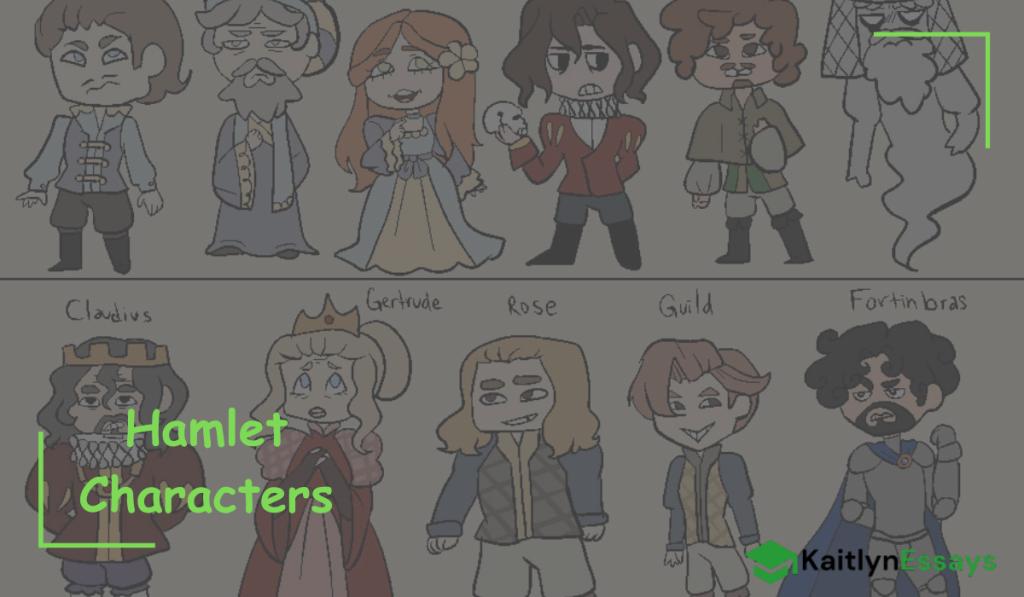
Shakespeare’s tragedy “Hamlet” features a cast of complex and memorable characters that have captivated audiences for centuries. The main character is Prince Hamlet, a sad and thoughtful young man dealing with loss and hard choices. Supporting him are loyal friends Horatio and the comedic duo Rosencrantz and Guildenstern. The royal court includes the usurping King Claudius, Hamlet’s uncle who murdered the previous king; Queen Gertrude, Hamlet’s mother who hastily remarried; and Polonius, the meddling royal advisor.
Ophelia, Polonius’ daughter and Hamlet’s love interest becomes a tragic victim of court intrigue. Her brother, Laertes, serves as Hamlet’s foil in seeking vengeance. The ghost of Hamlet’s father sets the plot in motion, while minor characters like the gravediggers provide moments of dark humor. Together, these richly drawn Hamlet characters show different sides of people, exploring themes of revenge, madness, and the corrupting nature of power.
Are you worried about meeting your assignment deadline?
We understand the pressure of deadlines, and we’re here to help you create a thorough paper quickly and efficiently
Hamlet
Hamlet is the main character in the play He is the Prince of Denmark, known for his reflective and melancholic nature. The play revolves around his quest for revenge against his uncle, Claudius, who has murdered Hamlet’s father, taken the throne, and married Hamlet’s mother, Gertrude. Hamlet’s journey is marked by his philosophical musings on life, death, and morality, as well as his feigned madness, which he uses to uncover the truth and achieve his revenge. His complex character, profound soliloquies, and tragic fate make him one of Shakespeare’s most compelling and enduring protagonists.
At the play’s outset, Hamlet is deeply mourning the death of his father, King Hamlet. His grief is compounded by his mother’s quick remarriage to Claudius, his uncle, which he finds morally repugnant. The ghost of his father reveals that he was murdered by Claudius, sparking Hamlet’s desire for revenge. This revelation sets Hamlet on his tragic path.
To gather information and protect himself, Hamlet decides to feign madness. This act of deception is a strategic move, but it also highlights his increasing isolation and inner turmoil. His famous soliloquy, “To be or not to be,” reveals his existential crisis and deep contemplation of life, death, and the nature of existence. He grapples with the moral implications of revenge and his own inaction.
Hamlet stages a play that reenacts his father’s murder to gauge Claudius’s guilt. Claudius’s reaction confirms his culpability, intensifying Hamlet’s resolve for revenge. Confronting his mother, Hamlet expresses his disgust and disappointment with her actions. This encounter also leads to the accidental killing of Polonius, further complicating Hamlet’s situation.
Hamlet is sent to England by Claudius, who secretly plans his murder. During his journey, Hamlet encounters the Norwegian prince Fortinbras’s army and reflects on his own hesitance compared to Fortinbras’s decisive action. Returning to Denmark, Hamlet seems to come to terms with the inevitability of death and his own fate. He shows a more mature acceptance of his destiny.
Hamlet returns to Elsinore and confronts Laertes, who seeks revenge for the deaths of his father, Polonius, and sister, Ophelia. In the ensuing duel, both Hamlet and Laertes are mortally wounded. Before dying, Hamlet finally kills Claudius, avenging his father’s murder. His last act is one of justice, albeit at the cost of his own life. Hamlet’s death is marked by a sense of tragic inevitability. His final request to Horatio is to tell his story, ensuring that his experiences and struggles are remembered and understood.
Character Analysis of Hamlet
- Melancholy and introspection: His melancholic nature is evident from the beginning of the play, stemming from his father’s death and his mother’s hasty remarriage. He’s prone to brooding and self-reflection, often pondering the meaning of life and death. This introspective quality is most famously displayed in his “To be, or not to be” soliloquy, where he contemplates suicide and the nature of existence.
- Indecisiveness and tendency to overthink: One of Hamlet’s most notable traits is his inability to act decisively. After learning of his father’s murder, he spends much of the play planning and deliberating rather than taking immediate action. This hesitation is partly due to his analytical nature, as he constantly questions his own motives and the reliability of the information he receives. His overthinking often leads to missed opportunities and contributes to the play’s tragic outcome.
- Intelligence and wit: He is highly intelligent and well-educated, often displaying his wit through wordplay, puns, and clever retorts. His intelligence is evident in his ability to devise complex plans, such as the play-within-a-play to confirm Claudius’s guilt. However, his intellect also contributes to his tendency to overthink situations.
- Moral struggle and existential questioning: Throughout the play, he struggles with moral dilemmas, particularly concerning revenge and the afterlife. He questions the morality of revenge, the nature of good and evil, and the purpose of human existence. This philosophical bent adds depth to his character and elevates the play beyond a simple revenge tragedy.
- Possible feigned madness: After encountering his father’s ghost, he decides to “put an antic disposition on,” or pretend to be mad. This raises questions about the extent to which his erratic behavior is an act versus genuine mental instability brought on by grief and the weight of his mission. The ambiguity of his mental state adds complexity to his character and his interactions with others.
- Desire for revenge conflicting with his contemplative nature: The central conflict of Hamlet’s character is between his duty to avenge his father and his contemplative, hesitant nature. While he feels compelled to act, his philosophical mindset and moral qualms cause him to delay. This internal struggle drives much of the play’s action and contributes to its tragic conclusion.
Hamlet’s Quotes
“To be, or not to be, that is the question”
(Act 3, Scene 1)
This is perhaps the most famous line in all of Shakespeare. It opens Hamlet’s soliloquy on the nature of existence and the contemplation of suicide. The line encapsulates the fundamental philosophical dilemma Hamlet faces: whether to continue living and fighting against life’s troubles, or to end his life and the suffering it brings.
“Frailty, thy name is woman!”
(Act 1, Scene 2)
Hamlet utters this line in his first soliloquy, referring to his mother’s hasty remarriage to his uncle. It reflects his disillusionment with women in general, sparked by what he sees as his mother’s inconstancy. This quote is often cited to discuss Hamlet’s complex relationships with women in the play.
“The play’s the thing / Wherein I’ll catch the conscience of the king.”
(Act 2, Scene 2)
This quote concludes Hamlet’s plan to stage a play mirroring his father’s murder to gauge Claudius’s reaction. It demonstrates Hamlet’s clever plotting and his determination to confirm his uncle’s guilt before taking action.
“What a piece of work is a man!”
(Act 2, Scene 2)
Part of a longer speech, this line begins Hamlet’s reflection on the nature of humanity. He marvels at human potential while simultaneously expressing his current distaste for humankind. This quote is often used to explore themes of human nature in the play.
“There are more things in heaven and earth, Horatio, / Than are dreamt of in your philosophy.”
(Act 1, Scene 5)
Hamlet says this to Horatio after his encounter with his father’s ghost. It suggests that reality is more complex and mysterious than human understanding can comprehend, setting the stage for the supernatural elements in the play.
“This above all: to thine own self be true”
(Act 1, Scene 3)
While this advice is actually given by Polonius to Laertes, it’s often misattributed to Hamlet due to its popularity. It encapsulates a key theme in the play about authenticity and self-knowledge.
“The lady doth protest too much, methinks.”
(Act 3, Scene 2)
Hamlet says this to his mother during the play-within-a-play. It’s a comment on the Player Queen’s overly effusive declarations of love, but also reflects Hamlet’s suspicion of his own mother’s sincerity.
“Alas, poor Yorick! I knew him, Horatio”
(Act 5, Scene 1)
This famous line is spoken by Hamlet as he holds the skull of Yorick, a court jester he knew in his childhood. It leads into Hamlet’s contemplation of the inevitability of death, regardless of one’s station in life.
Claudius
Claudius is the brother of King Hamlet, whom he murders in order to seize the throne of Denmark. Claudius quickly marries Queen Gertrude, Hamlet’s mother, after the murder, solidifying his hold on power. Throughout the play, Claudius is portrayed as ambitious, manipulative, and morally corrupt.
Claudius’s murder of King Hamlet sets the main plot of the play in motion. He is driven by ambition and a desire for power, willing to commit regicide to achieve his goals. After becoming king, Claudius tries to present himself as a capable ruler, but his guilt over the murder haunts him. He is aware of the potential threats to his reign, particularly from Hamlet, whose behavior becomes increasingly erratic as he seeks to uncover the truth about his father’s death.
Claudius is adept at manipulation and deceit. He orchestrates schemes to protect himself from potential threats, including sending Hamlet away to England with orders for his execution. He also plots with Laertes to kill Hamlet during a fencing match, demonstrating his willingness to use others to achieve his ends.
Throughout the play, Claudius is contrasted with Hamlet, highlighting his lack of moral integrity and his willingness to sacrifice others for his own gain. His downfall ultimately comes from his guilt and inability to escape the consequences of his actions. Claudius’s character serves as a foil to Hamlet, embodying ambition and corruption while Hamlet wrestles with moral dilemmas and seeks justice for his father’s murder.
Character Analysis of Claudius
Ambition and Deception: Claudius is ambitious and manipulative, driven by a desire for power and the throne of Denmark. He schemes to marry Queen Gertrude shortly after King Hamlet’s death, thereby seizing the throne for himself. His actions reveal his willingness to deceive and manipulate others to achieve his goals.
Guile and Political Acumen: Claudius demonstrates political astuteness throughout the play. He manages to manipulate the court and secure his position as king, presenting himself as a capable ruler while concealing his darker deeds.
Guilt and Remorse: Unlike many villains, Claudius shows moments of guilt and remorse. In his soliloquy in Act 3, Scene 3, he confesses to the murder of King Hamlet and reflects on the consequences of his actions. This complexity adds depth to his character, as he wrestles with his conscience while striving to maintain his power.
Contrast with Hamlet: Claudius serves as a foil to Prince Hamlet. Where Hamlet is introspective and hesitant, Claudius is decisive and action-oriented. Their conflict drives much of the play’s tension, as Hamlet seeks to avenge his father’s murder while Claudius attempts to thwart him.
Relationship with Gertrude: Claudius’s marriage to Queen Gertrude complicates his character further. While he appears genuinely fond of her at times, their relationship is tainted by the circumstances of King Hamlet’s death and Claudius’s thirst for power.
Fatal Flaws: Claudius’s fatal flaws include his ambition, deceitfulness, and moral corruption. These traits ultimately lead to his downfall, as his actions provoke the wrath of Prince Hamlet and contribute to the tragic events of the play.
Claudius’ Quotes
- “Though yet of Hamlet our dear brother’s death / The memory be green, and that it us befitted / To bear our hearts in grief and our whole kingdom / To be contracted in one brow of woe…” (Act 1, Scene 2)
This quote opens Claudius’s first public address as king. The language is carefully crafted to present himself as a dutiful successor, balancing grief with the needs of the state. The phrase “memory be green” suggests the death is still fresh, while “dear brother” attempts to convey familial affection. However, this sentiment rings hollow given Claudius’s true actions. The imagery of the whole kingdom united in grief (“contracted in one brow of woe”) serves to solidify his position as the new leader who can guide Denmark through this period of mourning.
- “Therefore our sometime sister, now our queen, / Th’ imperial jointress to this warlike state, / Have we, as ’twere with a defeated joy…” (Act 1, Scene 2)
Here, Claudius addresses his marriage to Gertrude. The phrase “sometime sister, now our queen” acknowledges the uncomfortable shift in relationships, while “imperial jointress” emphasizes Gertrude’s new status and implies a political dimension to the marriage. “Defeated joy” is a particularly loaded phrase, suggesting their happiness is tempered by grief. This oxymoron encapsulates Claudius’s public balancing act between celebration of his new position and appropriate mourning.
- “How smart a lash that speech doth give my conscience!” (Act 3, Scene 1)
This aside reveals Claudius’s guilty conscience. After overhearing Polonius and Hamlet, Claudius recognizes how his crimes weigh on him. The metaphor of a “lash” suggests his guilt is a physical, painful sensation. This moment humanizes Claudius, showing he’s not merely a cold-blooded killer but a man haunted by his actions.
- “O, my offense is rank, it smells to heaven; / It hath the primal eldest curse upon ‘t, / A brother’s murder.” (Act 3, Scene 3)
In this soliloquy, Claudius fully confesses his crime. The vivid imagery of his offense being “rank” and smelling “to heaven” conveys the magnitude of his sin. The reference to the “primal eldest curse” alludes to the biblical story of Cain and Abel, the first instance of fratricide. This connection elevates Claudius’s crime to an archetypal evil, emphasizing its severity.
- “Now might I do it pat, now he is praying; / And now I’ll do ‘t. And so he goes to heaven, / And so am I revenged.” (Act 3, Scene 3)
This is actually Hamlet’s line, not Claudius’s. Hamlet is considering killing Claudius while he’s praying but decides against it, believing that killing Claudius during prayer would send his soul to heaven. This misconception is ironic because, as we know from Claudius’s earlier soliloquy, he is unable to pray due to his guilt.
- “Do it, England; / For like the hectic in my blood he rages, / And thou must cure me.” (Act 4, Scene 3)
Claudius is referring to his plot to have Hamlet killed in England. The metaphor of Hamlet as a fever (“hectic”) in Claudius’s blood paints Hamlet as a disease that must be purged. This medical imagery continues with England being called upon to “cure” Claudius, euphemistically referring to the planned execution.
- “Let’s further think of this; / Weigh what convenience both of time and means / May fit us to our shape.” (Act 4, Scene 7)
This quote demonstrates Claudius’s calculating nature. In conspiring with Laertes, he’s careful to consider all angles (“time and means”). The phrase “fit us to our shape” suggests adapting the plan to suit their needs and abilities, revealing Claudius’s strategic mindset.
- “The king shall drink to Hamlet’s better breath, / And in the cup an union shall he throw…” (Act 5, Scene 2)
This line outlines Claudius’s final, desperate plot to kill Hamlet. The “union” (a pearl) is actually poisoned, meant to kill Hamlet if the rigged fencing match fails. The irony of drinking to Hamlet’s health while planning his death encapsulates Claudius’s duplicitous nature. This scheme ultimately backfires, leading to multiple deaths including his own, bringing his arc of treachery to a close.
Gertrude
Gertrude is the Queen of Denmark and the mother of Prince Hamlet. Gertrude plays a crucial role in the unfolding drama, primarily through her relationships with Hamlet and her new husband, King Claudius.
Initially, Gertrude appears to be a passive figure, easily influenced by those around her. She quickly remarries Claudius shortly after the death of her first husband, King Hamlet, which deeply disturbs Hamlet and fuels his sense of betrayal. Hamlet criticizes Gertrude for her hasty marriage, seeing it as a betrayal of his father’s memory and a sign of moral corruption.
Throughout the play, Gertrude’s character is complex and ambiguous. While she loves her son, her actions often prioritize maintaining peace and stability within the royal court. She tries to mediate between Hamlet and Claudius, hoping to reconcile their differences. However, her efforts are often ineffectual, and she becomes caught in the crossfire of their conflict.
Gertrude’s relationship with Claudius raises questions about her complicity in King Hamlet’s murder. Hamlet accuses her of being too easily swayed by Claudius and of being morally weak. Gertrude’s inability or unwillingness to see Claudius’s true nature contributes to the escalating tensions in the play.
In the final act of “Hamlet,” Gertrude unwittingly drinks poisoned wine intended for Hamlet, leading to her tragic death. Her death serves as a catalyst for the climactic events of the play, including Hamlet’s duel with Laertes and the revelation of Claudius’s guilt.
Character Analysis of Gertrude
- Moral Ambiguity: Gertrude’s moral compass is a subject of much discussion. Her hasty marriage to Claudius, Hamlet’s uncle and her late husband’s brother, shortly after King Hamlet’s death raises questions about her loyalty and moral integrity. Some see her as weak and easily manipulated, while others view her as complicit in Claudius’s plot to seize the throne.
- Maternal Instincts: Despite her questionable actions, Gertrude shows genuine concern for Hamlet. She is troubled by his feigned madness and expresses worry about his well-being. Her maternal instincts are evident when she pleads with Hamlet to stay in Denmark and not return to his studies in Wittenberg.
- Power and Influence: As the Queen, Gertrude holds a position of power and influence, although her authority is overshadowed by that of her husband, Claudius. Her role in the court is significant, and she often acts as a mediator between Claudius and Hamlet.
- Self-Deception: Gertrude may be seen as a character who deceives herself. She seems to be in denial about the true nature of her relationship with Claudius and the implications of her actions. Her inability to face the truth about her husband’s and possibly her own involvement in King Hamlet’s death leaves her vulnerable and manipulated.
- Tragic End: Gertrude’s tragic end comes when she drinks from the poisoned cup intended for Hamlet. Her death is a turning point in the play, leading to a series of fatal events. Whether she is truly innocent or guilty, her death is a moment of pathos that evokes sympathy from the audience.
- Interpretation: The interpretation of Gertrude’s character can vary greatly depending on the actor’s portrayal and the director’s vision. Some productions emphasize her as a victim of circumstance, while others highlight her as a more active participant in the play’s dark schemes.
Gertrude’s Quotes
“The lady doth protest too much, methinks.”
(Act 3, Scene 2)
Contrary to popular belief, this famous line is actually spoken by Gertrude, not Hamlet. She says this during the play-within-a-play, commenting on the Player Queen’s overly passionate vows of fidelity to her husband. This line is ironic given Gertrude’s own hasty remarriage after King Hamlet’s death.
“O Hamlet, speak no more. / Thou turn’st mine eyes into my very soul, / And there I see such black and grained spots / As will not leave their tinct.”
(Act 3, Scene 4)
Gertrude speaks these lines during the intense confrontation with Hamlet in her chamber. This quote reveals her growing awareness of her own guilt and moral compromise, as Hamlet’s accusations force her to examine her actions.
“O, my son, what theme?”
(Act 3, Scene 4)
This short line demonstrates Gertrude’s confusion and concern when Hamlet begins speaking to the ghost of his father, whom she cannot see. It highlights the complex dynamics between mother and son, as well as Gertrude’s inability to fully understand Hamlet’s experiences.
“There is a willow grows aslant a brook, / That shows his hoar leaves in the glassy stream.”
(Act 4, Scene 7)
Gertrude delivers this poetic description of Ophelia’s death by drowning. The beautifully lyrical nature of this speech contrasts sharply with the tragic event it describes, showcasing Gertrude’s eloquence and sensitivity.
“One woe doth tread upon another’s heel, / So fast they follow.”
(Act 4, Scene 7)
Spoken to Claudius after Ophelia’s madness becomes apparent, this line expresses Gertrude’s recognition of the cascade of tragedies befalling Denmark. It shows her awareness of the deteriorating situation in the court.
“No, no, the drink, the drink! O my dear Hamlet! / The drink, the drink! I am poison’d.”
(Act 5, Scene 2)
These are Gertrude’s final words as she realizes she has been poisoned by the cup intended for Hamlet. Her last act is to warn her son, showing her maternal love despite their complicated relationship.
“Let not thy mother lose her prayers, Hamlet. / I pray thee stay with us, go not to Wittenberg.”
(Act 1, Scene 2)
This early quote shows Gertrude’s desire to keep Hamlet close after his father’s death. It reveals her affection for her son, but also possibly her guilt and need for his presence.
“Come hither, my dear Hamlet, sit by me.”
(Act 3, Scene 2)
Spoken during the play-within-a-play scene, this line demonstrates Gertrude’s ongoing affection for Hamlet, despite the tension between them. It shows her attempting to maintain a normal mother-son relationship amidst the turmoil in Denmark.
Ophelia
Ophelia is the daughter of Polonius, a high-ranking courtier, and the sister of Laertes. Ophelia is also romantically involved with Prince Hamlet, but their relationship becomes strained and ultimately ends in tragedy.
At the beginning of the play, Ophelia is depicted as a gentle and obedient young woman. She is deeply affectionate towards Hamlet and initially believes in his love for her. However, their relationship faces challenges as Hamlet becomes increasingly erratic and distant following the death of his father and his mother’s quick remarriage to Claudius.
Ophelia becomes a pawn in the political intrigues of the court. Polonius and Claudius use her to spy on Hamlet, hoping to uncover the cause of his madness. This manipulation, combined with Hamlet’s harsh treatment and his apparent rejection of her love, causes Ophelia to spiral into madness herself.
In Act 4, Ophelia’s mental state deteriorates significantly. She sings songs and speaks in nonsensical riddles, reflecting her fractured psyche. Her madness culminates tragically in her drowning in a brook, an event described in a poignant and haunting manner by Queen Gertrude.
Character Analysis of Ophelia
- Innocence and Naivety: Ophelia is often portrayed as innocent and naive. Her obedience to her father and brother, who advise her to reject Hamlet’s advances, highlights her youthful inexperience and vulnerability.
- Love and Conflict: Ophelia’s love for Hamlet is evident, but it is fraught with conflict. Hamlet’s treatment of her, particularly after the death of his father, is harsh and contradictory. He accuses her of deceit and immorality, reflecting his own internal turmoil rather than her character.
- Madness and Despair: After the death of Polonius, Ophelia descends into madness. Her madness is expressed through disjointed speech and symbolic actions, such as distributing flowers that represent various aspects of her despair and loss.
- Symbolism: Ophelia’s character and actions are rich in symbolism. Her madness and eventual death by drowning can be seen as a reflection of the decay and corruption within the Danish court. Her funeral, attended by those who claim to love her but whose actions belie their words, underscores the hypocrisy and moral decay of the characters around her.
- Tragic Figure: Ophelia is a tragic figure, caught in the crossfire of the play’s central conflicts. Her death is a poignant moment that evokes sympathy and highlights the destructive nature of the characters’ actions and decisions.
- Interpretation: Like Gertrude, Ophelia’s character can be interpreted in various ways depending on the actor’s portrayal and the director’s vision. Some interpretations emphasize her victimhood, while others explore her agency and complexity.
Ophelia’s Quotes
“I shall the effect of this good lesson keep / As watchman to my heart.”
(Act 1, Scene 3)
Ophelia says this to her brother Laertes, promising to heed his advice about Hamlet. This quote shows her initial obedience and naivety, setting the stage for her later struggles.
“My lord, he hath importuned me with love / In honorable fashion.”
(Act 1, Scene 3)
Spoken to her father Polonius about Hamlet’s advances, this line reveals Ophelia’s genuine belief in Hamlet’s honorable intentions, contrasting with her father’s skepticism.
“O, what a noble mind is here o’erthrown!”
(Act 3, Scene 1)
Ophelia laments Hamlet’s apparent descent into madness after he rejects her. This quote shows her deep feelings for Hamlet and her distress at his changed behavior.
“There’s rosemary, that’s for remembrance. Pray you, love, remember. And there is pansies, that’s for thoughts.”
(Act 4, Scene 5)
In her madness, Ophelia distributes flowers, assigning them symbolic meanings. This quote demonstrates how her mental state has deteriorated, while also showcasing her poetic nature.
“There’s fennel for you, and columbines. There’s rue for you, and here’s some for me.”
(Act 4, Scene 5)
Another part of Ophelia’s mad scene, this quote continues her distribution of symbolic flowers. The mention of rue, associated with regret, is particularly poignant.
“He is dead and gone, lady, / He is dead and gone; / At his head a grass-green turf, / At his heels a stone.”
(Act 4, Scene 5)
Ophelia sings this mournful song about her father’s death. It reveals her grief and her descent into madness, expressed through folk songs and rhymes.
“Lord, we know what we are, but know not what we may be.”
(Act 4, Scene 5)
This philosophical statement, spoken in her madness, shows a flash of insight about the uncertainty of fate and identity.
“I would give you some violets, but they withered all when my father died.”
(Act 4, Scene 5)
Another line from her mad scene, this poignant statement links her father’s death with the loss of faithfulness and fidelity (symbolized by violets).
“And will he not come again? / No, no, he is dead, / Go to thy deathbed, / He never will come again.”
(Act 4, Scene 5)
This excerpt from another of Ophelia’s songs in her madness expresses her grief and acceptance of her father’s death.
Polonius
Polonius is known for his role as the Lord Chamberlain of the Danish court and as the father of Ophelia and Laertes. He is portrayed as a somewhat bumbling and verbose character, often offering long-winded advice and opinions to those around him.
As Lord Chamberlain, Polonius is a trusted adviser to King Claudius, and he is often involved in the political intrigues of the court. He is portrayed as a sycophantic and opportunistic figure, always seeking to ingratiate himself with those in power. Polonius is also shown to be overly concerned with appearances and social status, often giving lengthy and pedantic speeches that reflect his desire to appear wise and knowledgeable.
Polonius’s relationship with his children, Ophelia and Laertes, is characterized by paternalistic authority. He gives lengthy speeches of advice to both of them, particularly to Laertes before he departs for France. His advice to Ophelia, urging her to reject Hamlet’s advances due to his status and political instability, ultimately contributes to Ophelia’s tragic descent into madness.
In his interactions with Hamlet, Polonius is often the target of Hamlet’s sharp wit and mockery. Hamlet sees through Polonius’s pretensions and mocks his verbose speeches, such as the famous line, “Though this be madness, yet there is method in’t.”
Polonius meets a tragic end when Hamlet mistakenly kills him, thinking he is Claudius hiding behind a curtain in Gertrude’s chamber. This act further complicates Hamlet’s moral dilemma and adds to the sense of chaos and violence that pervades the play.
Character Analysis of Polonius
- Paternal Authority and Control: Polonius is the father of Laertes and Ophelia. He embodies the role of a strict and controlling parent, dispensing advice and instructions to his children. His famous lines, “Neither a borrower nor a lender be” and “This above all: to thine own self be true,” are examples of his attempts to guide his children with wisdom and caution.
- Political Ambition and Cunning: As the lord chamberlain, Polonius is a politically ambitious and cunning figure. He seeks to advance his position at court by ingratiating himself with King Claudius. His willingness to spy on Hamlet at the king’s request demonstrates his loyalty to Claudius but also his lack of moral scruples.
- Manipulation and Deception: Polonius is not above using manipulation and deception to achieve his goals. He uses Ophelia to spy on Hamlet, believing that her rejection might be the cause of Hamlet’s madness. His actions contribute to the atmosphere of distrust and deceit that pervades the court.
- Tragic Flaw: Polonius’s tragic flaw is his overconfidence in his own judgment and his inability to see the consequences of his actions. His decision to hide behind the arras in Gertrude’s chamber, believing he could eavesdrop on Hamlet without being discovered, leads to his death at Hamlet’s hands.
- Symbolism: Polonius’s death symbolizes the breakdown of order and the onset of chaos in the Danish court. His body, hidden and then revealed, becomes a source of tension and conflict, leading to further violence and tragedy.
- Interpretation: Polonius is often portrayed as a foolish and meddling old man. However, his character can also be seen as a tragic figure, caught in the web of court intrigue and ultimately paying for his loyalty to Claudius with his life.
Polonius’ Quotes
“This above all: to thine own self be true, / And it must follow, as the night the day, / Thou canst not then be false to any man.”
(Act 1, Scene 3)
Perhaps Polonius’s most famous lines, this advice to his son Laertes is often quoted out of context. While seemingly wise, it’s part of a long list of clichéd advice, highlighting Polonius’s tendency to speak in platitudes.
“Neither a borrower nor a lender be; / For loan oft loses both itself and friend, / And borrowing dulls the edge of husbandry.”
(Act 1, Scene 3)
Another piece of advice to Laertes, this quote showcases Polonius’s practical worldview and his penchant for dispensing wisdom.
“Brevity is the soul of wit.”
(Act 2, Scene 2)
Ironically, Polonius says this in the midst of a long-winded speech. This quote is often used to highlight his hypocritical nature and lack of self-awareness.
“Though this be madness, yet there is method in’t.”
(Act 2, Scene 2)
Polonius speaks this line about Hamlet, recognizing a pattern in Hamlet’s apparent insanity. It demonstrates Polonius’s perceptiveness, even as he misinterprets the cause of Hamlet’s behavior.
“By indirections find directions out.”
(Act 2, Scene 1)
This line encapsulates Polonius’s approach to gathering information, advocating for indirect methods. It reveals his cunning and duplicitous nature.
“I’ll loose my daughter to him.”
(Act 2, Scene 2)
Polonius uses this hunting metaphor to describe his plan to use Ophelia to uncover the cause of Hamlet’s madness, showing his willingness to manipulate his own daughter.
“The king is a thing-“
(Act 3, Scene 4)
These are Polonius’s final words before Hamlet kills him. The irony of his unfinished sentence adds to the tragic-comic nature of his death.
“My lord, I will use them according to their desert.”
(Act 2, Scene 2)
Spoken about the arriving players, this quote demonstrates Polonius’s sense of self-importance and his belief in social hierarchy.
“Your bait of falsehood takes this carp of truth.”
(Act 2, Scene 1)
This metaphorical line, spoken to Reynaldo, reveals Polonius’s manipulative tactics and his belief in using deceit to uncover truth.
Are you racing against the clock to finish your literature review assignment?
Don’t let the pressure of a looming deadline compromise the quality of your work. Our experienced writers can quickly produce a high-quality paper that meets all academic standards
Laertes
Laertes is introduced at the beginning of the play as a young Danish nobleman, the son of Polonius and brother of Ophelia. He is initially portrayed as a dutiful son and protective brother, embodying the values of honor and loyalty that were highly regarded in the Danish court. As he prepares to leave for France to continue his education, we see him offering advice to Ophelia about her relationship with Hamlet, warning her to guard her virtue and be wary of Hamlet’s intentions. This scene establishes Laertes as someone who takes his familial responsibilities seriously and possesses a keen awareness of court politics and social expectations.
During his absence in France, Laertes undergoes an off-stage transformation. While we don’t see this directly, it’s implied that his time abroad has exposed him to new ideas and experiences, potentially shaping his character in ways that become evident upon his return. This period of absence also serves to heighten the dramatic tension when he eventually returns to Denmark.
Laertes’ character takes a significant turn upon hearing of his father’s death. He returns to Denmark with a fury that showcases a more impulsive and passionate side of his personality. Leading a rebellion against Claudius, whom he initially blames for his father’s murder, Laertes demonstrates his capacity for decisive action – a stark contrast to Hamlet’s hesitation. This rebellion reveals not only Laertes’ love for his father but also his ability to garner popular support, hinting at his charisma and the respect he commands among the Danish people.
The manipulation of Laertes by Claudius marks a crucial point in his character development. Claudius skillfully redirects Laertes’ anger towards Hamlet, exploiting the young man’s grief and desire for vengeance. This manipulation exposes a vulnerability in Laertes’ character – his susceptibility to influence when emotionally distraught. It also sets the stage for his moral decline, as he agrees to Claudius’s underhanded plot to kill Hamlet, abandoning his previous adherence to honor and fair play.
The news of Ophelia’s death serves as another pivotal moment in Laertes’ development. His grief intensifies, pushing him further down the path of revenge. The loss of his sister, coupled with his father’s death, leaves Laertes emotionally raw and even more determined to seek vengeance. This accumulation of personal tragedies transforms Laertes from a noble young man into someone willing to forsake his principles for the sake of retribution.
In the final act, Laertes’ character reaches its zenith of moral ambiguity during the duel with Hamlet. His willingness to use a poisoned sword demonstrates how far he has fallen from his initial portrayal as an honorable gentleman. The duel scene is tense with dramatic irony, as the audience is aware of Laertes’ treachery while Hamlet remains oblivious.
However, Laertes’ character arc concludes with a moment of redemption. Mortally wounded and faced with the consequences of his actions, Laertes experiences a profound change of heart. He confesses the plot to Hamlet, asks for forgiveness, and offers his own in return. This final transformation showcases Laertes’ capacity for self-reflection and moral growth, even in his dying moments. His reconciliation with Hamlet brings his character full circle, returning to the honorable man he was at the beginning of the play, but now tempered by tragedy and hard-won wisdom.
Throughout his development, Laertes serves as a foil to Hamlet, highlighting the play’s themes of revenge, action versus inaction, and the consequences of one’s choices. His journey from a principled young nobleman to a vengeful conspirator, and finally to a redeemed figure, adds depth to the play’s exploration of human nature and the corrupting influence of revenge.
Character Analysis of Laertes
- Impulsiveness: Unlike Hamlet, Laertes is quick to act, especially when driven by emotion. This is evident in his immediate return to Denmark and his willingness to lead a rebellion.
- Loyalty: Laertes shows strong loyalty to his family, particularly in his protective attitude towards Ophelia and his fierce reaction to his father’s death.
- Malleability: Despite his initial strength of character, Laertes is easily manipulated by Claudius, highlighting his susceptibility to influence when emotionally vulnerable.
- Honor vs. Revenge: Laertes struggles with the conflict between his sense of honor and his desire for revenge. Initially valuing honor, he ultimately chooses revenge, agreeing to underhanded methods to kill Hamlet.
- Foil to Hamlet: Laertes serves as a foil to Hamlet. Where Hamlet is indecisive and philosophical, Laertes is impulsive and action-oriented. This contrast highlights key aspects of both characters.
- Tragic figure: Like Hamlet, Laertes is a tragic figure. His quest for revenge leads to his own downfall, illustrating the destructive nature of vengeance.
- Capacity for growth: Laertes shows the ability to recognize his errors and seek redemption, as seen in his final moments when he reconciles with Hamlet.
- Protective brother: His relationship with Ophelia reveals a caring and protective side, though his absence during her mental decline adds to his guilt and motivation for revenge.
- Skill and reputation: Laertes is known for his skill in fencing and his gentlemanly conduct, attributes that make him a worthy opponent for Hamlet in the final duel.
Laertes’ Quotes
“For Hamlet and the trifling of his favor, / Hold it a fashion and a toy in blood, / A violet in the youth of primy nature, / Forward, not permanent, sweet, not lasting, / The perfume and suppliance of a minute. / No more.”
(Act 1, Scene 3)
Laertes warns Ophelia about Hamlet’s affections, revealing his protective nature towards his sister and his skepticism about Hamlet’s intentions.
“Perhaps he loves you now, / And now no soil nor cautel doth besmirch / The virtue of his will; but you must fear, / His greatness weighed, his will is not his own.”
(Act 1, Scene 3)
Continuing his warning to Ophelia, Laertes demonstrates his understanding of political realities and the constraints on Hamlet as a prince.
“Then weigh what loss your honor may sustain / If with too credent ear you list his songs.”
(Act 1, Scene 3)
This quote further emphasizes Laertes’ concern for his sister’s reputation and his distrust of Hamlet’s motives.
“I dare damnation. To this point I stand, / That both the worlds I give to negligence, / Let come what comes, only I’ll be revenged / Most thoroughly for my father.”
(Act 4, Scene 5)
Spoken after his father’s death, this quote shows Laertes’ passionate desire for revenge, contrasting with Hamlet’s more hesitant approach.
“And so have I a noble father lost; / A sister driven into desperate terms, / Whose worth, if praises may go back again, / Stood challenger on mount of all the age / For her perfections: but my revenge will come.”
(Act 4, Scene 7)
This quote reveals Laertes’ grief for both his father and sister, as well as his determination to seek revenge.
“To cut his throat i’ the church.”
(Act 4, Scene 7)
When asked by Claudius what he would do to prove himself his father’s son, Laertes gives this shocking reply, showing the depth of his desire for vengeance.
“Exchange forgiveness with me, noble Hamlet: / Mine and my father’s death come not upon thee, / Nor thine on me.”
(Act 5, Scene 2)
In his dying moments, Laertes reconciles with Hamlet, demonstrating his inherent nobility and capacity for forgiveness.
“It is here, Hamlet: Hamlet, thou art slain; / No medicine in the world can do thee good; / In thee there is not half an hour of life; / The treacherous instrument is in thy hand, / Unbated and envenomed: the foul practice / Hath turned itself on me lo, here I lie, / Never to rise again: thy mother’s poisoned: / I can no more: the king, the king’s to blame.”
(Act 5, Scene 2)
Laertes’ final speech reveals the truth about the poisoned sword and Claudius’ plot, showing his final turn towards honesty and redemption.
The Ghost
The Ghost first appears in Act I, creating an atmosphere of unease and supernatural dread. Its presence is initially reported by the castle guards, lending credibility to its existence before it directly interacts with any main characters. This buildup of tension and mystery surrounding the Ghost’s nature and purpose effectively captures the audience’s attention from the outset.
When the Ghost finally speaks to Hamlet, it reveals the truth about King Hamlet’s murder at the hands of Claudius, the current king and Hamlet’s uncle. This revelation is the pivotal moment that drives the rest of the play’s events. The Ghost’s character is developed here as a figure caught between two worlds – no longer alive, yet unable to rest due to the circumstances of its death. This limbo state reflects the play’s broader themes of corruption, justice, and the blurred lines between appearance and reality.
Character Analysis of The Ghost
- Catalyst for action: The Ghost’s appearance and revelations are crucial to the plot. It informs Hamlet that his father was murdered by Claudius, Hamlet’s uncle and now stepfather. This disclosure transforms Hamlet from a mourning son to a man driven by the need for revenge. The Ghost’s command to “remember me” becomes a driving force for Hamlet throughout the play, shaping his actions and mental state.
- Ambiguous nature: The Ghost’s true identity and intentions are subjects of debate both within the play and among critics. Hamlet himself questions whether the apparition is truly his father’s spirit or a demon sent to deceive him. This ambiguity reflects the play’s broader themes of appearance versus reality and the difficulty of discerning truth. It also adds to Hamlet’s hesitation and internal conflict, as he grapples with whether to trust and act on the Ghost’s words.
- Symbolic significance: As a representation of the past intruding on the present, the Ghost embodies the idea that unresolved issues will resurface until addressed. It symbolizes the corruption in Denmark (“something is rotten in the state of Denmark”) and the hidden truths that must be brought to light. The Ghost also represents the disruption of the natural order, mirroring the political upheaval in Denmark following King Hamlet’s death.
- Moral complexity: While the Ghost seeks justice for its murder, it also demands vengeance, placing a heavy burden on Hamlet. This raises ethical questions about the nature of justice and the moral implications of revenge. The Ghost’s command challenges Hamlet’s moral compass and forces him to wrestle with the righteousness of vengeance versus legal or divine justice.
- Dramatic impact: The Ghost’s appearances are theatrical high points, creating an atmosphere of suspense, fear, and supernatural dread. Its presence blurs the line between the natural and supernatural worlds, adding a mystical dimension to the play. The Ghost’s scenes, often set at night or in isolated locations, contribute to the overall mood of unease and impending tragedy.
- Character insight: Through the Ghost’s speeches, we gain insight into the character of the late King Hamlet. We learn of his love for his wife and son, his prowess as a ruler and warrior, and the circumstances of his death. The Ghost also provides context for the political situation in Denmark, revealing the threats from Norway and the importance of royal succession.
- Psychological element: The Ghost can be interpreted as a psychological manifestation of Hamlet’s grief and suspicion. Its appearances and messages align with Hamlet’s internal turmoil, possibly representing his subconscious desires or fears. This interpretation adds depth to Hamlet’s character and the play’s exploration of the human psyche.
- Religious implications: The Ghost’s claim to be suffering in purgatory introduces religious elements to the play. It raises questions about the afterlife, sin, and redemption, reflecting the religious uncertainties of Shakespeare’s time, caught between Catholic and Protestant beliefs.
- Literary tradition: The Ghost in “Hamlet” draws on a rich tradition of spirits in revenge tragedies. However, Shakespeare’s Ghost is more complex and integral to the plot than many of its literary predecessors, showcasing Shakespeare’s innovation within established genres.
The Ghost’s Quotes
“I am thy father’s spirit, / Doomed for a certain term to walk the night, / And for the day confined to fast in fires, / Till the foul crimes done in my days of nature / Are burnt and purged away.”
(Act 1, Scene 5)
This is the Ghost’s introduction to Hamlet, revealing its identity and the nature of its purgatorial existence.
“But that I am forbid / To tell the secrets of my prison-house, / I could a tale unfold whose lightest word / Would harrow up thy soul, freeze thy young blood…”
(Act 1, Scene 5)
The Ghost hints at the horrors of the afterlife, building tension and emphasizing the gravity of its message.
“Murder most foul, as in the best it is, / But this most foul, strange, and unnatural.”
(Act 1, Scene 5)
The Ghost begins to reveal the circumstances of its death, emphasizing the heinous nature of the crime.
“Sleeping within my orchard, / My custom always of the afternoon, / Upon my secure hour thy uncle stole, / With juice of cursed hebenon in a vial, / And in the porches of my ears did pour / The leperous distilment…”
(Act 1, Scene 5)
This vivid description of King Hamlet’s murder provides the central motivation for Hamlet’s actions throughout the play.
“Let not the royal bed of Denmark be / A couch for luxury and damned incest.”
(Act 1, Scene 5)
The Ghost expresses its disgust at Gertrude’s marriage to Claudius, adding another layer to Hamlet’s emotional turmoil.
“But, howsoever thou pursuest this act, / Taint not thy mind, nor let thy soul contrive / Against thy mother aught: leave her to heaven…”
(Act 1, Scene 5)
The Ghost instructs Hamlet to spare Gertrude in his quest for revenge, a command that Hamlet struggles with throughout the play.
“Remember me.”
(Act 1, Scene 5)
This simple but powerful command becomes a driving force for Hamlet, encapsulating his duty to avenge his father.
“Do not forget. This visitation / Is but to whet thy almost blunted purpose.”
(Act 3, Scene 4)
The Ghost appears to Hamlet again, urging him to action when he seems to have lost focus on his revenge.
Horatio
At the beginning of the play, Horatio is introduced as a scholar and a skeptic. He is initially doubtful about the existence of the Ghost, demonstrating his rational and logical nature. However, upon witnessing the Ghost himself, Horatio shows his ability to accept evidence that challenges his preconceptions, a trait that sets him apart from more rigid characters.
As the play progresses, Horatio’s role as Hamlet’s trusted friend becomes increasingly apparent. He serves as a sounding board for Hamlet’s thoughts and plans, offering a steady presence amidst the prince’s emotional turmoil. Horatio’s loyalty and discretion make him the only character Hamlet feels he can fully trust, which is crucial in a play rife with deception and betrayal.
Horatio’s character develops further as he becomes an active participant in Hamlet’s schemes. He agrees to observe Claudius during the play-within-a-play, demonstrating his willingness to support Hamlet even in potentially dangerous situations. This shows growth from his initial role as a passive observer to a more engaged ally.
Throughout the play, Horatio maintains his composure and rationality, even as chaos unfolds around him. This consistency in his character serves as a counterpoint to the increasingly erratic behavior of other characters, particularly Hamlet. Horatio’s stability highlights the destructive nature of revenge and the toll it takes on those who pursue it.
In the final act, Horatio’s character reaches its fullest development. As Hamlet lies dying, Horatio, in a moment of intense emotion, considers suicide to join his friend. This shows the depth of his loyalty and affection for Hamlet. However, at Hamlet’s request, he chooses to live and tell Hamlet’s story, accepting the responsibility of preserving the truth of what has transpired.
Horatio’s final role as the survivor who will recount the tragic events underscores his importance as a character. He has evolved from a skeptical scholar to a loyal friend, and finally to the keeper of Hamlet’s legacy. His ability to bridge the world of academia and the world of the court, to maintain his integrity in a corrupt environment, and to remain steadfast in his friendship makes him a unique and admirable character in the play.
Character Analysis of Horatio
- Loyal friend: Horatio’s unwavering loyalty to Hamlet is a defining aspect of his character. He stands by Hamlet through all the turmoil, offering emotional support and practical assistance. This loyalty extends to risking his own life and reputation. Horatio’s steadfast friendship provides a stark contrast to the betrayals and deceptions that surround Hamlet. His loyalty is so strong that he even considers suicide when Hamlet is dying, showing the depth of his devotion.
- Voice of reason: As a foil to Hamlet’s often turbulent state of mind, Horatio represents rationality and calm judgment. He often advises caution and deliberation, tempering Hamlet’s more impulsive tendencies. For instance, he tries to dissuade Hamlet from following the ghost, fearing for his safety. Horatio’s reasoned approach serves as a grounding influence for Hamlet and provides the audience with a more objective perspective on events.
- Educated scholar: Horatio’s background as a scholar from Wittenberg (like Hamlet) establishes him as an intellectual peer to the prince. This shared educational experience forms a basis for their deep friendship and allows for sophisticated dialogue between them. Horatio’s scholarly nature is evident in his skepticism towards the supernatural and his ability to reference classical literature, as seen in his allusion to Julius Caesar’s death when discussing the ghost’s appearance.
- Skeptic turned believer: Horatio’s initial disbelief in ghosts adds weight to the reality of King Hamlet’s spirit. His transition from skeptic to believer lends credibility to the supernatural elements of the play. This transformation also mirrors the audience’s journey, as they too must come to terms with the ghost’s existence and its implications for the story.
- Outsider perspective: As someone not directly involved in the Danish court’s politics, Horatio provides an outsider’s view of the events at Elsinore. This perspective allows him to see things more clearly, free from the biases and entanglements that affect other characters. His outsider status also makes him a more reliable narrator, as he has less personal stake in the power struggles unfolding around him.
- Trusted witness: Hamlet’s reliance on Horatio to observe Claudius during the play-within-a-play demonstrates the deep trust between them. Horatio’s role as a witness extends beyond this scene; he becomes a witness to many key events in the play, including the final duel. His presence serves to validate Hamlet’s experiences and perceptions, particularly when Hamlet’s mental state is in question.
- Survivor and storyteller: Horatio’s survival at the end of the play is crucial. As the only main character left alive who knows the full story, he becomes responsible for preserving and sharing Hamlet’s tale. This role elevates Horatio from a supporting character to the crucial link between the events of the play and the wider world. His final lines, promising to tell Hamlet’s story, set him up as the play’s ultimate narrator and keeper of Hamlet’s legacy.
- Symbol of true friendship: In a play filled with betrayal and false friends, Horatio stands out as a symbol of genuine friendship. His relationship with Hamlet is one of the few uncorrupted elements in the Danish court, providing a moral anchor in a sea of corruption.
- Bridge between Hamlet and the audience: Horatio often serves as a proxy for the audience. His reactions and questions often mirror what the audience might be thinking or feeling, making him a relatable figure and a bridge between the complex world of the play and the viewers.
- Embodiment of stoic philosophy: Horatio’s calm demeanor and rational approach to events align with stoic philosophy, popular during Shakespeare’s time. His ability to remain steady in the face of extraordinary events provides a contrast to the emotional turbulence of other characters.
Horatio’s Quotes
“In the most high and palmy state of Rome, / A little ere the mightiest Julius fell, / The graves stood tenantless and the sheeted dead / Did squeak and gibber in the Roman streets.”
(Act 1, Scene 1)
Horatio draws a parallel between the appearance of the Ghost and omens preceding Julius Caesar’s assassination, showcasing his education and analytical mind.
“A mote it is to trouble the mind’s eye. / In the most high and palmy state of Rome, / A little ere the mightiest Julius fell, / The graves stood tenantless and the sheeted dead / Did squeak and gibber in the Roman streets.”
(Act 1, Scene 1)
This quote demonstrates Horatio’s initial skepticism about the Ghost, as well as his knowledge of history and omens.
“My lord, I think I saw him yesternight.”
(Act 1, Scene 2)
Horatio informs Hamlet about the Ghost’s appearance, setting the play’s main plot in motion.
“Season your admiration for a while / With an attent ear, till I may deliver, / Upon the witness of these gentlemen, / This marvel to you.”
(Act 1, Scene 2)
This quote shows Horatio’s measured and rational approach to explaining the supernatural occurrence to Hamlet.
“There needs no ghost, my lord, come from the grave / To tell us this.”
(Act 1, Scene 5)
Horatio’s dry comment after Hamlet makes him swear secrecy demonstrates his practical nature and subtle wit.
“O day and night, but this is wondrous strange!”
(Act 1, Scene 5)
This exclamation reveals Horatio’s amazement at the Ghost’s revelations, despite his usual composure.
“There’s no offense, my lord.”
(Act 3, Scene 2)
Horatio’s diplomatic response to Hamlet during the play-within-a-play scene shows his loyalty and tact.
“Now cracks a noble heart. Good night, sweet prince, / And flights of angels sing thee to thy rest!”
(Act 5, Scene 2)
Horatio’s famous farewell to the dying Hamlet is one of the most poignant lines in the play, showing his deep friendship and respect for the prince.
“Give order that these bodies / High on a stage be placed to the view; / And let me speak to the yet unknowing world / How these things came about.”
(Act 5, Scene 2)
In the play’s final moments, Horatio takes on the responsibility of telling Hamlet’s story, demonstrating his role as a faithful friend and chronicler.
“O God, Horatio, what a wounded name, / Things standing thus unknown, shall live behind me!”
(Act 5, Scene 2)
This quote is actually Hamlet speaking to Horatio, but it underscores Horatio’s important role as the keeper of Hamlet’s legacy.
Other Characters
Fortinbras
Prince of Norway, Fortinbras serves as a foil to Hamlet. His character develops from a perceived threat to Denmark to the ultimate inheritor of the Danish throne. Initially described as impetuous and war-like, Fortinbras evolves into a more diplomatic figure, negotiating passage through Denmark. His decisive action contrasts with Hamlet’s hesitation, and his arrival at the play’s end symbolizes the restoration of order.
Rosencrantz and Guildenstern
These childhood friends of Hamlet are often treated as a unit. Their character development is marked by their gradual shift from Hamlet’s friends to Claudius’s pawns. Initially seeming loyal to Hamlet, they reveal their willingness to betray him for royal favor. Their inability to see the full scope of the situation they’re involved in leads to their eventual demise, ordered by Hamlet.
Osric
A courtier, Osric appears late in the play but provides insight into the superficiality of the Danish court. His overly elaborate speech and mannerisms showcase the artificiality that Hamlet despises. Osric’s character doesn’t develop much but serves to highlight the contrast between courtly affectation and Hamlet’s desire for sincerity.
Voltimand and Cornelius
These ambassadors to Norway have minor roles but contribute to the political subplot involving Fortinbras. Their successful diplomatic mission demonstrates the effectiveness of King Claudius’s rule, despite his personal crimes.
Marcellus and Bernardo
Guards who first spot the Ghost, they play crucial roles in the opening scenes. Their characters serve to establish the atmosphere of unease and watchfulness that permeates the play. They don’t develop significantly but are essential in introducing the supernatural element.
Francisco
Another guard, Francisco appears briefly at the beginning of the play. His character helps to establish the tense atmosphere and the theme of watchfulness.
Reynaldo
A servant of Polonius, Reynaldo appears in a single scene where he is instructed to spy on Laertes in Paris. This brief appearance doesn’t allow for much character development, but it illustrates Polonius’s suspicious nature and the theme of surveillance present throughout the play.
With so much information available, it can be overwhelming to sift through sources and synthesize key findings.
Our professional team can streamline the process, providing you with a well-organized paper tailored to your needs
FAQs
Who is Yorick?
Yorick is the deceased court jester whose skull Hamlet discovers in the churchyard. Hamlet reflects on mortality while contemplating the skull.
What role do Marcellus and Bernardo play?
Marcellus and Bernardo are officers of the watch at Elsinore. They are among the first to see the Ghost and report it to Horatio, who then informs Hamlet.
How does Fortinbras serve as a foil to Hamlet?
Fortinbras serves as a foil to Hamlet by highlighting their contrasting approaches to similar situations. While Hamlet is indecisive and contemplative about avenging his father’s death, Fortinbras is decisive and action-oriented in seeking to reclaim his father’s lost lands and honor.
How do Hamlet characters contribute to the play’s themes?
The characters in Hamlet each contribute to the exploration of themes such as revenge, madness, mortality, and corruption. Hamlet’s introspective nature and quest for revenge drive the plot and highlight the complexities of human emotion and ethical dilemmas. Claudius embodies political corruption and moral decay. Ophelia’s descent into madness and eventual death underscore the theme of innocence lost.