

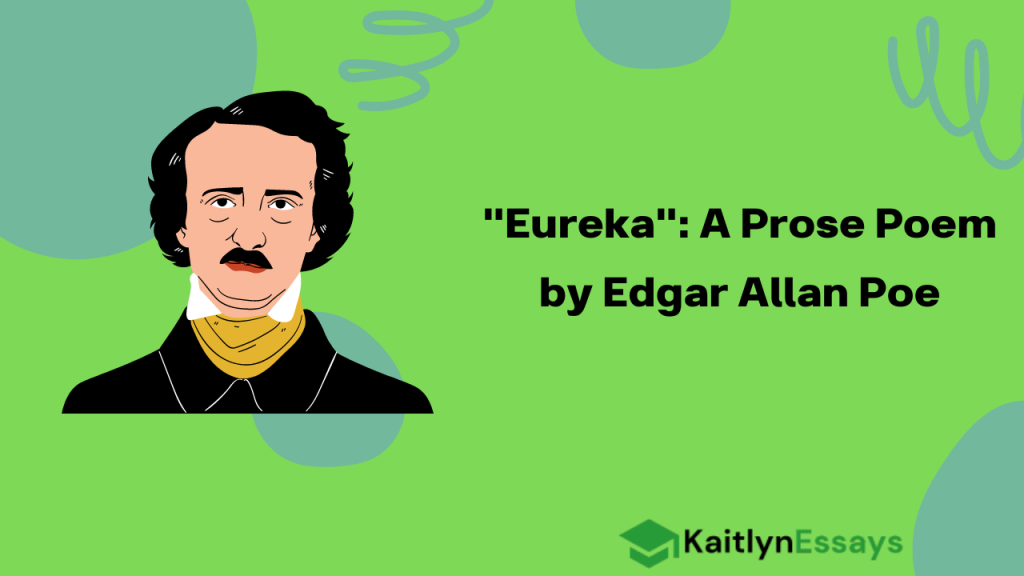
Edgar Allan Poe is renowned for his mastery of the macabre and the mysterious. Among his lesser-known works is “Eureka: A Prose Poem,” a philosophical treatise published in 1848. Unlike Poe’s famous tales of horror and suspense, “Eureka” presents a speculative exploration of the universe, existence, and the nature of reality. In this paper, we will explore the depths of “Eureka,” examining its themes, interpretations, and significance in the context of Poe’s literary legacy and philosophical thought.
Understanding “Eureka”
“Eureka: A Prose Poem” is a unique and enigmatic work that defies easy classification. Written in prose form but characterized by its poetic language and speculative nature, “Eureka” explores a wide range of philosophical, scientific, and metaphysical concepts. Poe described it as his attempt to convey “truth – in its fullest extent of meaning,” aiming to unravel the mysteries of the cosmos and humanity’s place within it (Poe, 1848).
The title “Eureka” is derived from the ancient Greek word meaning “I have found it,” famously exclaimed by the mathematician Archimedes upon making a significant discovery. In Poe’s work, “Eureka” represents a moment of revelation or enlightenment, wherein the mysteries of the universe are unveiled and understood. However, the nature of this revelation and its implications remain open to interpretation, inviting readers to embark on a journey of intellectual exploration and introspection.
Themes and Interpretations

“Eureka” covers a vast array of themes and subjects, ranging from cosmology and astronomy to metaphysics, theology, and existential philosophy. Poe’s speculative narrative unfolds as a series of interconnected ideas and observations, presented in a stream-of-consciousness style that reflects the author’s introspective musings.
One of the central themes of “Eureka” is the concept of the universe as a unified and interconnected whole. Poe proposes a theory of cosmogony wherein the universe is conceived as a boundless and eternal entity, governed by fundamental laws and principles. He explores the origins of the universe, the nature of matter and energy, and the cyclical patterns of creation and destruction.
Another prominent theme in “Eureka” is the relationship between humanity and the cosmos. Poe contemplates the nature of existence, consciousness, and the human soul within the vastness of the universe. He explores the interconnectedness of all things, suggesting that every individual is both a microcosm and a reflection of the macrocosm.
The significance of “Eureka” extends beyond its philosophical and scientific themes to encompass broader questions of truth, knowledge, and the pursuit of enlightenment. Poe grapples with the limitations of human understanding and the elusive nature of ultimate truth, suggesting that true knowledge lies beyond the confines of empirical observation and rational inquiry.
Literary and Philosophical Influences

“Eureka” reflects Poe’s engagement with various intellectual currents of his time, including Romanticism, Transcendentalism, and German idealism. Influenced by the works of philosophers such as Immanuel Kant and Ralph Waldo Emerson, as well as scientists like Isaac Newton and Alexander von Humboldt, Poe synthesizes diverse ideas into a cohesive and original philosophical framework.
The poetic language and imagery of “Eureka” evoke the transcendentalist tradition, with its emphasis on intuition, imagination, and spiritual insight. Poe’s use of metaphor and symbolism imbues the text with a sense of mystery and wonder, inviting readers to contemplate the deeper meanings concealed within its prose.
At the same time, “Eureka” exhibits elements of scientific speculation and rational inquiry, reflecting Poe’s fascination with the discoveries and theories of contemporary astronomers and physicists. While Poe’s scientific hypotheses may seem outdated by modern standards, his willingness to speculate boldly about the nature of the universe foreshadows later developments in cosmology and theoretical physics.
Criticism and Reception
“Eureka” received mixed reviews upon its publication, with critics divided over its literary merit and philosophical coherence. Some praised Poe’s ambition and imagination, hailing “Eureka” as a visionary work of speculative philosophy. Others dismissed it as nonsensical or pretentious, criticizing its lack of empirical evidence and logical rigor.
In the years since its publication, “Eureka” has undergone reappraisal and reinterpretation by scholars and critics. While its scientific theories may no longer hold sway in the light of modern cosmology, “Eureka” continues to fascinate readers with its poetic language, imaginative scope, and existential insights. Many scholars now view “Eureka” as a precursor to later developments in cosmology, metaphysics, and existential philosophy, appreciating its literary and philosophical contributions in their historical context.
Conclusion
“Eureka: A Prose Poem” stands as a testament to Edgar Allan Poe’s creative genius and intellectual curiosity. In this enigmatic work, Poe ventures beyond the realms of horror and suspense to explore the mysteries of the cosmos and the human condition. Through its poetic language, speculative musings, and philosophical meditations, “Eureka” invites readers on a journey of intellectual exploration and existential reflection. While its scientific hypotheses may be outdated, its poetic vision and existential insights continue to captivate and inspire readers to ponder the profound mysteries of existence.
Stuck with a daunting writing task? We’ve got the solution you need. Our skilled writers specialize in a wide range of subjects, ready to tackle any assignment with expertise and precision. Say goodbye to writer’s block and hello to academic success – reach out to us and get started today!
FAQs
What is “Eureka: A Prose Poem” by Edgar Allan Poe?
“Eureka: A Prose Poem” is a philosophical treatise written by Edgar Allan Poe and published in 1848. Unlike Poe’s more famous works of fiction, “Eureka” explores themes of cosmology, metaphysics, and the nature of existence in a prose format.
What is the significance of the title “Eureka”?
The title “Eureka” is derived from the ancient Greek word meaning “I have found it,” famously exclaimed by the mathematician Archimedes upon making a significant discovery. In Poe’s work, “Eureka” represents a moment of revelation or enlightenment, wherein the mysteries of the universe are unveiled and understood.
What themes are explored in “Eureka”?
“Eureka” covers a wide range of themes, including cosmology, astronomy, metaphysics, theology, and existential philosophy. Poe contemplates the origins of the universe, the nature of matter and energy, the relationship between humanity and the cosmos, and the pursuit of ultimate truth and enlightenment.
Is “Eureka” a poem or a prose work?
“Eureka” is often described as a prose poem due to its poetic language, imagery, and speculative nature. While written in prose form, “Eureka” exhibits qualities commonly associated with poetry, such as metaphor, symbolism, and rhythmic cadence.
What literary and philosophical influences are evident in “Eureka”?
“Eureka” reflects Poe’s engagement with various intellectual currents of his time, including Romanticism, Transcendentalism, and German idealism. Influenced by philosophers such as Immanuel Kant and Ralph Waldo Emerson, as well as scientists like Isaac Newton and Alexander von Humboldt, Poe synthesizes diverse ideas into a cohesive and original philosophical framework.
How was “Eureka” received by contemporary audiences and critics?
“Eureka” received mixed reviews upon its publication, with critics divided over its literary merit and philosophical coherence. Some praised Poe’s ambition and imagination, while others criticized the work as nonsensical or pretentious. In the years since its publication, “Eureka” has undergone reappraisal and reinterpretation by scholars and critics.
What is the legacy of “Eureka” in literature and philosophy?
Despite its initial reception, “Eureka” continues to fascinate readers with its poetic language, imaginative scope, and existential insights. Many scholars now view “Eureka” as a precursor to later developments in cosmology, metaphysics, and existential philosophy, appreciating its literary and philosophical contributions in their historical context.
Is “Eureka” still relevant today?
While some of Poe’s scientific theories may be outdated by modern standards, “Eureka” remains relevant for its poetic vision and existential insights into the mysteries of existence. Its exploration of fundamental questions about the universe and humanity’s place within it continues to inspire readers to ponder the profound mysteries of life and reality.
Can “Eureka” be understood by readers without a background in science or philosophy?
Yes, “Eureka” can be appreciated by readers with varying levels of familiarity with scientific and philosophical concepts. While some passages may be challenging due to their complexity, Poe’s poetic language and imaginative storytelling make “Eureka” accessible to a wide audience interested in exploring the mysteries of the universe.
Where can I find “Eureka: A Prose Poem” by Edgar Allan Poe?
“Eureka: A Prose Poem” by Edgar Allan Poe is available in various collections of Poe’s works and can also be accessed online through digital archives and literary websites. Additionally, printed editions of “Eureka” may be found in libraries, bookstores, and online retailers specializing in classic literature.
References
Poe, E. A. (1848). Eureka: A Prose Poem. Wiley and Putnam.