

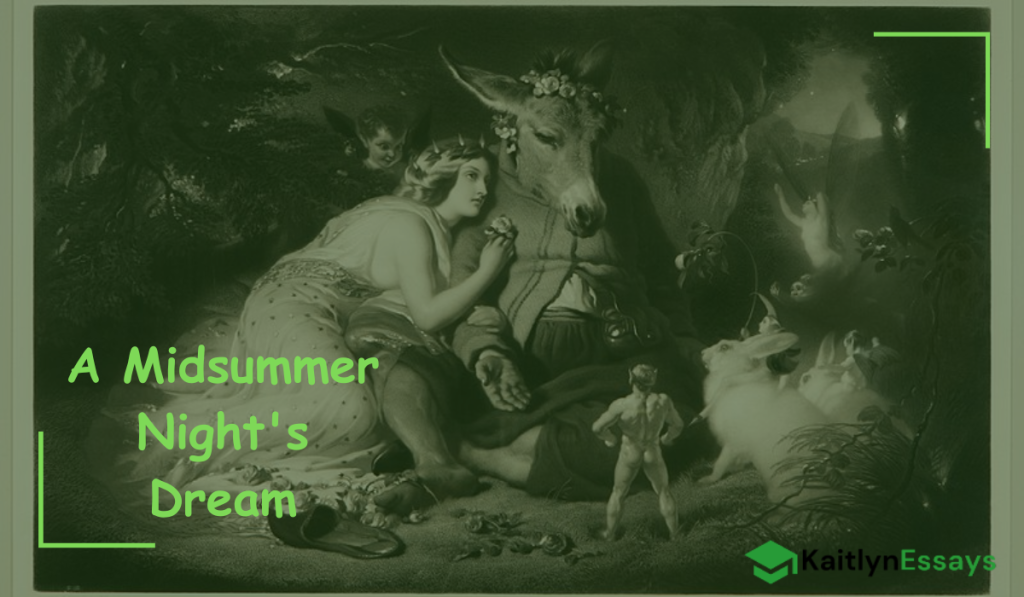
“A Midsummer Night’s Dream” is one of William Shakespeare’s most enchanting comedies, blending romance, fantasy, and playful confusion. Set in an enchanted forest, the play weaves together the lives of four young Athenians and a group of amateur actors, all of whom become entangled in the mischievous schemes of the fairy king and queen. As love potions create chaos, misunderstandings multiply, and magical transformations occur, the story explores themes of love, illusion, and transformation. Shakespeare’s imaginative plot and vibrant characters make this play a delightful exploration of the nature of love and the whimsical interplay between reality and imagination.
Summary of “A Midsummer Night’s Dream”
The play opens with a tense atmosphere in Athens. Theseus, the Duke of Athens, is preparing for his upcoming wedding to Hippolyta, Queen of the Amazons. Egeus, a nobleman, seeks Theseus’s intervention to compel his daughter, Hermia, to marry Demetrius, whom she does not love. Hermia is determined to marry Lysander, the man she loves, despite her father’s wishes. Theseus gives Hermia an ultimatum: marry Demetrius, face execution, or become a nun. Hermia and Lysander decide to flee to the forest outside Athens to escape this decree.
Meanwhile, in the forest, a group of amateur actors, led by the comical Bottom, are rehearsing a play to perform at Theseus and Hippolyta’s wedding. Their rehearsal is interrupted by the mischievous fairy Puck, who serves Oberon, the King of the Fairies. Oberon and his queen, Titania, are in the midst of a bitter quarrel. Oberon seeks to use a magical flower to enchant Titania and make her fall in love with the first creature she sees upon waking, intending to distract her so he can take custody of a changeling child she refuses to relinquish.
Puck mistakenly applies the flower’s potion to Lysander instead of Demetrius, causing Lysander to fall in love with Helena, Hermia’s friend who is hopelessly in love with Demetrius. This mix-up creates chaos as Demetrius, now also affected by the potion, falls in love with Helena as well. Hermia, bewildered and enraged, confronts Helena, believing that her friend has betrayed her.
Amidst this turmoil, the amateur actors continue their rehearsals, with Bottom being magically transformed into a donkey by Puck. Titania, under the potion’s spell, falls in love with Bottom in his donkey form, leading to further comedic confusion.
Eventually, Oberon intervenes to correct the enchantments. Puck administers an antidote to Lysander, restoring his love for Hermia. Demetrius’s affections remain for Helena, resolving the love triangle. Titania and Oberon reconcile, and Puck reverses Bottom’s transformation. The play concludes with a joyous celebration of Theseus and Hippolyta’s wedding, and the actors perform their play, which is humorously inept but charmingly earnest.
The culmination of A Midsummer Night’s Dream offers a resolution to the tangled web of love and magic, showcasing Shakespeare’s skillful blending of romance, comedy, and fantasy.
Access a more detailed summary.
Characters in A Midsummer Night’s Dream
Puck (Robin Goodfellow)
At the heart of the magical realm is Puck, also known as Robin Goodfellow. As Oberon’s loyal servant, Puck is instrumental in the unfolding of the play’s events. His magical abilities and playful nature are responsible for much of the chaos in the forest. He mistakenly causes both Lysander and Demetrius to fall in love with Helena, turning the lovers’ situation into a comic mess. Puck’s famous line, “Lord, what fools these mortals be!” (Shakespeare, A Midsummer Night’s Dream 3.2.115), epitomizes his outlook on human behavior. Puck’s mischief isn’t malicious but rather playful, adding a layer of lightheartedness to the confusion he causes.
Dive deeper into how Puck’s actions drive the play’s plot.
Oberon and Titania
Oberon and Titania, the King and Queen of the Fairies, represent a power struggle that extends beyond the mortal world. Their disagreement over the custody of a changeling boy serves as a catalyst for much of the magical interference in the play. Oberon’s desire to humble Titania leads him to enchant her, causing her to fall in love with the first creature she sees – which, thanks to Puck, is the comically transformed Bottom with a donkey’s head. Despite Oberon’s initial pettiness, he ultimately reconciles with Titania, signaling the resolution of their conflict.
Get more insight into the dynamics between Oberon and Titania.
Lysander, Hermia, Demetrius, and Helena
The tangled love story between Lysander, Hermia, Demetrius, and Helena forms the core of A Midsummer Night’s Dream. Hermia loves Lysander, but her father, Egeus, demands that she marry Demetrius, who has the support of Theseus, the Duke of Athens. Helena, on the other hand, is hopelessly in love with Demetrius, despite his rejection of her.
Lysander and Hermia’s decision to elope leads them into the magical forest, where Puck’s enchantment causes both Lysander and Demetrius to fall in love with Helena. This sudden shift in affection creates tension, confusion, and ultimately comedy. The lovers’ storyline is Shakespeare’s commentary on the fickle and irrational nature of love. As Lysander states, “The course of true love never did run smooth” (A Midsummer Night’s Dream 1.1.134).
Examine the complexities of the lovers’ relationships.
Bottom
Nick Bottom, a weaver and one of the mechanicals, is perhaps one of the most memorable characters in A Midsummer Night’s Dream. His transformation into a donkey and subsequent enchantment by Titania provides much of the play’s comedy. Bottom’s arrogance and inflated sense of self-importance make him an easy target for Puck’s magic, and his unawareness of his transformation makes the situation even more humorous.
Bottom’s role also adds a layer of satire to the play, poking fun at the amateur actors and the mechanicals’ inept performance of “Pyramus and Thisbe.” Despite his flaws, Bottom is endearing, and his genuine enthusiasm for the craft of acting makes him a beloved character.
Explore Bottom’s comedic role in the play.
Theseus and Hippolyta
Theseus, the Duke of Athens, and his bride-to-be, Hippolyta, are the symbols of order and authority in A Midsummer Night’s Dream. Their wedding, which serves as the backdrop for the events in the forest, represents the restoration of balance and harmony by the end of the play. Although their relationship is less tumultuous than those of the other characters, Theseus and Hippolyta’s union is significant in anchoring the fantastical events of the play in the real world.
Get a deeper analysis of Theseus and Hippolyta’s roles in the play.
The Mechanicals
The mechanicals, a group of Athenian laborers, add a humorous subplot to the play. Led by Peter Quince, they prepare a play for Theseus and Hippolyta’s wedding, with Bottom taking the lead role. Their amateurish attempt at putting on “Pyramus and Thisbe” contrasts sharply with the magical and romantic plots involving the fairies and lovers.
Despite their lack of talent, the mechanicals’ earnestness and commitment to their craft make them lovable characters. Their performance of the play within the play also serves as a comic reflection on the themes of love and tragedy explored elsewhere in the play.
More on the mechanicals and their role in the narrative.
Themes in A Midsummer Night’s Dream
The Theme of Love: Unpredictable and Irrational
One of the central themes in A Midsummer Night’s Dream is love, portrayed as a force that is both beautiful and chaotic. Throughout the play, love is shown to be irrational, unpredictable, and often uncontrollable. The tangled relationships between Hermia, Lysander, Helena, and Demetrius are a prime example of love’s volatility. The use of the love potion by Oberon and Puck to manipulate the lovers further highlights the idea that love can be fickle and subject to outside forces.
Shakespeare explores different kinds of love—from the pure, mutual love between Lysander and Hermia to the unrequited love Helena holds for Demetrius. By the end, the magical influences are removed, and the couples are “restored,” but the play suggests that love, in all its forms, remains a complex and capricious emotion.
Uncover more insights on how Shakespeare portrays love’s volatility.
Magic and Its Influence on Reality
Magic plays a pivotal role in A Midsummer Night’s Dream, serving as a mechanism for transformation and disruption. The forest, a mystical space outside the bounds of Athenian society, is where much of the magical action occurs. Here, the rules of the real world no longer apply, and characters’ identities and emotions are altered through supernatural means. Puck’s magic leads to mistaken identities and temporary changes in feelings, reinforcing the theme that reality itself is malleable and can be altered by unseen forces.
The fairies’ magic, especially Oberon’s use of the love potion, blurs the line between reality and illusion, raising questions about the authenticity of the lovers’ feelings. The play seems to suggest that while magic can cause confusion, it ultimately serves to reveal deeper truths about the characters.
Explore how Shakespeare uses magic to shape reality.
The Conflict Between Reality and Illusion
Closely related to the theme of magic is the play’s exploration of the tension between reality and illusion. The enchanted forest becomes a setting where the characters are subject to fantastical experiences that contrast sharply with the structured reality of Athens. Shakespeare frequently blurs the line between the real and the imagined, forcing both the characters and the audience to question what is true.
This theme is most apparent in the play-within-a-play performed by the mechanicals. Their crude performance of “Pyramus and Thisbe” highlights the thin boundary between artifice and reality, as well as the comedic potential of theatrical illusion. The audience within the play, like the audience watching the play itself, is drawn into the fictional world, only to be reminded of its constructed nature.
Get a deeper dive into the theme of illusion versus reality.
Transformation and Metamorphosis
Transformation is another recurring theme in A Midsummer Night’s Dream, both in a literal and figurative sense. Characters undergo changes in their emotions, their perceptions, and even their physical appearances. Bottom’s transformation into a donkey-headed figure by Puck is the most obvious example of metamorphosis, serving as both a comedic device and a symbolic representation of the play’s interest in change and illusion.
On a deeper level, the lovers’ shifting affections throughout the play also represent emotional transformations, driven by both magic and personal revelations. By the end of the play, these transformations lead to personal growth, with the characters gaining new perspectives on love and relationships.
Examine the role of transformation in A Midsummer Night’s Dream.
The Intersection of Social Hierarchies and the Natural World
The play contrasts the structured, hierarchical society of Athens with the untamed, magical forest, highlighting the tension between civilization and nature. In Athens, the characters are bound by social conventions and legal constraints, such as Egeus’ demand that Hermia marry Demetrius. The forest, by contrast, is a space where societal rules are suspended, and the characters are free to explore their desires without the restrictions of Athenian law.
Shakespeare uses the forest to emphasize the theme of liberation from social norms, as well as the idea that the natural world operates on its own set of rules, which are often mysterious and unpredictable to the human characters. This theme is further developed through the fairy kingdom, where characters like Oberon and Titania wield power that transcends the authority of human rulers.
Get a closer look at how social hierarchies and the natural world intersect in the play.
The Role of Dreams and Imagination
The title itself, A Midsummer Night’s Dream, suggests that dreams and imagination play a significant role in the narrative. Throughout the play, characters experience events that seem dreamlike in their absurdity and strangeness. Puck even addresses the audience directly at the end of the play, suggesting that the entire story may have been nothing more than a dream: “If we shadows have offended, think but this, and all is mended, that you have but slumbered here” (A Midsummer Night’s Dream 5.1.423-425).
Shakespeare uses dreams as a metaphor for the transient and ephemeral nature of the events in the forest, as well as for the unpredictability of human emotions. The dreamlike quality of the play serves to highlight the impermanence of the characters’ experiences and the fine line between fantasy and reality.
Discover more about the significance of dreams in the play.
The Nature of Comedy and Tragedy
Although A Midsummer Night’s Dream is categorized as a comedy, it plays with elements of both comedy and tragedy. The lovers’ entanglements, while humorous, could easily lead to tragic outcomes, particularly when the characters are under the influence of the love potion. Shakespeare balances these potential tragedies with moments of levity, particularly through the mechanicals’ bumbling attempts at performing their play.
The play’s comedic tone is further underscored by its resolution, where the lovers are reunited, and all conflicts are resolved, but the darker undertones of the narrative remind the audience of how closely comedy and tragedy can intertwine.
Symbolism in A Midsummer Night’s Dream
The Forest
The forest outside Athens serves as a central symbol in the play, representing a magical realm where the rules of society no longer apply. As the characters enter this wild and mysterious setting, they undergo profound transformations. The forest symbolizes:
- Freedom from societal constraints
- The unpredictable nature of love and desire
- A place where magic and reality intertwine
In the forest, characters like Lysander, Hermia, Demetrius, and Helena find themselves liberated from the strict laws of Athens, allowing their true feelings to surface and evolve. The contrast between the ordered city and the chaotic forest highlights the tension between civilization and nature, reason and emotion.
A deeper exploration of the forest’s symbolism
The Moon
Throughout the play, the moon is a recurring symbol that represents:
- The changing nature of love
- Feminine power and influence
- The dream-like quality of the events
Theseus refers to the moon as “the governess of floods,” emphasizing its connection to the ebb and flow of emotions. The moon’s phases mirror the inconstancy of the lovers’ affections, particularly as they are influenced by the fairies’ magic. Moreover, the moon is closely associated with the character of Titania, the fairy queen, further reinforcing its symbolism of feminine power and mystery.
Further analysis of lunar symbolism in the play
Flowers and Herbs
The use of flowers and herbs as symbols is prevalent throughout A Midsummer Night’s Dream, most notably in the form of the love potion derived from “love-in-idleness” (wild pansy). This magical flower symbolizes:
- The capricious nature of love
- The power of suggestion and illusion
- The thin line between infatuation and genuine affection
When Oberon instructs Puck to use the love potion, it sets off a chain of events that highlight the unpredictable and often irrational nature of romantic love. The flower’s ability to make someone fall in love with the first person they see upon waking emphasizes the role of chance and circumstance in matters of the heart.
Detailed examination of floral symbolism
The Mechanicals’ Play
The play-within-a-play performed by the mechanicals serves as a symbolic mirror to the main plot, reflecting:
- The transformative power of theater and imagination
- The blurring of reality and illusion
- The comic relief that balances the more serious themes
The mechanicals’ comical portrayal of the tragic tale of Pyramus and Thisbe not only provides humor but also offers a simplified version of the lovers’ struggles in the main plot. This meta-theatrical element symbolizes the power of art to reflect and comment on life, while also highlighting the thin line between reality and performance.
In-depth analysis of the play-within-a-play
The Fairies
The fairy characters, led by Oberon and Titania, symbolize:
- The unpredictable forces of nature
- The magical elements that influence human affairs
- The delicate balance between order and chaos
The fairies’ interference in the lives of the mortal characters represents the unseen forces that often shape human destinies. Their quarrels and reconciliations mirror the conflicts and resolutions in the mortal world, suggesting a interconnectedness between the natural and supernatural realms.
Comprehensive look at fairy symbolism
The Love Potion
The love potion, created from the “love-in-idleness” flower, is a powerful symbol that represents:
- The arbitrary nature of attraction
- The power of suggestion and belief
- The fine line between love and infatuation
When applied to the eyes, the potion causes the affected individual to fall in love with the first person they see upon waking. This magical element serves as a metaphor for the often inexplicable nature of romantic attraction and the role that perception plays in love. The potion’s effects highlight how easily one’s affections can be swayed and how what we perceive as love may sometimes be mere illusion.
Further exploration of the love potion’s symbolism
The Changeling Boy
The changeling boy, though never seen on stage, serves as a significant symbol in the play:
- Representing the object of desire that drives conflict
- Symbolizing the tension between maternal and marital love
- Highlighting the theme of possession and control in relationships
The dispute over the changeling boy between Oberon and Titania sets the entire fairy plot in motion. Their quarrel symbolizes the power struggles that can occur in relationships, especially when external factors come into play. The boy’s unseen presence throughout the play emphasizes how unseen forces can have profound effects on the visible world of the characters.
Detailed analysis of the changeling boy’s symbolic role
The Walls in Pyramus and Thisbe
In the mechanicals’ play, the wall that separates Pyramus and Thisbe serves as a potent symbol:
- Representing the obstacles that lovers must overcome
- Symbolizing the division between reality and illusion
- Highlighting the comic nature of love’s struggles
The literal wall in the play-within-a-play mirrors the metaphorical walls that separate the four young lovers in the main plot. Bottom’s portrayal of the wall adds a layer of humor to this symbol, emphasizing the often absurd nature of the barriers we perceive in love and relationships.
In-depth look at the symbolism of walls in the play
The Crown of Flowers
When Titania places a crown of flowers on Bottom’s ass’s head, it becomes a powerful symbol:
- Representing the transformative power of love and nature
- Symbolizing the blending of the natural and supernatural worlds
- Highlighting the theme of appearance versus reality
This floral crown serves as a visual representation of how love can elevate even the most lowly or ridiculous figure. It also emphasizes the play’s recurring theme of transformation, showing how the natural world (represented by the flowers) can change our perception of reality.
Comprehensive analysis of the floral crown symbolism
The Ass’s Head
Bottom’s transformation into an ass-headed figure is perhaps one of the most memorable symbols in the play:
- Representing the foolishness often associated with love
- Symbolizing the transformative power of the forest and fairy magic
- Highlighting the theme of self-awareness (or lack thereof)
Bottom’s obliviousness to his transformation mirrors the way the lovers remain unaware of how they are being manipulated by fairy magic. This symbol emphasizes the play’s exploration of perception and reality, suggesting that we are often blind to our own absurdities, especially when it comes to love.
Deeper dive into the symbolism of Bottom’s transformation
The Duck’s Egg
Puck’s famous speech about circling the earth in “forty minutes” mentions a detail about hiding in a “fair vestal throned by the west” and a little western flower struck by Cupid’s arrow that “before milk-white, now purple with love’s wound.” This seemingly small detail carries significant symbolism:
- Representing the fragility of innocence
- Symbolizing the potential for transformation
- Highlighting the theme of love’s power to change
The transformation of the flower from white to purple serves as a microcosm of the larger transformations that occur throughout the play. It emphasizes how a small event (Cupid’s arrow) can have far-reaching consequences, much like how the love potion affects the entire course of the play.
Expanded analysis of Puck’s speech and its symbolism
The Sword
While not as prominent as other symbols, the sword appears at key moments in the play, particularly in the confrontations between the male characters:
- Representing masculine power and aggression
- Symbolizing the potential for violence in matters of love
- Highlighting the contrast between the civilized world of Athens and the wild forest
The presence of swords in the play serves as a reminder of the underlying tensions and potential for conflict, even in a comedic setting. It also emphasizes the role of masculine pride and honor in the characters’ actions and decisions.
Further exploration of the sword’s symbolism
The Wedding
The triple wedding at the end of the play serves as a powerful concluding symbol:
- Representing the restoration of social order
- Symbolizing the harmonious resolution of conflicts
- Highlighting the play’s ultimate celebration of love and union
The wedding ceremony brings together the mortal and fairy worlds, resolving the conflicts that have driven the plot. It symbolizes the play’s movement from chaos to order, from misunderstanding to clarity, and from individual desires to social harmony.
In-depth analysis of the wedding’s symbolic significance
Literary Devices in A Midsummer Night’s Dream
Dramatic Irony
Dramatic irony is a prevalent literary device in A Midsummer Night’s Dream, creating much of the play’s humor and tension. This occurs when the audience possesses knowledge that the characters do not, leading to situations where the characters’ actions or words take on a different meaning for the audience.
A prime example of dramatic irony is seen in the forest scenes, where the audience is aware of the fairies’ meddling with the lovers’ affections, while the characters remain oblivious. This creates humorous situations as the audience watches the confused lovers struggle with their suddenly changing emotions.
Another instance of dramatic irony occurs when Bottom is transformed into an ass-headed figure. The audience and other characters can see his transformation, but Bottom remains unaware of his changed appearance, leading to comical interactions.
Explore more examples of dramatic irony in the play
Metaphor and Simile
Shakespeare’s mastery of figurative language is on full display in A Midsummer Night’s Dream, with metaphors and similes enriching the dialogue and adding depth to the characters’ expressions.
One notable metaphor is when Lysander describes the course of true love: “The course of true love never did run smooth; / But, either it was different in blood, / Or else misgraffed in respect of years…” (Act 1, Scene 1). This metaphor compares love to a turbulent journey, emphasizing the challenges faced by lovers.
Similes are also employed effectively, such as when Helena compares herself to Hermia: “Your eyes are lodestars, and your tongue’s sweet air / More tuneable than lark to shepherd’s ear” (Act 1, Scene 1). This simile highlights Helena’s feelings of inadequacy compared to her friend.
Detailed analysis of metaphors and similes in the play
Alliteration and Assonance
Shakespeare’s use of alliteration and assonance adds a musical quality to the language, enhancing the play’s poetic nature. These devices are particularly evident in the fairies’ speeches and songs.
An example of alliteration can be found in Puck’s famous closing speech: “If we shadows have offended, / Think but this, and all is mended” (Act 5, Scene 1). The repetition of the ‘sh’ and ‘m’ sounds creates a soothing, rhythmic effect.
Assonance is used to create a lyrical quality in lines such as Oberon’s description of the love potion’s location: “I know a bank where the wild thyme blows, / Where oxlips and the nodding violet grows” (Act 2, Scene 1). The repetition of the ‘o’ sound adds a musical element to the verse.
Further examples of alliteration and assonance
Personification
Personification is employed throughout the play to bring the natural world to life, particularly in relation to the fairy characters. This device helps blur the line between the mortal and supernatural realms.
One striking example is when Titania describes the impact of her quarrel with Oberon on the natural world: “The ox hath therefore stretch’d his yoke in vain, / The ploughman lost his sweat, and the green corn / Hath rotted ere his youth attain’d a beard” (Act 2, Scene 1). Here, natural phenomena are given human attributes, emphasizing the far-reaching consequences of the fairies’ actions.
Comprehensive look at personification in the play
Pun and Wordplay
Shakespeare’s love for puns and wordplay is evident throughout A Midsummer Night’s Dream, adding layers of meaning and humor to the dialogue.
A notable example occurs when Puck mistakes Lysander for Demetrius and applies the love potion to his eyes. Upon waking and seeing Helena, Lysander exclaims, “Content with Hermia? No, I do repent / The tedious minutes I with her have spent” (Act 2, Scene 2). The word “content” here plays on both its meanings of “satisfied” and “contained,” highlighting the sudden shift in Lysander’s affections.
More examples of Shakespeare’s clever wordplay
Imagery
Rich imagery permeates the play, creating vivid mental pictures that enhance the audience’s engagement with the story. This is particularly evident in descriptions of the fairy world and the forest setting.
Oberon’s description of the bower where Titania sleeps is a prime example: “I know a bank where the wild thyme blows, / Where oxlips and the nodding violet grows, / Quite over-canopied with luscious woodbine, / With sweet musk-roses and with eglantine” (Act 2, Scene 1). This lush imagery transports the audience to a magical, sensory-rich environment.
Deeper exploration of imagery in the play
Soliloquy and Monologue
While not as prominent as in some of Shakespeare’s tragedies, soliloquies and monologues play a crucial role in A Midsummer Night’s Dream, providing insight into characters’ thoughts and motivations.
Helena’s monologue in Act 1, Scene 1, reveals her inner turmoil and self-doubt: “How happy some o’er other some can be! / Through Athens I am thought as fair as she. / But what of that? Demetrius thinks not so; / He will not know what all but he do know.” This speech gives the audience a deeper understanding of Helena’s character and her unrequited love for Demetrius.
Analysis of key soliloquies and monologues
Paradox and Oxymoron
Shakespeare employs paradox and oxymoron to highlight the play’s themes of love’s irrationality and the blurring of reality and illusion.
A notable example is when Lysander, under the influence of the love potion, tells Helena: “Reason becomes the marshal to my will / And leads me to your eyes, where I o’erlook / Love’s stories written in love’s richest book” (Act 2, Scene 2). The paradox of reason leading to an irrational love emphasizes the confusing nature of his sudden infatuation.
Further exploration of paradoxes and oxymorons
Foreshadowing
Foreshadowing is used subtly throughout the play to hint at future events and create anticipation in the audience.
Early in the play, Hermia’s father Egeus warns of the consequences of disobeying Athenian law: “As she is mine, I may dispose of her: / Which shall be either to this gentleman / Or to her death, according to our law” (Act 1, Scene 1). This foreshadows the conflict that drives Hermia and Lysander to flee into the forest, setting the main plot in motion.
Detailed analysis of foreshadowing techniques
Symbolism
Symbolism is a crucial literary device in A Midsummer Night’s Dream, with various elements representing larger themes and ideas.
The love potion, for instance, symbolizes the arbitrary and often inexplicable nature of love. Its ability to make characters fall in love with the first person they see upon waking highlights the play’s exploration of love’s irrationality.
The forest itself is a potent symbol, representing a space where social norms are suspended and magical transformations can occur. It serves as a contrast to the ordered world of Athens, symbolizing the tension between civilization and nature, reason and emotion.
Comprehensive look at symbolism in the play
Juxtaposition
Shakespeare uses juxtaposition to highlight contrasts and create dramatic effect throughout the play.
One clear example is the juxtaposition of the fairy world with the mortal world. The ethereal, magical realm of Oberon and Titania is set against the more grounded, law-bound world of Theseus and Hippolyta. This contrast serves to emphasize the play’s themes of reality versus illusion and the interplay between the natural and supernatural.
Another instance of juxtaposition is seen in the pairing of the noble lovers (Lysander, Hermia, Demetrius, and Helena) with the “rude mechanicals.” The contrast between their speech patterns, behaviors, and social standings adds depth to the play’s exploration of love across social boundaries.
Further analysis of juxtaposition in the play
Irony
Irony, in its various forms, is a key literary device in A Midsummer Night’s Dream, often used to create humor and highlight the play’s themes.
Situational irony is prevalent, particularly in the forest scenes where the lovers’ affections are scrambled by the love potion. For instance, Demetrius, who initially spurns Helena, ends up pursuing her ardently, while Lysander abandons his love for Hermia in favor of Helena.
Verbal irony is also employed, such as when Puck, having mistakenly applied the love potion to Lysander instead of Demetrius, comments, “Then fate o’er-rules, that, one man holding troth, / A million fail, confounding oath on oath” (Act 3, Scene 2). His words ironically reflect on his own mistake rather than fate’s intervention.
Explore more instances of irony in the play
Allusion
Shakespeare incorporates various allusions in A Midsummer Night’s Dream, drawing on classical mythology and folklore to enrich the play’s context and themes.
The character of Theseus, for example, is an allusion to the mythical Greek hero, known for his defeat of the Minotaur. This allusion adds depth to Theseus’s character as a powerful ruler and conqueror.
Another significant allusion is the reference to Cupid’s arrow striking a flower, transforming it from white to purple. This alludes to the myth of Apollo and Daphne, adding layers of meaning to the play’s exploration of love and transformation.
Detailed examination of allusions in the play
Hyperbole
Hyperbole, or exaggeration for dramatic effect, is used throughout the play to emphasize emotions and create humorous situations.
Helena’s declaration of love for Demetrius is a clear example: “I am your spaniel; and, Demetrius, / The more you beat me, I will fawn on you” (Act 2, Scene 1). This extreme comparison of herself to a dog emphasizes the depth of her infatuation and her willingness to endure Demetrius’s rejection.
More examples of hyperbole in the play
Meter and Rhyme
Shakespeare’s use of meter and rhyme in A Midsummer Night’s Dream contributes significantly to the play’s poetic quality and helps distinguish between different characters and realms.
The play primarily uses iambic pentameter, a rhythmic pattern of ten syllables with alternating unstressed and stressed syllables. This is particularly evident in the speech of the noble characters. For example, Theseus’s line: “Now, fair Hippolyta, our nuptial hour / Draws on apace; four happy days bring in / Another moon: but, O, methinks, how slow / This old moon wanes!” (Act 1, Scene 1)
In contrast, the fairy characters often speak in a more varied meter, including rhyming couplets, which adds to their otherworldly nature. Puck’s famous closing speech exemplifies this: “If we shadows have offended, / Think but this, and all is mended, / That you have but slumber’d here / While these visions did appear” (Act 5, Scene 1)
In-depth analysis of meter and rhyme patterns
Allegory
While not as overt as in some of Shakespeare’s other works, elements of allegory can be found in A Midsummer Night’s Dream, particularly in relation to the play’s exploration of love and social order.
The conflict between Oberon and Titania, for instance, can be seen as an allegory for marital discord and its far-reaching consequences. Their quarrel over the changeling boy leads to chaos in both the fairy and mortal worlds, illustrating how domestic strife can have wider implications.
Further exploration of allegorical elements
Motif
Several motifs recur throughout A Midsummer Night’s Dream, reinforcing its themes and adding cohesion to the narrative.
The motif of dreams is central to the play, blurring the line between reality and illusion. Characters frequently question whether their experiences were real or merely a dream, such as when Bottom awakens from his transformation: “I have had a most rare vision. I have had a dream, past the wit of man to say what dream it was” (Act 4, Scene 1).
Another significant motif is that of the moon, which is mentioned repeatedly throughout the play. The moon symbolizes change and inconstancy, reflecting the shifting nature of love and the play’s dreamlike atmosphere.
Get a comprehensive analysis of recurring motifs
Quotes from A Midsummer Night’s Dream
“The course of true love never did run smooth.”
This famous line, spoken by Lysander to Hermia in Act 1, Scene 1, encapsulates one of the play’s central themes: the unpredictable and often tumultuous nature of love. Lysander utters these words as he and Hermia face opposition to their relationship from her father and the Athenian law. This quote sets the stage for the romantic complications that unfold throughout the play, foreshadowing the challenges the lovers will face.
“Love looks not with the eyes, but with the mind, And therefore is wing’d Cupid painted blind.”
Helena delivers this poignant line in Act 1, Scene 1, as she laments Demetrius’s infatuation with Hermia. This quote highlights the play’s exploration of the irrational nature of love. Helena suggests that true love transcends physical appearance and is based on a deeper, mental connection. The reference to Cupid being blind further emphasizes the idea that love is often unpredictable and doesn’t always follow logical patterns.
“Lord, what fools these mortals be!”
Puck’s famous exclamation in Act 3, Scene 2 perfectly captures the fairy’s mischievous nature and his amusement at the confusion he has caused among the human characters. This quote underscores the play’s theme of the folly of love and the contrast between the fairy world and the mortal realm. It also serves as a meta-commentary on the audience’s perspective, inviting us to laugh at the characters’ misadventures.
“The lunatic, the lover, and the poet Are of imagination all compact.”
Theseus delivers this line in Act 5, Scene 1, as he reflects on the strange tale told by the four young lovers. This quote draws parallels between madness, love, and creativity, suggesting that all three states involve a departure from reality and a heightened imagination. It encapsulates the play’s exploration of the blurred lines between reality and fantasy, especially in matters of love.
“I’ll follow thee and make a heaven of hell, To die upon the hand I love so well.”
Helena speaks these words in Act 2, Scene 1, expressing her devotion to Demetrius despite his cruel rejection. This quote showcases Helena’s unwavering love and her willingness to endure hardship for the sake of her feelings. It also foreshadows the topsy-turvy nature of the events to come in the forest, where notions of heaven and hell, love and hate, become intertwined.
“O, when she’s angry, she is keen and shrewd! She was a vixen when she went to school; And though she be but little, she is fierce.”
This description of Hermia, given by Helena in Act 3, Scene 2, provides insight into Hermia’s character and the history between the two women. The quote emphasizes Hermia’s spirited nature and serves as a counterpoint to her initial portrayal as a romantic heroine. It also adds depth to the relationship between Hermia and Helena, hinting at past rivalries that resurface during their forest misadventures.
“Methinks, mistress, you should have little reason for that. And yet, to say the truth, reason and love keep little company together nowadays.”
Bottom delivers this line to Titania in Act 3, Scene 1, after his transformation and her enchantment. This quote humorously underscores the play’s theme of love’s irrationality. Bottom, despite his comical appearance, offers a surprisingly insightful comment on the nature of love, suggesting that it often defies logical explanation.
“If we shadows have offended, Think but this, and all is mended— That you have but slumbered here While these visions did appear.”
These lines begin Puck’s famous epilogue in Act 5, Scene 1. This quote serves multiple purposes: it apologizes to the audience if they found the play offensive, reinforces the dream-like quality of the events, and blurs the line between reality and illusion. By suggesting that the entire play might have been a dream, Shakespeare invites the audience to reflect on the nature of theater and imagination.
“And yet, to say the truth, reason and love keep little company together nowadays.”
This quote, spoken by Bottom in Act 3, Scene 1, encapsulates one of the play’s central themes: the irrationality of love. Despite his comical transformation, Bottom offers a surprisingly astute observation about the nature of romantic relationships. This line highlights the contrast between logical thinking and emotional impulses, a conflict that drives much of the play’s action.
“I have had a most rare vision. I have had a dream, past the wit of man to say what dream it was.”
Bottom utters these words in Act 4, Scene 1 after awakening from his transformation. This quote reinforces the play’s blurring of reality and fantasy, as Bottom struggles to articulate his extraordinary experience. It also serves as a meta-commentary on the nature of the play itself, inviting the audience to reflect on the dreamlike quality of theater.
“My Oberon! what visions have I seen! Methought I was enamour’d of an ass.”
Titania speaks this line in Act 4, Scene 1 after being released from the love spell. This quote humorously encapsulates the absurdity of her enchanted state and serves as a commentary on the transformative power of love (or infatuation). It also highlights the theme of self-reflection and the embarrassment that can follow when one’s passions are revealed to be misplaced.
“I will roar you as gently as any sucking dove; I will roar you, an ’twere any nightingale.”
Bottom delivers this comically contradictory line in Act 1, Scene 2 as he auditions for the role of the lion in the play-within-a-play. This quote showcases Bottom’s lack of self-awareness and his enthusiasm for acting, regardless of his actual abilities. It also foreshadows the blending of gentleness and fierceness that occurs throughout the play, particularly in the forest scenes.
“Over hill, over dale, Thorough bush, thorough brier, Over park, over pale, Thorough flood, thorough fire, I do wander everywhere.”
This quote from the fairy in Act 2, Scene 1 beautifully illustrates the magical and omnipresent nature of the fairy world. The lyrical quality of these lines, with their repetitive structure and vivid imagery, helps to establish the enchanted atmosphere of the forest. This passage also emphasizes the fairies’ connection to nature and their ability to traverse all manner of landscapes, setting the stage for their meddling in human affairs.
“The poet’s eye, in fine frenzy rolling, Doth glance from heaven to earth, from earth to heaven; And as imagination bodies forth The forms of things unknown, the poet’s pen Turns them to shapes and gives to airy nothing A local habitation and a name.”
Theseus delivers this eloquent speech in Act 5, Scene 1, reflecting on the nature of imagination and creativity. This quote draws parallels between the poet’s creative process and the events of the play itself. It suggests that imagination has the power to bring intangible ideas into concrete reality, much as the play brings its fantastical elements to life on stage.
Get a deeper Analysis of the play’s significant quotes
FAQs
How has A Midsummer Night’s Dream influenced popular culture?
The play has inspired numerous adaptations in theater, film, and literature. Its themes and characters have become cultural touchstones, and phrases from the play are often quoted.
What is the historical context of the play?
While set in ancient Athens, the play reflects Elizabethan England’s customs and beliefs, particularly regarding marriage, social hierarchy, and folklore about fairies and magic.
What type of play is A Midsummer Night’s Dream?
It’s classified as a romantic comedy, but it also contains elements of fantasy and farce. Its blend of the mundane and the magical makes it unique among Shakespeare’s works.
How does the play end?
The play concludes with the resolution of all conflicts:
The lovers are properly paired
Oberon and Titania reconcile
The mechanicals perform their play
Puck delivers an epilogue, suggesting the entire play might have been a dream