


Research philosophy explains how knowledge is created, studied, and understood in research. It guides how researchers think about truth, evidence, and reality. Every research project is shaped by a research philosophy, even if the researcher is not fully aware of it. This philosophy influences the choice of research methods, data collection, and analysis. Understanding research philosophy helps students and researchers design studies that are clear, logical, and consistent.
There are several main types of research philosophy, such as positivism, interpretivism, pragmatism, and realism. Each type has its own view on how knowledge should be studied and what counts as valid evidence. Choosing the right philosophy depends on the research question and goals.
What Is Research Philosophy?
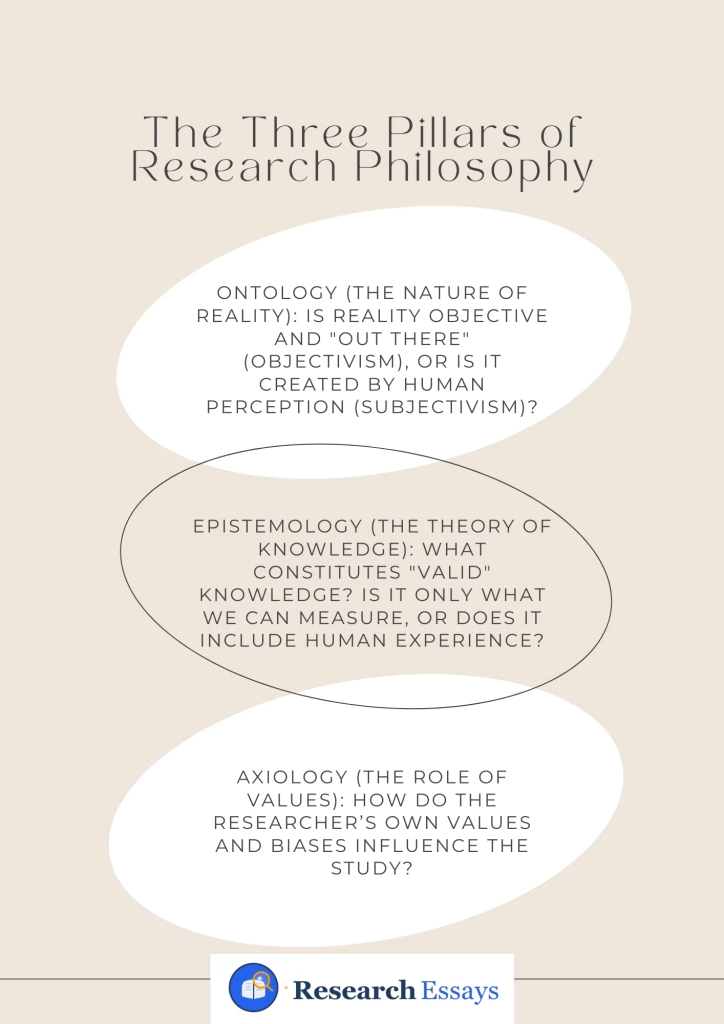
Research philosophy is the underlying set of beliefs and assumptions that guide how a researcher views the world and goes about developing knowledge. It is the “outer layer” of the research process, determining which methods are appropriate and how data should be interpreted.+1
If you are writing a dissertation, this is often explained using the Saunders’ Research Onion model, which visualizes research as a series of layers you must “peel back” to reach your final data collection methods.
Why Research Philosophy Is Important
1. It Ensures Methodological Consistency
Research philosophy acts as the glue that holds your methodology together. Without it, your methods might contradict your goals.
- Example: If you claim your goal is to find a single, objective “truth” (Positivism) but then you use deep, subjective interviews as your only data source, your study lacks internal logic. Philosophy ensures your tools match your worldview.
2. It Justifies Your Choice of Research Design
When an examiner or peer reviewer asks, “Why did you choose a survey instead of an experiment?” or “Why did you use qualitative interviews?”, your philosophy provides the answer.
- It explains the strategic “why” behind the tactical “how.”
- It helps you move beyond “because I like this method” to “because this method is the most valid way to uncover the type of knowledge I am seeking.”
3. It Clarifies the “Nature of Knowledge” (Epistemology)
Research philosophy forces you to define what you accept as “valid” evidence.
- Are only measurable, numerical facts valid (Positivism)?
- Or are the lived experiences and “meanings” people give to events also valid forms of knowledge (Interpretivism)?
- Deciding this early prevents you from gathering data that doesn’t actually help answer your research question.
4. It Enhances Research Rigor and Credibility
By explicitly stating your philosophical stance, you show that you have thought deeply about your biases and the limitations of your study. This transparency makes your findings more credible because:
- You acknowledge the lens you are using to look at the data.
- You provide a clear “audit trail” for how you reached your conclusions.
5. It Helps You Recognize Your Own Biases (Axiology)
Every researcher brings personal values and beliefs to their work. Philosophy (specifically Axiology) helps you decide if you should try to be completely neutral and “value-free” or if you should acknowledge that your background will “value-laden” your interpretation of the data.
Main Types of Research Philosophy
Positivism
Positivism emerged from the natural sciences and assumes that reality exists independently of human perception and can be observed and measured objectively. Positivists believe that knowledge comes from what we can observe and verify empirically.
Core assumptions: There is a single, objective reality that exists regardless of our beliefs about it. Researchers can and should remain detached and neutral, observing phenomena without influencing them. The goal is to discover universal laws and patterns that explain cause-and-effect relationships.
Research approach: Positivists favor quantitative methods like experiments, surveys, and statistical analysis. They emphasize hypothesis testing, measurement, and replication. A positivist studying workplace productivity might measure output metrics, control variables, and use statistical tests to identify causal relationships.
Strengths: This approach produces precise, generalizable findings that can predict outcomes. It’s particularly effective for studying observable phenomena and testing theories across large populations.
Limitations: Positivism struggles with subjective human experiences, meanings, and contexts. Critics argue it oversimplifies complex social realities and that true objectivity is impossible when humans are both researchers and subjects.
Post-Positivism
Post-positivism accepts the basic premises of positivism but with important modifications. Post-positivists acknowledge that perfect objectivity is unattainable and that all observation is fallible and theory-laden.
Core assumptions: While an objective reality exists, our understanding of it is necessarily imperfect. Researchers should strive for objectivity while recognizing their inevitable biases. Knowledge is probabilistic rather than certain—we can only approach truth, never fully grasp it.
Research approach: Post-positivists still favor scientific methods but with more humility and flexibility. They use triangulation (multiple methods or data sources), acknowledge limitations, and view findings as the best current approximation rather than absolute truth. A post-positivist might combine surveys with interviews to cross-validate findings.
Strengths: This philosophy maintains scientific rigor while being more realistic about human limitations and the complexity of social phenomena.
Limitations: Some argue post-positivism doesn’t go far enough in questioning objectivity, while others feel it introduces too much uncertainty into scientific inquiry.
Interpretivism (Constructivism)
Interpretivism fundamentally challenges positivist assumptions, arguing that social reality is fundamentally different from natural reality because it involves meaning-making by conscious beings.
Core assumptions: Reality is socially constructed through human interaction and interpretation. There isn’t one objective truth but multiple, valid perspectives. Understanding requires grasping the subjective meanings people attach to their experiences. The researcher cannot be separated from what they’re researching—they co-create knowledge with participants.
Research approach: Interpretivists favor qualitative methods like ethnography, interviews, case studies, and narrative analysis. They seek rich, contextual understanding rather than generalization. An interpretivist studying organizational culture would immerse themselves in the setting, exploring how employees make sense of their work environment.
Strengths: This approach captures complexity, context, and human meaning. It’s excellent for understanding why people behave as they do and how they experience their worlds.
Limitations: Findings are often specific to particular contexts and difficult to generalize. The researcher’s influence on the research is unavoidable, raising questions about objectivity and replicability.
Critical Realism
Critical realism attempts to bridge positivism and interpretivism by distinguishing between the real world (which exists independently) and our knowledge of it (which is socially constructed and fallible).
Core assumptions: Reality exists in layers—the empirical (what we observe), the actual (events that occur whether observed or not), and the real (underlying mechanisms that generate events). Our observations are theory-laden and fallible, but we can still make meaningful claims about reality. Understanding requires uncovering hidden structures and mechanisms, not just observing surface patterns.
Research approach: Critical realists use mixed methods, combining observation with retroduction (inferring underlying mechanisms from observable patterns). A critical realist studying educational inequality might combine statistical analysis of outcomes with qualitative exploration of structural factors like funding systems, policy frameworks, and cultural norms.
Strengths: This philosophy accommodates both objective reality and subjective interpretation, structure and agency, explanation and understanding. It’s particularly useful for studying complex social systems.
Limitations: The layered ontology can be conceptually challenging. Critics argue it’s either too similar to positivism or doesn’t adequately resolve the tensions it claims to bridge.
Pragmatism
Pragmatism sidesteps traditional philosophical debates by focusing on what works. Pragmatists argue that the value of knowledge lies in its practical consequences and usefulness.
Core assumptions: Truth is what works in practice. The research question should drive methodological choices, not philosophical commitments. Reality may or may not be objective, but what matters is solving real-world problems. Knowledge is provisional and contextual—valid for particular purposes at particular times.
Research approach: Pragmatists freely mix methods, choosing whatever works best for the question at hand. They value actionable knowledge and often favor applied research. A pragmatist studying healthcare delivery might use patient surveys, cost-benefit analysis, and stakeholder interviews—whatever generates useful insights.
Strengths: This approach is flexible, practical, and oriented toward real-world impact. It frees researchers from rigid methodological constraints.
Limitations: Critics argue pragmatism lacks philosophical depth and can justify inconsistent or poorly thought-out research designs. The “whatever works” approach may ignore important epistemological considerations.
Relativism and Constructionism
These closely related philosophies take interpretivism further, arguing that all knowledge is relative to particular contexts, cultures, or frameworks.
Core assumptions: There is no universal truth or objective reality—only different perspectives shaped by language, culture, and power. Knowledge is entirely socially constructed through discourse and interaction. What counts as “true” or “real” varies across contexts and cannot be judged by universal standards.
Research approach: Relativists often use discourse analysis, deconstruction, and reflexive ethnography. They examine how knowledge claims are constructed and whose interests they serve. Research focuses on multiple perspectives without privileging any as more “true.”
Strengths: This philosophy highlights power dynamics, cultural differences, and the politics of knowledge production. It’s valuable for understanding diverse worldviews.
Limitations: Radical relativism faces logical problems—if all knowledge is relative, isn’t that claim also relative? It can struggle to justify any research conclusions or make practical recommendations.
Transformative and Critical Philosophies
These philosophies view research as inherently political and aim to challenge oppression and promote social justice.
Core assumptions: Knowledge is never neutral—it’s shaped by power structures and can either reinforce or challenge inequality. Research should explicitly serve emancipatory goals. Understanding reality requires examining whose interests are served by current arrangements.
Research approach: Critical researchers often use participatory action research, feminist methodologies, or critical ethnography. They work with marginalized communities, making power structures visible and facilitating social change. A critical researcher studying poverty wouldn’t just describe it but would work to understand and challenge the systems that produce it.
Strengths: This approach addresses ethical dimensions of research and connects scholarship to social justice. It gives voice to marginalized perspectives.
Limitations: Critics argue this approach sacrifices objectivity for advocacy. The explicit political agenda may bias findings or limit credibility with some audiences.
Research Philosophy vs Research Approach
Excellent question. Understanding the distinction between Research Philosophy and Research Approach is fundamental to designing a coherent and rigorous research project. They exist at different levels of your research “worldview” and strategy.
Here’s a detailed breakdown:
Research Philosophy: The “Why” and “What is Truth?”
This is the highest, most abstract layer. It’s your set of beliefs and assumptions about the nature of reality (ontology), knowledge (epistemology), and values (axiology). It’s the foundational paradigm that informs everything else.
- Purpose: To justify why you choose certain methods. It answers: What counts as valid knowledge? What is the nature of the phenomena I’m studying?
- Key Philosophies:
- Positivism: There is a single, objective reality that can be measured and discovered. The researcher is independent from what is being researched (like a natural scientist).
- Interpretivism (Constructivism): Reality is socially constructed and subjective. Multiple realities exist based on human experiences. The researcher interacts with participants to co-create understanding.
- Pragmatism: Focuses on the research problem and uses whichever philosophical or methodological mix works best to address it. Reality is what works in practice.
- Critical Realism: Acknowledges an objective reality exists independently of our thoughts, but our understanding of it is always mediated by our social, historical, and conceptual frameworks.
- Analogy: Your philosophy is your religious/ethical worldview (e.g., “I believe in observable facts” vs. “I believe in personal lived experience”). It shapes your entire perspective.
Research Approach: The “How” of Theory and Logic
This is the strategic layer that links your philosophy to your specific methods. It dictates the logical flow of your research, particularly the relationship between theory and data.
- Purpose: To determine the overall logic and direction of your inquiry.
- Key Approaches:
- Deductive Approach: Works from the general to the specific. You start with a theory, develop a hypothesis, and design research to test it (often associated with Positivism and quantitative methods).
- Logic: Theory → Hypothesis → Data Collection → Confirmation/Rejection of Hypothesis.
- Inductive Approach: Works from the specific to the general. You start with data (e.g., observations, interviews) and use them to develop patterns, themes, and ultimately a theory or conceptual framework (often associated with Interpretivism and qualitative methods).
- Logic: Data Collection → Patterns/Themes → Theory Development.
- Abductive Approach: Moves back and forth between data and theory. You start with an incomplete set of observations and seek the best possible explanation for them, iterating between data and existing theories (common in Pragmatism and mixed-methods studies).
- Deductive Approach: Works from the general to the specific. You start with a theory, develop a hypothesis, and design research to test it (often associated with Positivism and quantitative methods).
- Analogy: Your approach is your travel strategy (e.g., “I will follow this existing map from A to Z” [Deductive] vs. “I will explore this territory and draw my own map” [Inductive]).
Key Differences at a Glance
| Feature | Research Philosophy | Research Approach |
|---|---|---|
| Level | Foundational, abstract, paradigmatic | Strategic, logical, directional |
| Concerns | Nature of reality & knowledge (Ontology/Epistemology) | Relationship between theory and data |
| Question | What is truth? How can we know the world? | What is the logical path of my inquiry? |
| Examples | Positivism, Interpretivism, Pragmatism | Deductive, Inductive, Abductive |
| Role | Provides justification for choices | Provides the logical structure for the study |
How They Work Together: The Flow of Research Design
The choice is not random; there are typical alignments (though not absolute rigid rules):
- Positivist Philosophy → Typically leads to a Deductive Approach → Employs Quantitative Methods (e.g., surveys, experiments) → Analyzes numbers.
- Example: Testing a theory of customer satisfaction by surveying 1000 customers with a statistical questionnaire.
- Interpretivist Philosophy → Typically leads to an Inductive Approach → Employs Qualitative Methods (e.g., interviews, ethnography) → Analyzes words/themes.
- Example: Exploring the lived experience of remote workers through in-depth interviews to build a new model of work-life balance.
- Pragmatist Philosophy → Often leads to an Abductive or Mixed Approach → Employs Mixed Methods (both quantitative and qualitative).
- Example: Using a survey (quantitative) to identify a puzzling trend, then following up with focus groups (qualitative) to find the best explanation for it.
How to Choose the Right Research Philosophy
Start with Your Research Question
Your research question is the single most important guide to your philosophical stance. Different types of questions require different philosophical approaches.
Questions seeking objective measurement and prediction often align with positivist or post-positivist philosophies. If you’re asking “What is the relationship between X and Y?” or “Does intervention A cause outcome B?”, you’re implicitly assuming these relationships exist objectively and can be measured.
For example: “Does employee training improve productivity?” This question assumes productivity is measurable, that cause-effect relationships exist, and that they can be identified through systematic observation—all positivist assumptions.
Questions exploring meaning, experience, and interpretation typically align with interpretivist philosophies. If you’re asking “How do people experience X?” or “What does Y mean to different stakeholders?”, you’re acknowledging multiple perspectives and subjective realities.
For example: “How do remote workers experience organizational culture?” This question recognizes that culture is experienced differently by different people and that understanding requires grasping subjective meanings—interpretivist assumptions.
Questions uncovering hidden structures or mechanisms often align with critical realism. If you’re asking “What underlying factors explain X?” or “What mechanisms produce Y?”, you’re distinguishing between surface observations and deeper reality.
For example: “What factors explain why some communities resist climate change adaptation?” This question suggests observable resistance stems from deeper mechanisms (cultural values, power structures, economic interests) that need to be inferred—critical realist assumptions.
Questions focused on solving practical problems often align with pragmatism. If you’re asking “What works?” or “How can we improve X?”, you’re prioritizing usefulness over philosophical purity.
For example: “How can we reduce hospital readmission rates?” This question cares about practical solutions more than philosophical consistency—pragmatist assumptions.
Questions challenging power or inequality often align with critical or transformative philosophies. If you’re asking “Whose interests does X serve?” or “How does Y perpetuate injustice?”, you’re assuming research should expose and challenge oppression.
For example: “How do hiring practices disadvantage marginalized groups?” This question assumes power dynamics shape reality and research should promote justice—critical assumptions.
Examine Your Core Beliefs
Your research philosophy should align with your genuine beliefs about reality and knowledge, not just what seems academically fashionable or what your supervisor prefers.
Ask Yourself About Reality (Ontology)
Is there one objective reality or multiple constructed realities?
If you believe reality exists independently of human perception—that facts are facts regardless of what anyone thinks—you’re leaning toward realism or positivism. If you believe reality is constructed through social interaction and interpretation—that what’s “real” depends on perspective—you’re leaning toward interpretivism or constructivism.
Consider this scenario: Two managers describe the same organizational restructuring completely differently—one calls it “necessary efficiency,” the other calls it “corporate greed.” Which view is correct?
A realist might say one view is more accurate based on objective facts (financial data, outcomes, comparable cases). An interpretivist might say both views are valid—they reflect different constructed realities based on different positions and experiences.
Are social phenomena similar to natural phenomena?
If you believe human behavior follows discoverable laws like physical phenomena, you lean toward positivism. If you believe human consciousness, agency, and meaning-making make social reality fundamentally different from natural reality, you lean toward interpretivism.
Ask Yourself About Knowledge (Epistemology)
Can researchers be objective?
If you believe researchers can and should remain detached, neutral observers who don’t influence what they study, you lean toward positivism. If you believe researchers inevitably influence their research and co-create knowledge with participants, you lean toward interpretivism or critical approaches.
Think about interviewing someone about a traumatic experience. A positivist might try to remain emotionally neutral and use standardized questions to minimize their influence. An interpretivist might acknowledge that their presence, reactions, and questions shape what’s shared and that this interaction is where meaning emerges.
What counts as valid evidence?
If you believe only observable, measurable data should count as evidence, you lean toward positivism. If you believe subjective experiences, emotions, and interpretations are legitimate evidence, you lean toward interpretivism. If you believe evidence must reveal hidden structures beyond surface observations, you lean toward critical realism.
Is generalization possible or desirable?
If you believe research should produce universal laws applicable across contexts, you lean toward positivism. If you believe deep understanding of specific contexts matters more than broad generalization, you lean toward interpretivism. If you believe we can identify tendencies and mechanisms but not universal laws, you lean toward critical realism.
Ask Yourself About Values (Axiology)
Should research be value-neutral?
If you believe researchers should set aside their values to pursue objective truth, you lean toward positivism. If you believe values inevitably shape research and that’s acceptable or even necessary, you lean toward interpretivism or critical approaches.
What is the purpose of research?
If you believe research should explain and predict, you lean toward positivism. If you believe research should understand and interpret, you lean toward interpretivism. If you believe research should expose injustice and promote change, you lean toward critical or transformative approaches. If you believe research should solve practical problems, you lean toward pragmatism.
Consider Your Discipline and Context
Different academic fields have different philosophical traditions. Understanding these can help you position your work, though you shouldn’t simply conform to disciplinary norms if they conflict with your beliefs.
Natural sciences, medicine, and psychology traditionally favor positivist or post-positivist approaches. These fields emphasize measurement, causation, and generalization. If you’re working in these areas and want to use an interpretivist approach, you’ll need strong justification.
Sociology, anthropology, and education have strong interpretivist traditions alongside positivist strands. Both approaches are well-established, and your choice often depends on your specific question and theoretical orientation.
Critical management studies, feminist research, and postcolonial studies explicitly embrace critical or transformative philosophies. If you’re working in these areas, a purely positivist approach might be seen as politically naive.
Applied fields like business, nursing, and engineering often embrace pragmatism, valuing what works over philosophical consistency. Mixed methods designs combining different philosophies are common and accepted.
However, don’t let disciplinary tradition override your research question or genuine beliefs. If you’re studying healthcare but your question genuinely requires understanding patient experiences, embrace interpretivism even if quantitative approaches dominate your field. Just be prepared to justify your choice.
Match Philosophy to Your Methodology
Your philosophy should align with your research design and methods, though the relationship isn’t deterministic.
If You’re Planning Quantitative Research
You’ll typically adopt positivist, post-positivist, or pragmatist philosophies. Quantitative methods assume you can measure variables, identify relationships, and test hypotheses—these align naturally with realist ontologies and empiricist epistemologies.
However, you could use quantitative methods with interpretivist philosophy if you’re measuring subjectively constructed phenomena (like perceptions or attitudes) while acknowledging these don’t reflect objective reality. The key is being explicit about what your measurements represent.
If You’re Planning Qualitative Research
You’ll typically adopt interpretivist, critical, or constructivist philosophies. Qualitative methods emphasize understanding meaning, context, and subjective experience—these align with relativist ontologies and interpretivist epistemologies.
However, you could use qualitative methods with realist philosophy if you’re using interviews or observations to uncover objective facts or hidden structures. Critical realists often use qualitative methods to infer underlying mechanisms.
If You’re Planning Mixed Methods
You’ll likely adopt pragmatism, critical realism, or deliberately combine philosophies. Mixed methods research mixes quantitative and qualitative approaches, which can create philosophical tensions.
Pragmatists resolve this by prioritizing practical questions over philosophical consistency. Critical realists argue that different methods access different layers of reality. Some researchers explicitly use different philosophies for different phases of their study.
Work Through a Decision Framework
Here’s a systematic way to think through your philosophical choice:
Step 1: Analyze Your Research Question
Write out your main research question and sub-questions. For each one, identify what it assumes about reality and knowledge.
Does it assume something exists objectively to be measured? Does it assume multiple valid perspectives? Does it assume hidden structures beneath observations? Does it assume practical solutions matter more than theoretical understanding?
Step 2: Reflect on Your Beliefs
Honestly answer the ontological, epistemological, and axiological questions posed earlier. Don’t choose what sounds most sophisticated or what you think you should believe—identify what you actually believe.
If you’re genuinely uncertain about your beliefs, that’s okay. Read examples of different philosophies in action. Notice which approaches feel more convincing, natural, or legitimate to you.
Step 3: Consider Your Methods
What data collection and analysis methods do you plan to use? Are they compatible with your emerging philosophical stance?
If there’s misalignment, either adjust your methods or reconsider your philosophy. For example, if you believe in one objective reality but plan only to collect subjective perceptions, you have an inconsistency to resolve.
Step 4: Check for Coherence
Map out how your philosophy connects to your approach and methods. Can you tell a coherent story from fundamental assumptions through to practical research activities?
A coherent story might be: “I’m a critical realist (philosophy) because I believe healthcare disparities result from real structural factors that must be inferred from observations. I’m using an abductive approach (reasoning strategy), moving between data and theory to identify underlying mechanisms. I’m using mixed methods (methodology), combining statistical analysis of health outcomes with qualitative interviews exploring barriers to care, because different methods access different layers of reality.”
An incoherent story might be: “I’m a positivist but I’m only interviewing five people because I believe deep understanding matters more than generalization.” The philosophy (positivism values generalization) contradicts the method choice and justification.
Step 5: Be Prepared to Adapt
Your philosophical stance might evolve as your research progresses. You might start with one philosophy and realize another better fits what you’re actually doing. This is normal, especially for newer researchers.
The key is recognizing when adaptation is needed and being explicit about your philosophical stance at every stage. Don’t switch philosophies mid-study without acknowledging and justifying the change.
Pitfalls to Avoid
Pitfall 1: Choosing Based on Methods Alone
“I’m using surveys, so I must be a positivist.” This is backwards. Your philosophy should drive your methods, not the reverse. Surveys can be used with different philosophies—what matters is what you’re measuring and what you think those measurements represent.
Pitfall 2: Following Fashion Without Conviction
Interpretivism is trendy in some fields, positivism in others. Don’t adopt a philosophy because it seems sophisticated or because everyone in your department uses it. If your genuine beliefs and research question suggest a different philosophy, have the courage to pursue it.
Pitfall 3: Treating Philosophy as Window Dressing
Some researchers choose methods, collect data, and then retrospectively assign themselves a philosophy to satisfy examiners. This produces superficial, unconvincing research. Your philosophy should guide decisions from the beginning, not justify them afterward.
Pitfall 4: Being Too Rigid
While coherence matters, you don’t need perfect philosophical purity. Pragmatic considerations (available data, time constraints, participant access) sometimes require flexibility. Acknowledge these realities rather than pretending your choices are purely philosophical.
Pitfall 5: Ignoring Your Discipline’s Expectations
While you shouldn’t blindly conform, you need to understand and engage with your discipline’s philosophical norms. If you’re using an unconventional philosophy for your field, explicitly justify why it’s appropriate for your question.
Special Considerations for Different Research Contexts
For Doctoral Research
Your philosophy needs to be explicit, well-justified, and consistently applied throughout your thesis. Examiners will scrutinize philosophical coherence. Take time to deeply understand your chosen philosophy—read foundational texts, not just methodology textbooks.
Consider how your philosophy positions you in relation to existing literature. Are you working within or challenging the dominant paradigm in your area?
For Applied or Commercial Research
Pragmatism often works well because stakeholders care about useful results more than philosophical consistency. However, don’t use pragmatism as an excuse for sloppy thinking. Even pragmatic research needs coherent logic.
Be prepared to explain your philosophy in accessible language. Stakeholders may not know what “interpretivist epistemology” means, but they’ll understand “I’m studying how employees experience changes, so I need to understand their perspectives rather than just measuring outcomes.”
For Interdisciplinary Research
You may be working across fields with different philosophical traditions. Be explicit about your choices and how they relate to each discipline. Consider whether different phases of your research might legitimately use different philosophies.
For Student Research
If you’re new to research philosophy, don’t overcomplicate it. Focus on understanding a few main philosophies well rather than trying to master every variant. Choose the philosophy that most naturally fits your question and beliefs, then develop a deep understanding of that one approach.
Seek examples of your chosen philosophy in action. Read published research that explicitly uses your philosophy and notice how those researchers justify and apply it.
Getting Practical Help
Talk to Your Supervisor or Advisor
Your supervisor has experience navigating philosophical choices in your field. Explain your research question and emerging thoughts about philosophy. Ask how they see the fit and what philosophical traditions exist in your area.
Don’t just accept their first suggestion—engage in dialogue. If they recommend a philosophy that doesn’t resonate with you, explain your hesitation and explore alternatives together.
Read Methodological Examples
Find published research similar to yours and identify their philosophical stances. How do they justify their choices? How do they connect philosophy to methods? What can you learn from their approach?
Look for methodology sections that explicitly discuss philosophy, not just those that list methods. Quality journals increasingly require philosophical transparency.
Consult Methodology Texts
Read beyond basic textbook definitions. Seek texts that explain philosophical implications in depth. Good resources include research philosophy chapters in advanced methodology books and philosophical foundations texts for your discipline.
Test Your Understanding
Try explaining your philosophical choice to someone outside your field. If you can articulate why you’ve chosen a particular philosophy and how it shapes your research in accessible language, you probably understand it well enough.
Write a brief philosophical statement (500 words) explaining your ontology, epistemology, and axiology, and how these connect to your research design. If you can’t write this clearly, you need deeper engagement with your philosophy.
The Bottom Line
Choosing a research philosophy isn’t about finding the “right answer”—it’s about finding the best fit between your beliefs, your question, and your methods. The right philosophy for you is one that:
- Aligns with what your research question actually asks
- Reflects your genuine beliefs about reality and knowledge
- Fits coherently with your chosen methods and approach
- Is appropriate (or defensibly unconventional) for your discipline
- You can understand deeply enough to apply consistently
Examples of Research Philosophy in Practice
Example 1: Studying Workplace Motivation
Let’s see how researchers with different philosophies would approach the same broad topic—what motivates employees at work.
The Positivist Approach
Research question: “What is the relationship between financial incentives and employee productivity?”
Philosophical assumptions: The positivist believes objective relationships exist between variables that can be measured and quantified. Employee motivation and productivity are real phenomena that exist independently of how people perceive them.
Research design: The researcher conducts an experimental study with 500 employees across 10 companies. Half receive performance-based bonuses (experimental group), half don’t (control group). Productivity is measured through objective metrics: units produced, sales figures, tasks completed.
Data collection: Standardized productivity measurements taken monthly for one year. Pre-validated survey instruments measure motivation levels using Likert scales. All variables are quantified.
Analysis: Statistical analysis using regression models to identify the strength and significance of relationships. Tests hypotheses like “Employees receiving performance bonuses will show 15% higher productivity than those who don’t.”
Findings: “Financial incentives increase productivity by 12.3% on average (p<0.05). The effect is stronger for routine tasks (18.7%) than creative tasks (6.1%).”
Justification: These findings are presented as objective facts discovered through rigorous measurement. The researcher remained detached, controlled variables, and used a large sample to ensure generalizability. The goal was to identify universal principles about human motivation.
The Interpretivist Approach
Research question: “How do employees experience and make sense of motivation in their work?”
Philosophical assumptions: The interpretivist believes motivation is subjectively experienced and socially constructed. What motivates people depends on their personal meanings, cultural contexts, and interpretations—there isn’t one objective reality of “motivation.”
Research design: In-depth case study of a single organization. The researcher immerses themselves in the workplace, building relationships and understanding the cultural context.
Data collection: Semi-structured interviews with 20 employees from different roles, exploring their personal stories about what drives them. Participant observation of workplace interactions. Analysis of employees’ own language and metaphors for describing motivation.
Analysis: Thematic analysis identifying patterns in how people talk about and experience motivation. The researcher remains reflexive about how their presence and interpretations shape the findings.
Findings: “Employees describe motivation through metaphors of ‘flow’ and ‘being in the zone.’ What motivates varies dramatically: some describe connection to colleagues, others describe mastery of craft, still others describe providing for family. Financial incentives are rarely mentioned spontaneously but are described as ‘hygiene factors’—their absence demotivates but their presence doesn’t motivate. Motivation is deeply personal and context-dependent.”
Justification: These findings aren’t presented as universal truths but as rich understandings of how these particular people make sense of motivation in this particular context. The goal was understanding lived experience, not discovering laws.
The Critical Realist Approach
Research question: “What underlying mechanisms explain variations in employee motivation across different organizational contexts?”
Philosophical assumptions: The critical realist believes real structures and mechanisms generate observable patterns in motivation, but these mechanisms aren’t directly observable—they must be inferred. Context matters because mechanisms operate differently in different conditions.
Research design: Comparative case study of three organizations with dramatically different motivation patterns despite similar industries and pay structures. The researcher investigates what hidden factors might explain the differences.
Data collection: Mixed methods combining employee surveys (measuring observable motivation patterns), interviews (exploring experienced meanings), document analysis (examining organizational structures and policies), and observation (identifying cultural practices).
Analysis: Retroduction—working backward from observed patterns to identify plausible underlying mechanisms. Testing whether proposed mechanisms adequately explain the data. Identifying contextual conditions that activate or suppress different mechanisms.
Findings: “Three distinct generative mechanisms shape motivation: (1) psychological ownership—the degree to which structures enable employees to feel the work is ‘theirs,’ (2) relational trust—the quality of social relationships that make vulnerability acceptable, and (3) purpose alignment—the fit between personal values and organizational mission. These mechanisms operate differently depending on contextual conditions like job autonomy, leadership practices, and organizational culture. Financial incentives only enhance motivation when these deeper mechanisms are already functioning.”
Justification: These findings identify real mechanisms while acknowledging they operate differently in different contexts. The researcher moved between theory and data, used multiple methods to triangulate, and distinguished between observable patterns (motivation levels) and unobservable structures (mechanisms generating those patterns).
The Pragmatist Approach
Research question: “What interventions effectively increase employee motivation in small businesses?”
Philosophical assumptions: The pragmatist cares less about philosophical debates and more about what works in practice. Truth is what produces useful results.
Research design: Action research with five small businesses trying to improve motivation. The researcher works collaboratively with managers to identify problems, design interventions, implement changes, and evaluate outcomes.
Data collection: Whatever data helps answer the question—quantitative metrics (turnover, productivity, sales), qualitative feedback (interviews, focus groups), observational data (workplace climate), and stakeholder input (what managers and employees think is working).
Analysis: Iterative evaluation of each intervention. What reduced turnover? What improved morale? What was feasible to implement? The researcher isn’t committed to any single method but uses whatever generates actionable insights.
Findings: “Effective interventions varied by context. Company A benefited most from flexible scheduling (23% reduction in turnover). Company B saw improvements from skills training (employee satisfaction increased from 3.2 to 4.1 on 5-point scale). Company C gained most from transparent communication about business challenges (productivity increased 16%). Financial incentives alone proved insufficient in all cases. Successful interventions required employee input in design and sustained management commitment.”
Justification: These findings prioritize practical usefulness. The researcher combined methods freely, adapted the approach based on what worked, and focused on actionable recommendations rather than universal theories or deep understanding.
The Critical/Transformative Approach
Research question: “How do workplace motivation systems reinforce or challenge class and gender inequalities?”
Philosophical assumptions: The critical researcher believes motivation isn’t neutral—it’s shaped by power structures. Research should expose and challenge these dynamics.
Research design: Participatory research with low-wage workers, particularly women and minorities. The researcher works with participants to identify issues, analyze power dynamics, and develop strategies for change.
Data collection: Interviews exploring workers’ experiences of motivation systems. Analysis of which workers benefit from performance incentives and which don’t. Examination of who designs motivation systems and whose interests they serve. Participatory workshops where workers analyze their own situations.
Analysis: Critical discourse analysis examining how motivation is talked about and who’s voice is privileged. Power analysis identifying who benefits from current arrangements. Collaborative analysis with workers interpreting findings.
Findings: “Current motivation systems systematically disadvantage women and minorities. Performance metrics privilege work styles associated with dominant groups (individual competition vs. collective success; face-time vs. flexible scheduling). Incentive systems reward roles disproportionately held by men (sales commissions) while undervaluing roles dominated by women (care work, administrative support). Workers report feeling ‘motivated’ is coded language for compliance with management expectations. Motivation discourse masks structural inequalities in power and resources.”
Justification: These findings explicitly challenge existing power structures. The researcher worked with marginalized workers to give voice to their experiences, identified whose interests are served by current systems, and provided analysis that could support advocacy for change.
Example 2: Studying Educational Technology
Let’s examine how different philosophies approach research on whether technology improves learning.
Positivist Study
Question: “Does using tablets in classrooms improve student test scores?”
Design: Randomized controlled trial with 1,000 students across 50 classrooms. Half use tablets for math instruction (treatment), half use traditional textbooks (control). Researchers measure standardized test scores before and after one semester.
Findings: “Students using tablets scored 7.2 points higher on average (p=0.03). Effect sizes were larger for lower-performing students (11.4 points) than higher-performing students (3.8 points).”
Philosophy in action: The researcher treats learning as an objective outcome measurable through test scores. The experimental design controls confounding variables to isolate the effect of tablets. Findings are presented as universal—tablets improve learning, especially for struggling students. The researcher remained neutral, didn’t interact with students or teachers, and focused solely on measurable outcomes.
Interpretivist Study
Question: “How do students and teachers experience learning with educational technology?”
Design: Ethnographic case study of one classroom using tablets. The researcher spends an entire semester observing lessons, interviewing students and teachers, and analyzing how technology shapes classroom interactions and learning experiences.
Findings: “Students describe tablets as ‘making learning feel like playing’—the game-like interfaces engage them differently than textbooks. However, teachers struggle with balancing technology use and maintaining classroom management. Some students use tablets for connection and exploration; others find them distracting. The technology doesn’t simply improve or hinder learning—it transforms what ‘learning’ means in this classroom, creating new possibilities and new challenges.”
Philosophy in action: The researcher focuses on subjective experiences and meanings rather than objective outcomes. Learning isn’t reduced to test scores but understood as a complex, lived experience. Findings are contextual and recognize multiple perspectives. The researcher’s presence and relationships with participants are acknowledged as shaping what could be learned.
Critical Realist Study
Question: “What mechanisms explain why technology integration succeeds in some schools but fails in others?”
Design: Comparative study of six schools—two where technology integration succeeded, two where it failed, two with mixed results. The researcher combines survey data on outcomes with qualitative investigation of underlying structures and mechanisms.
Findings: “Technology’s impact depends on three generative mechanisms: (1) pedagogical integration—whether technology aligns with teaching philosophy or is merely added on, (2) institutional support—whether infrastructure, training, and resources enable effective use, and (3) cultural readiness—whether school culture embraces innovation or resists change. These mechanisms don’t operate in isolation. In successful schools, all three aligned. In failed implementations, even when technology was superior, missing mechanisms (typically inadequate support or misaligned pedagogy) prevented success.”
Philosophy in action: The researcher distinguishes between observable outcomes (success/failure) and unobservable mechanisms generating those outcomes. The study acknowledges that technology itself has causal powers (it enables certain interactions) but that these powers only manifest under specific conditions. Findings explain why the same technology produces different results in different contexts.
Pragmatist Study
Question: “What technology implementation strategies work best for improving student engagement?”
Design: Design-based research across multiple iterations. The researcher works with teachers to design technology integration, implement it, evaluate what works, redesign based on feedback, and repeat the cycle.
Findings: “Successful strategies share common features: starting small with enthusiastic teachers, providing ongoing technical support, involving students in selecting appropriate tools, and adjusting approaches based on regular feedback. Interactive apps work better than static content. Blended approaches (combining digital and traditional methods) outperform fully digital approaches. Implementation matters more than which specific technology is used.”
Philosophy in action: The researcher focuses on actionable findings rather than philosophical debates about what counts as “real” learning. Multiple methods are combined pragmatically. The approach is iterative and collaborative. Findings emphasize practical strategies that can be implemented, not universal theories or deep philosophical understanding.
FAQs
What is the research philosophy in qualitative research?
This philosophy aims to understand meanings, opinions, and experiences rather than measure data with numbers.
How do I know what my research philosophy is?
Do I study facts using numbers? → Positivism
Do I study people’s views and experiences? → Interpretivism
Do I believe reality exists but is shaped by people? → Realism
Do I choose methods based on what works best? → Pragmatism
Your research question and methods usually guide your choice.
What are the three research philosophies?
Positivism – focuses on facts that can be measured and tested using numbers and data.
Interpretivism – focuses on understanding people’s thoughts, experiences, and meanings.
Pragmatism – focuses on what works best to answer the research question, using different methods if needed.