


Understanding how to write a strong thematic statement is an important skill for students, writers, and anyone analyzing literature. A thematic statement expresses the central message or idea of a story, poem, or other work of fiction. It goes beyond simply stating the topic and explains what the author is saying about that topic. Crafting a clear thematic statement helps readers connect with the deeper meaning of a text and improves their ability to write essays or lead discussions.
This article provides several thematic statement examples to show how broad topics—like love, freedom, or justice—can be shaped into meaningful insights. These examples will guide you in identifying themes in various texts and turning them into full, thoughtful statements. Whether you’re working on a literature assignment or trying to improve your analytical writing, the examples here will give you a strong foundation for expressing a work’s core message with clarity and purpose.
Thematic Statement Examples by Theme
A thematic statement is a complete sentence that expresses the central message, lesson, or insight of a literary work. Unlike a topic (which is just a word or phrase), a thematic statement articulates what the author is saying about that topic. Here are detailed examples organized by common literary themes:
Love and Relationships
Romantic Love:
- “True love requires sacrifice and understanding, not just passion and desire.”
- “Love can be both a source of great joy and profound suffering, often simultaneously.”
- “Unconditional love has the power to transform and redeem even the most broken individuals.”
Family Love:
- “Family bonds can endure even the greatest betrayals and misunderstandings.”
- “The love between parent and child often involves letting go rather than holding on.”
- “Sometimes the family we choose is stronger than the family we’re born into.”
Friendship:
- “True friendship is tested not in good times, but in moments of crisis and moral conflict.”
- “Loyalty to friends sometimes conflicts with personal moral convictions.”
Coming of Age and Identity
Growing Up:
- “The transition from childhood to adulthood requires losing innocence but gaining wisdom.”
- “Growing up means learning that the world is more complex and morally ambiguous than it first appears.”
- “Maturity comes not from age but from accepting responsibility for one’s choices and their consequences.”
Self-Discovery:
- “Understanding oneself requires confronting uncomfortable truths about one’s character and desires.”
- “True identity cannot be imposed by others but must be discovered and claimed by the individual.”
- “The journey to self-acceptance often requires rejecting society’s expectations and definitions.”
Social Justice and Inequality
Racism and Prejudice:
- “Prejudice is learned behavior that perpetuates cycles of hatred and misunderstanding across generations.”
- “Racism dehumanizes both the oppressor and the oppressed, destroying the moral fabric of society.”
- “Individual acts of courage and compassion can challenge systemic racism and create meaningful change.”
Class and Economic Inequality:
- “Economic inequality corrupts both the wealthy and the poor, creating moral blindness in different ways.”
- “Social mobility is often an illusion that masks deeper structural inequalities.”
- “Poverty is not a moral failing but a systemic problem that requires collective solutions.”
Power and Corruption
Political Power:
- “Absolute power corrupts absolutely, transforming even well-intentioned leaders into tyrants.”
- “Those who seek power are often least qualified to wield it responsibly.”
- “Political systems that concentrate power inevitably become tools of oppression.”
Personal Power:
- “The desire for control over others ultimately leads to the loss of control over oneself.”
- “True strength comes from empowering others, not from dominating them.”
Good vs. Evil
Moral Conflict:
- “Good and evil exist not as absolute categories but as choices individuals make in specific circumstances.”
- “The capacity for both good and evil exists within every person, regardless of their outward appearance.”
- “Evil often presents itself as reasonable and necessary, making moral choices more difficult than they appear.”
Redemption:
- “Redemption is possible for anyone willing to acknowledge their mistakes and work to make amends.”
- “The path to redemption requires not just regret but active efforts to repair the harm one has caused.”
Death and Mortality
Facing Death:
- “Confronting mortality gives life meaning and urgency, forcing individuals to prioritize what truly matters.”
- “Death is a natural part of life that gives weight and significance to human experiences.”
- “The fear of death often prevents people from truly living.”
Grief and Loss:
- “Grief is the price we pay for love, and it honors the significance of what we’ve lost.”
- “Loss teaches us to value what we have while we still have it.”
Technology and Progress
Modern Technology:
- “Technological advancement without moral development leads to dehumanization and isolation.”
- “Progress measured only in material terms often comes at the expense of spiritual and emotional well-being.”
- “Technology amplifies both human virtues and human flaws, making moral choices more consequential.”
Nature and Environment
Humanity’s Relationship with Nature:
- “Humans are not separate from nature but part of it, and their fate is inseparable from the natural world’s health.”
- “The exploitation of nature reflects and reinforces the exploitation of vulnerable human populations.”
- “Respecting the natural world requires recognizing the interconnectedness of all living things.”
War and Conflict
The Nature of War:
- “War reveals both the worst and best aspects of human nature, often simultaneously.”
- “The glory of war is a myth that conceals the reality of senseless suffering and loss.”
- “Those who survive war carry invisible wounds that affect not just them but entire communities.”
Peace and Reconciliation:
- “True peace requires not just the absence of conflict but the presence of justice and understanding.”
- “Forgiveness is not weakness but the strength to break cycles of revenge and hatred.”
Thematic Statements from Famous Works
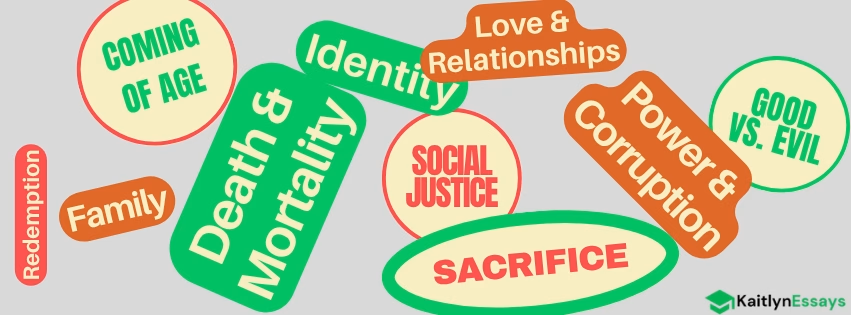
Most Common Literary Themes
Shakespeare
Hamlet
Revenge and Justice:
- “The pursuit of revenge ultimately destroys both the avenger and the innocent, calling into question whether justice can ever truly be achieved through violence.”
- “Inaction in the face of moral obligation can be as destructive as rash action, trapping individuals in cycles of guilt and paralysis.”
Appearance vs. Reality:
- “The inability to distinguish between truth and deception leads to moral confusion and tragic consequences for entire communities.”
Macbeth
Ambition and Power:
- “Unchecked ambition corrupts the soul and transforms noble individuals into monsters who destroy everything they once valued.”
- “The pursuit of power requires the sacrifice of one’s humanity, creating a hollow victory that brings no satisfaction.”
Guilt and Conscience:
- “Guilt is an inescapable consequence of evil actions that manifests both psychologically and physically, driving perpetrators toward madness.”
Romeo and Juliet
Love and Fate:
- “True love transcends social boundaries but cannot overcome the destructive power of ancient hatred and prejudice.”
- “Young love burns brightly but lacks the wisdom and patience necessary for survival in a hostile world.”
Family Honor vs. Individual Desire:
- “Family loyalty and individual happiness often conflict irreconcilably, forcing tragic choices between duty and personal fulfillment.”
American Classics
To Kill a Mockingbird by Harper Lee
Racial Injustice:
- “Prejudice blinds communities to truth and justice, allowing innocent people to be destroyed by systems designed to protect them.”
- “Moral courage requires standing up for what is right even when the entire community stands against you.”
Loss of Innocence:
- “Children’s natural sense of fairness and equality is gradually corrupted by adult prejudices and social expectations.”
The Great Gatsby by F. Scott Fitzgerald
The American Dream:
- “The American Dream promises equality and opportunity but actually reinforces class distinctions and moral corruption.”
- “The pursuit of an idealized past prevents individuals from accepting present reality and finding genuine happiness.”
Wealth and Class:
- “Money cannot buy love, respect, or belonging, but the lack of it ensures permanent exclusion from society’s upper circles.”
Of Mice and Men by John Steinbeck
Friendship and Loyalty:
- “True friendship requires protecting those we love from suffering, even when that protection comes at great personal cost.”
- “In a world that devalues human dignity, friendship becomes both a source of hope and inevitable heartbreak.”
The American Dream and Social Isolation:
- “The dream of owning land and achieving independence is ultimately unattainable for society’s most vulnerable members.”
The Scarlet Letter by Nathaniel Hawthorne
Sin and Redemption:
- “Hidden sin corrupts the soul more thoroughly than acknowledged sin, which can lead to repentance and spiritual growth.”
- “Society’s harsh judgment of moral failures often creates more suffering than the original transgression.”
Individual vs. Society:
- “Personal integrity requires the courage to live according to one’s own moral code rather than society’s hypocritical standards.”
British Literature
Pride and Prejudice by Jane Austen
Love and Marriage:
- “True love requires looking beyond first impressions and social expectations to recognize genuine character and worth.”
- “Marriage based solely on economic necessity or social status leads to misery, while marriage based on mutual respect and understanding creates lasting happiness.”
Social Class:
- “Social mobility is possible through personal merit and moral character, but class prejudices create unnecessary barriers to human connection.”
Jane Eyre by Charlotte Brontë
Independence and Self-Worth:
- “True equality in relationships requires both partners to respect each other’s independence and moral integrity.”
- “Self-respect is more valuable than wealth or social status and cannot be compromised without losing one’s essential humanity.”
Lord of the Flies by William Golding
Civilization vs. Savagery:
- “The veneer of civilization is thin and easily stripped away, revealing humanity’s capacity for cruelty and violence.”
- “Without social structures and moral authority, even children can become capable of unspeakable evil.”
Leadership and Power:
- “Leadership based on fear and violence ultimately destroys the very community it claims to protect.”
1984 by George Orwell
Totalitarianism and Individual Freedom:
- “Totalitarian governments maintain power by controlling language, history, and even personal relationships, making resistance nearly impossible.”
- “The human spirit’s desire for freedom and truth can survive even the most oppressive systems, though at enormous personal cost.”
Truth and Reality:
- “When governments control information completely, the very concept of objective truth becomes meaningless.”
World Literature
The Kite Runner by Khaled Hosseini
Redemption and Guilt:
- “Redemption requires not just acknowledgment of past wrongs but active efforts to repair the damage caused by one’s cowardice or cruelty.”
- “The sins of fathers are often visited upon their children, creating cycles of guilt and betrayal that span generations.”
Friendship Across Social Lines:
- “True friendship cannot survive when one person refuses to acknowledge the other’s full humanity and equal worth.”
Things Fall Apart by Chinua Achebe
Colonialism and Cultural Identity:
- “The collision between traditional and colonial cultures destroys not just political structures but individual identity and community cohesion.”
- “Rigid adherence to tradition can make societies vulnerable to destruction when they cannot adapt to changing circumstances.”
One Hundred Years of Solitude by Gabriel García Márquez
Isolation and Repetition:
- “Families and communities that refuse to learn from their past are condemned to repeat the same patterns of violence, love, and loss across generations.”
- “Solitude is both a choice and a curse that prevents individuals from forming meaningful connections with others.”
The Stranger by Albert Camus
Existentialism and Absurdity:
- “Life has no inherent meaning, and individuals must create their own purpose while accepting the absurd nature of human existence.”
- “Society demands conformity to emotional and moral expectations that may be fundamentally artificial and meaningless.”
Contemporary Literature
Beloved by Toni Morrison
Trauma and Memory:
- “Historical trauma affects not only those who experienced it directly but subsequent generations who inherit its psychological and spiritual wounds.”
- “Confronting painful memories is necessary for healing, even when those memories threaten to destroy the present.”
The Handmaid’s Tale by Margaret Atwood
Women’s Rights and Autonomy:
- “When women lose control over their own bodies and choices, entire societies become dehumanized and morally corrupted.”
- “Religious fundamentalism can be used to justify the most extreme forms of oppression and control.”
Persepolis by Marjane Satrapi
Identity and Cultural Conflict:
- “Individuals caught between conflicting cultures must forge their own identity while honoring their heritage and adapting to new realities.”
- “Political upheaval forces ordinary people to make extraordinary choices about their values and loyalties.”
How These Themes Work in Literature
Universal Relevance: These thematic statements resonate across time periods and cultures because they address fundamental aspects of human experience: love, power, justice, identity, and mortality.
Textual Support: Each statement can be supported by specific events, character development, and symbolic elements within the respective works.
Complexity and Nuance: The most powerful themes acknowledge contradictions and complexities rather than offering simple moral lessons.
Cultural Context: While themes are universal, their specific manifestations reflect the historical, social, and cultural contexts of their creation.
Reader Engagement: These themes invite readers to examine their own beliefs and experiences, making literature personally meaningful and socially relevant.
Time running out for your project?
Our assignment help service delivers fast and accurate work